OVARIAN CANCER
Learn about ovarian cancer, including risk factors, diagnosis, treatment, stories from our community, and where to find support.
ABOUT OVARIAN CANCER
Ovarian cancer is a term for a group of diseases that originate in the ovaries, fallopian tubes or peritoneum. There are many types of ovarian cancer, each with slightly different characteristics, making it a complex disease to treat.
On this page, learn all of the key facts about ovarian cancer, as well as:
KEY FACTS ABOUT OVARIAN CANCER
- Around 1,929 Australians are diagnosed with ovarian cancer each year.
- Approximately 1064 lives are lost to ovarian cancer annually in Australia.
- There is no early detection test for ovarian cancer — a pap/cervical smear does not detect ovarian cancer.
- Although a small number of cases are associated with a genetic predisposition, the cause of most cases remains unknown.
- Due to vagueness of symptoms and lack of an early detection test, around 70% of cases are diagnosed when the cancer is in the advanced stages, having already spread to other parts of the body.
1929
AUSTRALIANS WILL BE DIAGNOSED WITH OVARIAN CANCER THIS YEAR

49%
OF THOSE DIAGNOSED WITH OVARIAN CANCER WILL SURVIVE FIVE YEARS FROM DIAGNOSIS

1064
AUSTRALIANS WILL LOSE THEIR LIVES TO OVARIAN CANCER THIS YEAR

- Ovarian cancer is the fifth most common cause of death from cancer among females in Australia.
- The average five-year survival rate for ovarian cancer patients is 49%, compared with 92% for breast cancer, 84% for uterine cancer, and 74% for cervical cancer.
- Over the next 10 years alone, it is estimated that 10,000 Australian women and girls will lose their lives to ovarian cancer.
* All data published by Cancer Australia website. Last updated May 2026.
TYPES OF OVARIAN CANCER
Like many cancers, ovarian cancer is now understood to be a spectrum of disease, with over 30 known subtypes. The major subtypes of ovarian cancer include: epithelial, germ cell, sex-cord stromal and borderline ovarian cancer. The most commonly diagnosed ovarian cancers fall under the epithelial ovarian cancer subtype.
The treatment and likely outcome for a particular type of ovarian cancer will vary within each individual case and needs to be discussed with a gynaecological oncologist. Whilst gaps in the understanding of ovarian cancer biology remain, it is currently estimated that around 85-90% of all ovarian cancers arise from mutations in epithelial cells.
Epithelial ovarian cancer
Epithelial ovarian cancers are derived from cells covering the surface of the ovary and comprise over 90% of cases. Epithelial ovarian cancer is further divided into subtypes, including high-grade serous, low-grade serous, mucinous, endometrioid, clear cell, and undifferentiated. Epithelial ovarian cancer can also be divided into grades depending on how abnormal the cancer looks under the microscope.

Epithelial cells are a tightly packed body tissue that lines the surfaces of the body, body cavities and surfaces of organs.
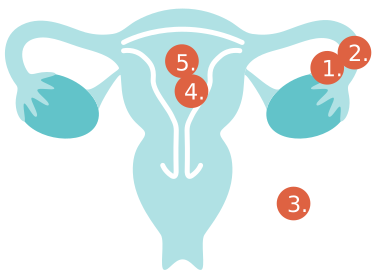
High-grade serous carcinoma (~70% of cases) originate in fallopian tube epithelial tissue. High-grade means the cells look substantially different from normal cells.
Low-grade serous carcinoma (<5% of cases) originate in fallopian tube epithelial tissue. Low-grade means the cells look less different to normal cells.
Mucinous ovarian cancer (MOC) is a rare form of ovarian cancer, accounting for less than 5% of cases. It tends to form a large tumour and so may cause symptoms and be detected before it has spread. This results in more cases being diagnosed early than compared to other ovarian cancer subtypes.
Endometrioid carcinomas of the ovary are a sub-type of epithelial ovarian tumours, accounting for 8-15% of ovarian cancers. The vast majority are malignant and invasive. They are usually characterised as complex nonspecific solid-cystic masses and found associated with endometriosis.
Clear cell ovarian carcinomas are an uncommon subtype of epithelial ovarian cancer, generally accounting for 5-10% of all cases, except in East Asia, where this subtype represents closer to 25% of cases. Clear cell carcinoma may develop from other ovarian tumours known as adenofibromas.
Germ cell ovarian cancer
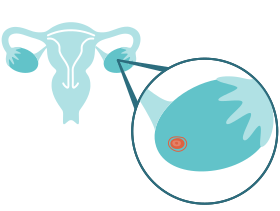
Germ cell ovarian cancers arise from the eggs within the ovary and can also be classified into several subtypes. Germ cell cancers are uncommon, and tend to mostly occur in women under 30. Generally, this type responds well to treatment, and young women may still preserve their fertility if only one ovary is affected.
Sex-cord stromal ovarian cancer
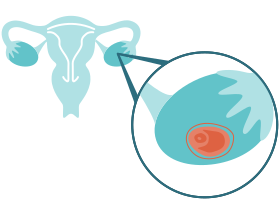
Sex-cord stromal ovarian cancers originate from the tissue that releases female hormones. These are uncommon and can occur at any age. They respond well to treatment, and young women may still have children if only one ovary is affected..
Borderline ovarian cancer
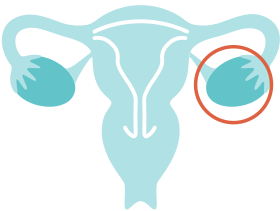
Borderline ovarian cancers are a group of epithelial tumours that are not as aggressive or malignant as the epithelial cancers. They generally have a better outcome, whether diagnosed early or late.
HELP FUND VITAL OVARIAN CANCER RESEARCH.
Ovarian cancer can affect women and girls at any age. Your support can help change outcomes for future generations.
WHERE DOES OVARIAN CANCER ORIGINATE?
Ovarian cancers can originate in the ovaries, fallopian tubes and peritoneum.
Whilst a small number of cases are linked to genetic factors, in most instances the causes of ovarian cancer remain unknown.
Most ovarian cancers start in the epithelial cells, which form the outer layer of tissue around the ovary. Many epithelial ovarian cancers may originate in the fallopian tubes, which connect the ovaries to the uterus.
After investigations into the quality of ovarian cancer data, the Australian Institute of Health and Welfare (AIHW) highlighted the need to improve the reliability of ovarian cancer rates. They have introduced the ‘ovarian cancer and serous carcinomas of the fallopian tube’ reporting group as a step towards better representing the changes in ovarian cancer incidence and mortality rates over time.
HOW DOES OVARIAN CANCER SPREAD?
Ovarian cancers can spread or metastasize at varying rates, depending on the type of ovarian cancer. However, ovarian cancer metastasis often follows a similar pattern, whereby the cancer cells spread from the primary tumour to the pelvis, peritoneal cavity, more distant parts of the abdomen and then to the lymph nodes and the liver.
Recent studies have shown that during disease progression, ovarian cancer cells can spread through both single cells as spheroids or cell clusters. Ovarian cancer spheroids are often found in the ascites fluid which accumulates within the peritoneal cavity. These spheroids present an additional challenge for researchers as they have displayed increased resistance to chemotherapies. This is likely due to their structure with a layer of outer cells forming a protective barrier preventing chemotherapy from properly penetrating the cells.
This is why early detection of ovarian cancer is vital to improving survival. Once the cancer spreads beyond the primary tumour and progresses to more advanced stages, chances of survival rapidly decrease and current treatment methods become less effective.
GRADES AND STAGES OF OVARIAN CANCER
Ovarian cancer can be assessed by stage and grade. The stage of ovarian cancer indicates the degree to which it has invaded healthy tissue and how big it is. The grade of ovarian cancer indicates how abnormal the cancer cells appear when compared to normal, healthy cells.
Ovarian cancer is given a Stage from 1-4 using the FIGO system and can be graded from 1-3, with 1 being low grade and 3 being high grade. The grade can indicate how quickly the cancer is likely to grow. Epithelial ovarian cancers are divided into low grade and high grade only, rather than assigning a number.
STAGE 1 OVARIAN CANCER
Stage 1 ovarian cancer indicates that the cancer is confined to one or both of the ovaries only.
This stage can be divided into more specific groups as below:
Stage 1A: cancer is found in one single ovary
Stage 1B: cancer is found inside both ovaries
Stage 1C: cancer is found inside one or both ovaries and additional cancer cells are present:
- on the outside surface of one or both ovaries; or
- the capsule or outer covering of the ovary has ruptured; or
- cancer cells have been found in the peritoneal cavity fluid (in the abdomen)
Is ovarian cancer curable at Stage 1?
Ovarian cancer Stages 1A and 1B have been identified by researchers as the critical stages that an early detection test must target to ensure optimal chances of survival. If patients can be diagnosed at these stages, chances of survival are greater than 90%, making the disease curable.
Is Stage 1 ovarian cancer serious?
Less than 20% of new ovarian cancer cases are diagnosed at Stage 1. Although this diagnosis is considered an ‘early’ diagnosis, the seriousness of the disease is dependent on the type of ovarian cancer and can vary from person to person depending on other lifestyle factors. The earlier ovarian cancers can be diagnosed, the better the chances of survival.
STAGE 2 OVARIAN CANCER
Stage 2 ovarian cancer indicates that the cancer is found in one or both ovaries and has also spread into other areas of the pelvis/pelvic tissues.
STAGE 3 OVARIAN CANCER
Stage 3 ovarian cancer indicates that one or both ovaries are affected and the cancer is also in the abdominal cavity outside of the pelvis, or there is cancer in nearby lymph nodes, around the aorta, or in the groin.
It is also considered to be stage 3 ovarian cancer if it has spread to the surface of the liver.
STAGE 4 OVARIAN CANCER
Stage 4 ovarian cancer indicates that one or both ovaries are affected, and the cancer has spread to distant organs beyond the abdomen, such as the tissue inside the liver or lung.
If there are cancer cells in the fluid around the lungs, this is also considered to be stage 4 ovarian cancer.
Ovarian cancer survival by stage
Survival rates differ by stage of diagnosis and subtype of ovarian cancer. Survival can also be impacted by your age, overall health and other lifestyle and environmental factors.
Ovarian cancers that are diagnosed when the cancer is localised to the ovary have the highest 5-year survival rate.
The 2020 State of the Nation in Ovarian Cancer: Research Audit showed the below relative survival rates for ovarian cancers by stage of diagnosis:
Proportion of new cases diagnosed and 5 year-survival rates by ovarian cancer stages:
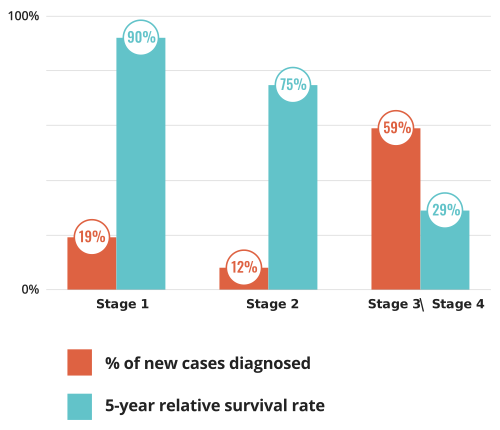
Source: State of the Nation in Ovarian Cancer: Research Audit.
Stage descriptions based on International Federation of Gynecology and Obstetrics; 5-year survival based on American Cancer Society statistics accessed in March 2020 and % of new cases based on Cancer Institute NSW data accessed in March 2020.
Statistics from the American Cancer Society indicate that germ cell and sex-cord stromal ovarian cancers generally have the highest survival rates when assessed across localised, regional and distant stages.
MORE ABOUT OVARIAN CANCER

Causes & Risk Factors
Learn more about what causes ovarian cancer and whether you may be at an increased risk.

Signs & Symptoms
Get to know the common signs and symptoms of ovarian cancer.

Diagnosing
Learn about how ovarian cancer is diagnosed.

Treatment
Understand the general treatment options for ovarian cancer patients.

Personal Stories
Read personal stories from those living with or impacted by ovarian cancer.

Support Services
Where you can find specialised ovarian cancer support for yourself and your family.

Get the latest news, stories & updates.
