Elevating scanning techniques: Ovarian Cancer Research Foundation-supported diagnostics research enters phase one clinical trial
The term ‘radioactive’ is often in headlines for its dangers. However, in small doses it can be safely used to achieve medical wonders such as allowing nuclear medical specialists to see through skin and into the body to identify cancer presence.
Reading time: 2 mins
Entering a phase one clinical trial*, a new approach has been developed by a team at Mater Research led by Professor John Hooper. It involves a new agent formulated with a small dose of radioactive particles which could improve scanning capabilities and ovarian cancer diagnostics.
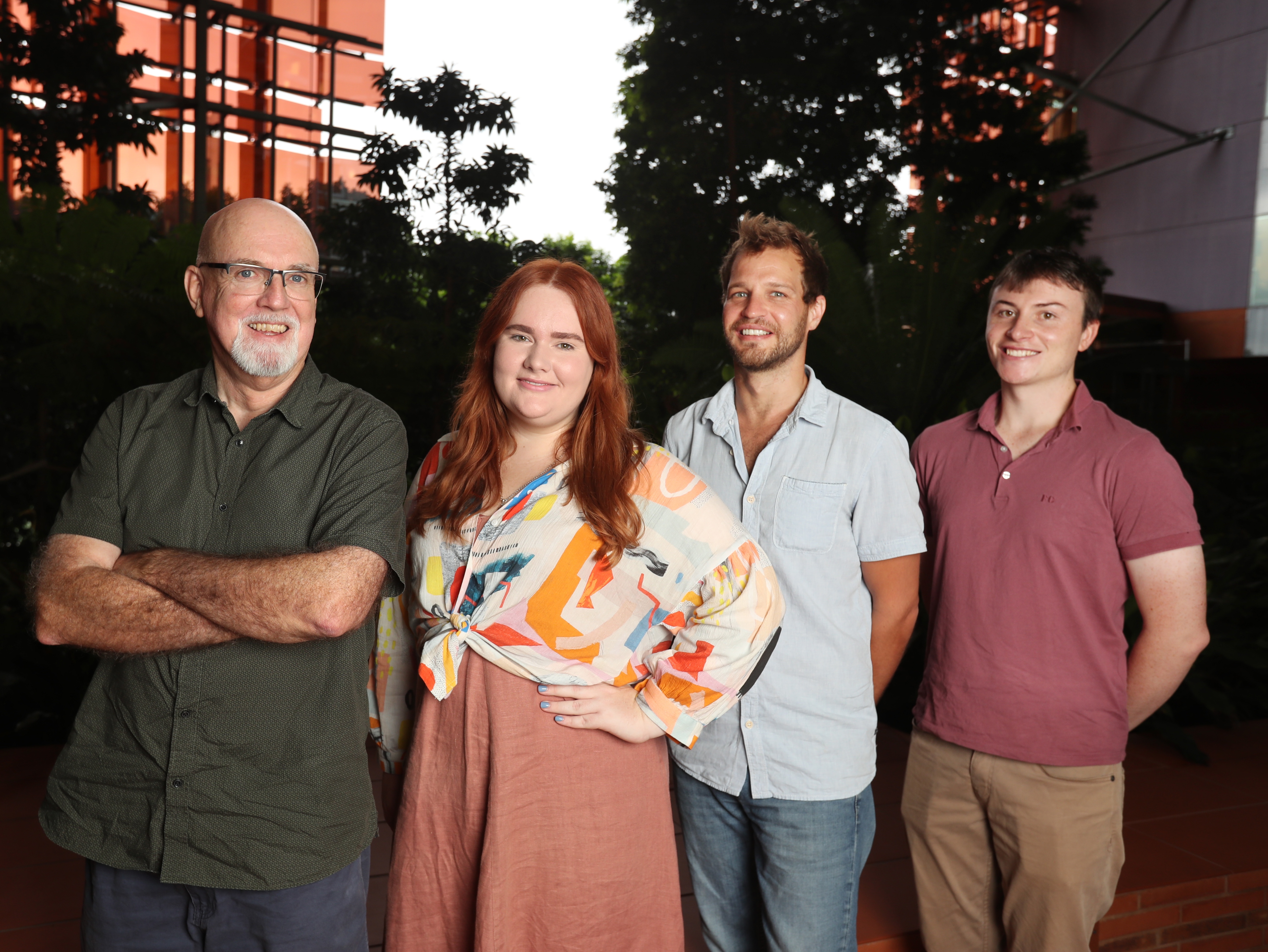
Image: Professor John Hooper with team Madeline Gough, Dr Thomas Kryza, Will Davidson
Why is this research important and what does the trial hope to achieve?
The approach offers a less invasive way for clinicians to better visualise ovarian cancer and its exact location during scans, better informing surgeons prior to theatre and assisting with accurate and earlier diagnosis. Additionally, the team anticipate that it could help monitor ovarian cancer recurrence and, in future, may even be adapted into an ovarian cancer treatment.
Professor Hooper highlights that, “ovarian cancer is generally diagnosed at an advanced staged when treatment options are often limited.”
There is currently no early detection method for ovarian cancer and accurately diagnosing it usually requires invasive surgery, highlighting the importance of this research, which has been funded by the OCRF, the government’s Medical Research Future Fund and Tour de Cure.
What will the trial involve?
In this trial, the Professor Hooper’s team hopes to enhance commonly used Positron Emission Tomography (PET) scanning techniques. PET scans use a small, safe dose of radioactive material injected into the body to trace cancer cells. Professor Hooper’s team have developed a new contrast agent which, when injected into the body, highlights the difference between healthy tissue and cancer cells, as only the cancer cells become illuminated on the scan. The team have demonstrated its safety and effectiveness in the lab and are now approved for the phase one clinical trial.
The trials will be conducted at the Royal Brisbane and Women’s Hospital and the Mater Hospital in Brisbane. The aim is to determine how the agent is distributed and can be tracked through the body and to further evaluate its safety. Ultimately, the team hope to determine how precisely it can highlight where ovarian cancer cells are located and how effectively the agent clears through the body.
If the first trial stage is successful, and the team can see an accumulation of the agent in patient tumours, they will then adjust the formula so that the agent when injected again treats the tumours. They will do this by replacing radioactive particle in the original formula with one capable of eliminating tumour cells.
Thanks to the generous support of OCRF, we're offering ovarian cancer patients the potential for improved and more individualised treatments, and hopefully, with this research, earlier diagnosis as well, which will be game changing.
Professor Hooper.
Demonstrating the OCRF community's impact
The OCRF co-funded this project over four years between 2020 and 2024. Reaching the clinical trial stage demonstrates the impact of accelerating ovarian cancer research through collaborative funding to leverage scarce resources and assist researchers by bridging funding gaps.
We look forward to sharing the results of this trial and reporting on others reaching similar significant milestones, which collectively indicate momentum and hope for all those impact by ovarian cancer.
The trial is currently open. For more information, including eligibility, click here.
Key term
*Phase 1 Clinical Trial: This is when the research approach is trialled with a small group of people, approximately 20 to 80, to assess its safety, determine the effective dosage range and whether there are any side effects. This is generally done in a monitored environment.

Get the latest news, stories & updates.
