ABOUT US
Learn more about why the OCRF exists and our expertise in ovarian cancer research.
STATE OF THE NATION IN OVARIAN CANCER
In 2020, the OCRF commissioned this independent, landmark State of the Nation in Ovarian Cancer: Research Audit to bring together current knowledge, research and statistics around the state of ovarian cancer in Australia.
State of the Nation in Ovarian Cancer: Research Audit
The Report is the first ever national audit focused on ovarian cancer research, incorporating views from clinicians and researchers across Australia, the United States of America and the United Kingdom.
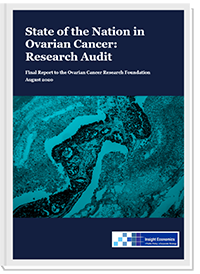
Every major research institute and university in Australia generously supported the audit either by contributing historical research data or participating in a survey or interview. This has ensured that the audit is truly reflective of where we are, and where we need to go.
As the country’s primary non-government funder of early detection research, the Ovarian Cancer Research Foundation (OCRF) has worked tirelessly for 20 years to fill the breach. But historic and current funding levels are inadequate and, as researchers, specialists and practitioners, we are calling for more to be done.
KEY FINDINGS
Statistics current as of report publish date in 2020. Some statistics may have changed since this time.
Ovarian cancer survival today lower than average cancer survival in 1975
The State of the Nation report found that the survival rate for ovarian cancer today is lower than the survival rate achieved for all cancers in 1975. Ovarian cancer has also seen a significantly smaller shift in survival rates, when compared with other female cancers.
This small improvement in survival can be attributed to the lack of an early detection or screening test, and the vague nature of disease symptoms, resulting in 70% of women receiving a late-stage diagnosis.
Early detection the key to changing outcomes
Unanimously, researchers, those living with ovarian cancer, and clinicians all agree the key to improving survival rates lies in an early detection method.

The Report showed that an early detection test could save the lives of more than 8,000 Australian women over a decade.
Other priorities highlighted by researchers and clinicians were finding more treatment options and ways to prevent the disease from coming back. Likewise, those living with ovarian cancer and their families said stopping the disease from spreading and recurring is the priority.
Each of these priorities requires significant and focussed research investment from governments, philanthropists, corporates and the broader Australian community.
Ovarian cancer is the most lethal cancer seen in women and girls
f a woman is diagnosed with ovarian cancer, the chance that she will still be alive five years later is just 46%. That’s if it’s caught early: historically 70% of women diagnosed were already at an advanced stage of the disease, and just 29% of them survive beyond five years. That’s mothers, given less than half a chance to raise their children. Wives, grappling with the fact their partner will grow old alone. Sisters and daughters, facing the unimaginable.

In 2020, ovarian cancer was the sixth most common cause of death from cancer among females.
GOALS TO IMPROVE OVARIAN CANCER SURVIVAL
Based on what the State of the Nation report found, we have set out a vision for a future where women live without ovarian cancer. We propose improvements in survival outcomes over the short, medium and longer terms:
Our goal for today's women
Improve five-year survival rates to 50% for women today by implementing current best practice equitably around Australia.

Our goal for the next generation of women
Improve five-year survival rates beyond 50% through further development and increased access to new and innovative personalised treatments for ovarian cancer.

Our goal for the future generation of women
Towards 90% survival through the development of an accurate, accessible and reliable early detection test to catch ovarian cancer in Stages 1a, 1b or pre-cancerous lesions.

To achieve these goals, we need:
- A national approach to clinical best practice. While the national 5- year survival rate is 46 per cent, currently each state and territory in Australia has a different approach to treating ovarian cancer and some states have reported 5-year survival rates above 50 per cent. We need to quickly establish a best practice approach nationally, reduce variation in care, expand awareness of ovarian cancer risk and uptake of preventative surgery by high-risk women.
- A greater understanding of what causes the disease and its fundamental biology.Importantly, this includes funding research to better understand disease progression.
- More research into treatment options.We need to invest in the development of precision medicine capabilities in ovarian cancer and better understanding of how to best prevent disease recurrence.
- More funding allocated to early detection research.We need a way to identify early indicators of ovarian cancer more clearly, particularly among those at high risk.
- More funding allocated to prevention research.More funding allocated to prevention research. We need to better understand the role of lifestyle and environmental factors in ovarian cancer development so that we can start to prevent the disease before it occurs.
YOU CAN HELP BY GIVING A MONTHLY DONATION TO SUPPORT OVARIAN CANCER RESEARCH FUNDED BY THE OCRF
Together, our community of monthly donors are backing the best and brightest researchers around Australia to keep them in the lab, where real progress is made.
MORE ABOUT US
Why We Exist
Learn more about why the OCRF exists in Australia and how we’re tackling ovarian cancer.
Governance
The OCRF is governed by a Committee of Management supported by four expert subcommittees.
History of the OCRF
Learn about our founders and the progress we’ve made from humble beginnings.

Annual Reports & Publications
Read all of our recent achievements as a community.

Get the latest news, stories & updates.
