OCRF sponsors collaborative international consortium of world-leading researchers
February 13, 2025
International research collaborations are vital to accelerating ovarian cancer research. As a less common cancer, ovarian cancer research progress relies on access to shared resources, connected data, knowledge and expertise exchange to improve outcomes.
- World-leading international ovarian cancer researchers attend consortium in Melbourne, to collaboratively expedite solutions for the global ovarian cancer community.
- The Ovarian Cancer Research Foundation (OCRF), alongside the Mayo Clinic and the Peter MacCallum Cancer Centre, sponsored the meeting of approximately 70 members.
- With transparency and collaboration at the heart of the consortia’s principles, researchers shared their latest advancements before workshopping solutions to key challenges.
- The conference week closed with Prof. Brad Nelson presenting the 2025 Penny Taylor Oration, highlighting his promising investigations into an immunotherapy approach for ovarian cancer.
It was a solutions-oriented start to Ovarian Cancer Awareness Month. The OCRF was proud to support a major meeting of three global research groups: the Multidisciplinary Ovarian Cancer Outcomes Group (MOCOG), the Ovarian Tumour Tissue Analysis (OTTA) consortium, and the Ovarian Cancer Association Consortium (OCAC). To date, the consortia has published their findings in over 80 publications, significantly boosting our understanding of ovarian cancer.
The forum brought together leading ovarian cancer researchers from around the world, including, Prof. David Huntsman from the BC Cancer Agency, Canada, and Dr Michelle Jones, Assistant Professor at the Centre for Bioinformatics and Functional Genomics at Cedars-Sinai, California.
The OCRF discussed the value of the event with researchers from the Peter MacCallum Cancer Centre who organised this year’s meeting, Dr Dale Garsed and Associate Professor Kylie Gorringe.
Dr Garsed acknowledged that OCRF sponsorship has enabled additional value for Australian ovarian cancer researchers,
“It’s difficult to get funding for productive networking events, so we rely on sponsorship. Having this meeting in Australia allows local junior researchers to join and so, the funding from OCRF has allowed us to have a strong local contingent and bring in Australian researchers to meet world leaders that they might otherwise not get the chance to meet.”
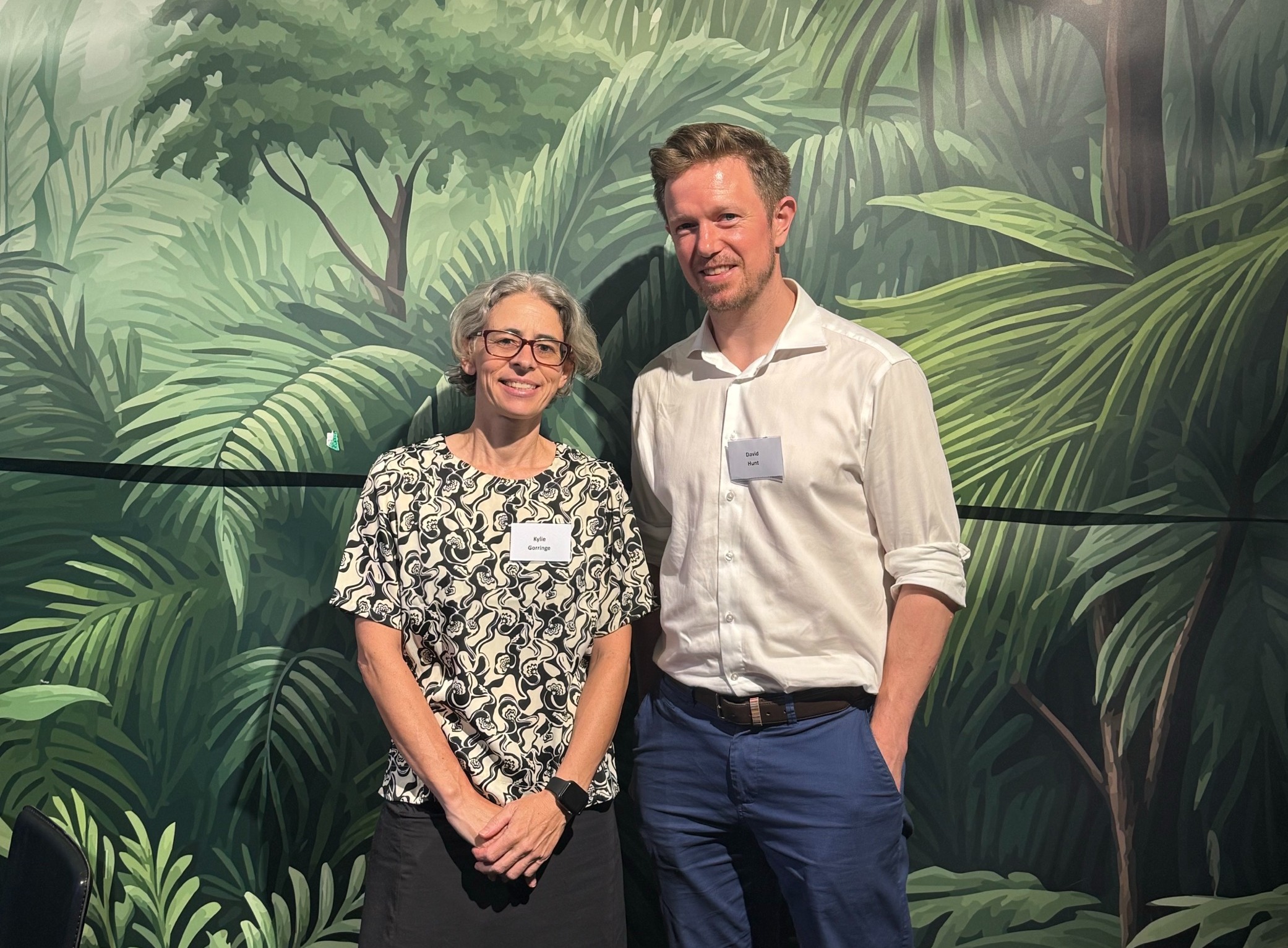
Pictured: OCRF Research Director David Hunt and Associate Professor Kylie Gorringe
During day one researchers presented across new ovarian cancer risk genes, risk assessment models, emerging therapies and biomarkers to predict treatment response. They also communicated challenges in data and sample storage and collection. The collaboratively spirit was quickly apparent with hands raised between presentations offering suggestions and solutions such as, “we have samples you could use for that!”
The second and third days saw researchers workshop key issues identified on day one, leveraging one another’s expertise and resources to discern feasible solutions.
Associate Professor Kylie Gorringe said “It’s not only a knowledge sharing opportunity. It’s also about the leading researchers coming together to report back on how their ovarian cancer studies are going and propose new projects. For example, members propose an idea and other members of the group work out where they can help whether that’s with analysis, samples or expertise to form pragmatic collaborations.”
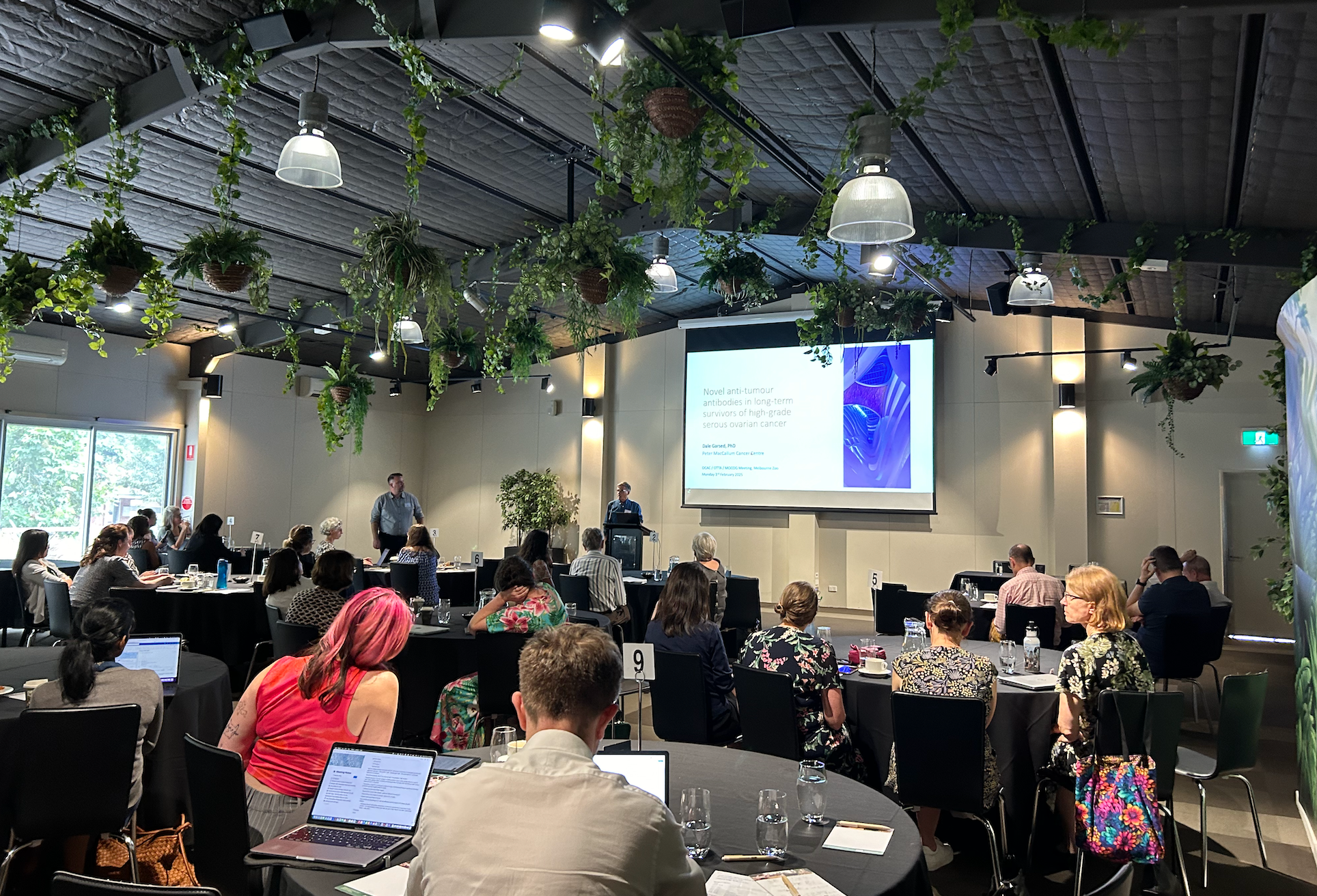
Dr Bronwyn Grout, a long-term survivor of HGSOC who works closely with MOCOG researchers, presented to remind the room of brilliant technical minds that they can leverage the power of their research by ensuring they translate and communicate it digestibly to the community.
Importantly, she emphasised that, “the ovarian cancer community is googling and trying to keep up to date, but how can we be sure we’re interpreting research correctly? It’s about providing informed decision making in a digestible, visual and meaningful way allowing the community to more easily discuss the research with their doctor, and each other, in a way that doesn’t lead to more confusion, stress or hardship.”
Dr Amy Wilson, OCRF Research Advisor, said, “It’s incredible to witness the power of researchers coming together to discuss their latest findings. These long-term collaborative initiatives highlight the importance of large-scale and longitudinal studies—without which many of the fundamental building blocks of ovarian cancer research would not exist. Given the high variability of this disease, it is important for researchers to collaborate, pooling data, samples, and insights, because ultimately, we are all working towards the same goal.”
Following the scientific forum, Prof. Brad Nelson, Co-Director of the Immunotherapy Program at BC Cancer Research, Canada, presented the 2025 Penny Taylor Oration. Prof. Nelson’s team has shown that long-term survivors of high-grade serous ovarian cancer tend to have specific immune cells—T cells and B cells—within their tumours. His team are collaborating with Australian researchers, including Dr Dale Garsed, to harness the specific biological mechanisms of these cells towards an immunotherapy approach for ovarian cancer.
Dr. Nicola Meagher was awarded the Penny Taylor Prize for Research Excellence in Ovarian Cancer, for her published research on rare mucinous ovarian cancers which resulted in a critical change to clinical guidelines, improving patient outcomes.
The Penny Taylor Oration is supported by Mrs Wendy Taylor, mother of Penny Taylor who died of ovarian cancer in 2014. Mrs Taylor warmly addressed the progress of Dr Meagher and Prof. Nelson, closing the oration with hope, acknowledging the most successful outcome research can deliver — life.

Get the latest news, stories & updates.
