Recently published study reveals promising targeted treatment approach for ovarian cancer
Reading time: 3 minutes
- Researchers from the UNSW Sydney and the Walter and Eliza Hall Institute of Medical Research (WEHI) have published findings of a new, targeted high-grade serous ovarian cancer (HGSOC) treatment.
- Foundational research for this targeted therapy was funded by the Ovarian Cancer Research Foundation (OCRF), where researchers demonstrated that the receptor (ROR1) is an ideal treatment target for HGSOC.
- The research team say their results provide strong evidence that future trials across all cancer types that target ROR1 should also include high-grade serous ovarian cancer patients.
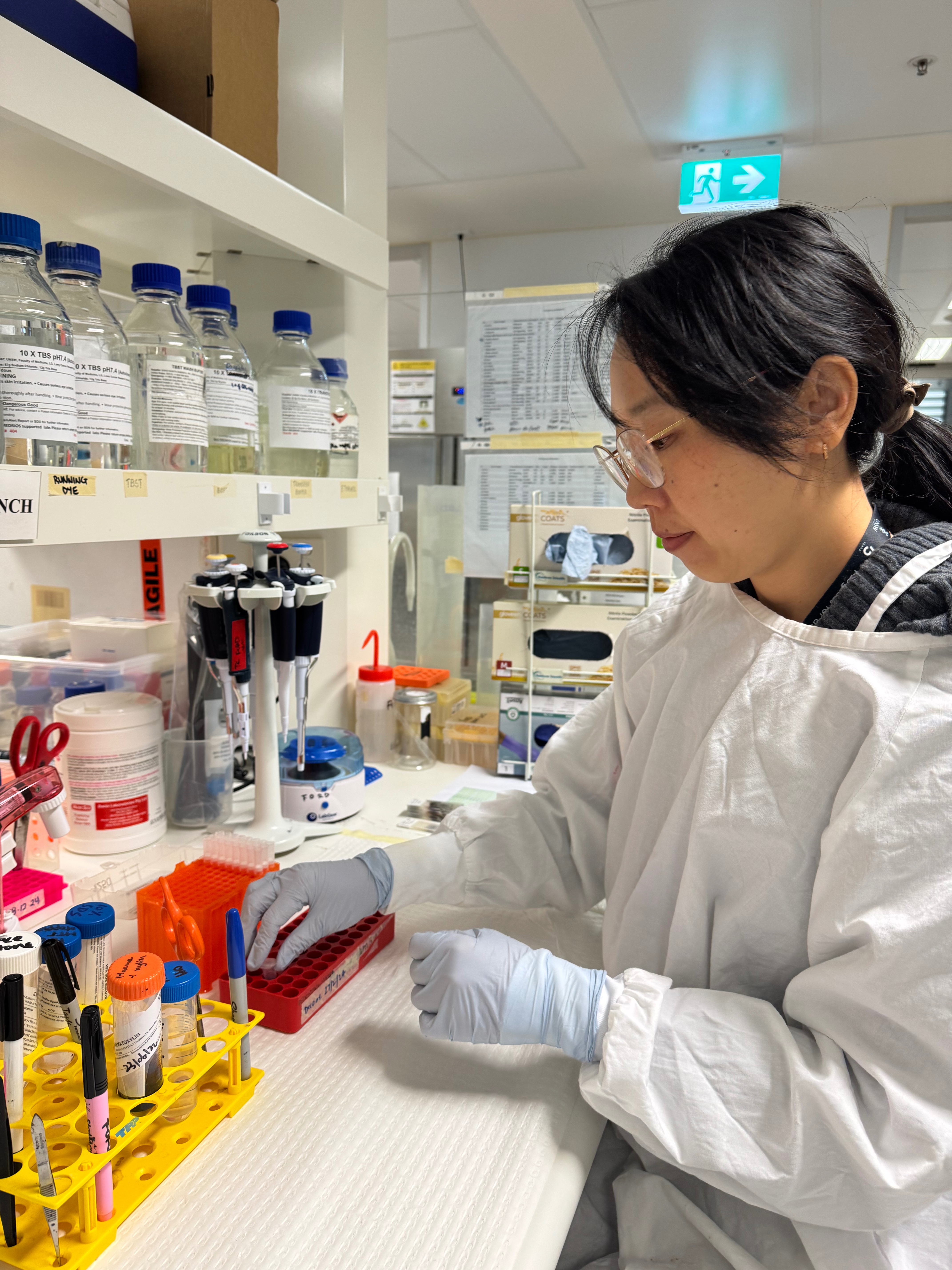
Image: provided by Dr Dongli Liu of Professor Ford's lab
Following funding from the OCRF, a research team from the UNSW has since partnered with a pharmaceutical company, to test a targeted treatment approach that could improve treatment of high-grade serous ovarian cancer, the most common and aggressive form of the disease. Led by Professor Caroline Ford, the team recently published findings in the Therapeutic Advances Medical Oncology Journal.
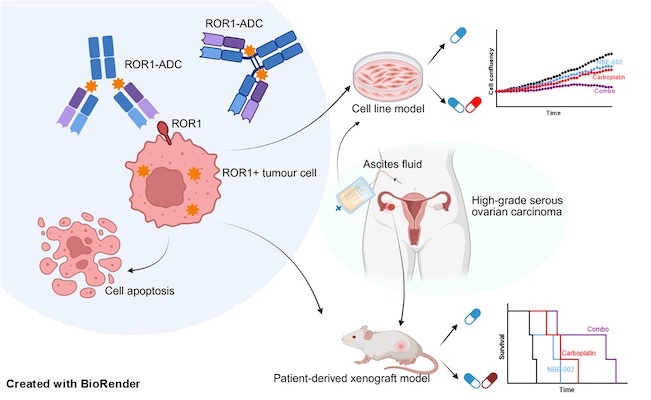
In laboratory models, the team tested their new treatment, NBE-002, over four weeks and found it was effective when used alone and in combination with standard of care therapies, including chemotherapy and PARP inhibitors.

Most excitingly, Professor Ford explained:
"This study built on many years of foundational work where we demonstrated that ROR1 would be a good drug target in ovarian cancer. We were able to show that a modern type of cancer therapy called an antibody drug conjugate, or ADC, could kill cancer cells in laboratory models that express ROR1." .

The team observed that the treatment reduced the ability of cancer cells to multiply and spread in 7 of the 10 preclinical models. Models that had the highest expression of ROR1 responded the best. Importantly some of these models included samples from patient groups who currently have very limited treatment options. Results showed that the treatment was even effective in chemoresistant resistant samples (which often don’t respond to chemotherapies) and homologous recombination proficient samples (which often don’t respond to widely used PARPi therapy). These findings indicate that the approach could one day provide a crucial new option and fill a treatment gap for those with these types of ovarian cancers.
What the team uncovered about ROR1: how does it work and why is it important for ovarian cancer treatment?
Funded by the OCRF for four years between 2013-2016, Professor Ford’s team established that there was a higher presence of ROR1 in ovarian cancer cells than in healthy cells. They found if they stopped the effects of ROR1 in these cells, ovarian cancer growth could be also stopped. The normal role of the ROR1 receptor is to help regulate cell function, and generally ROR1 levels reduce as a person ages. Yet, when the team analysed 178 high-grade serous ovarian cancer patient samples against health controls, they found a pattern of higher ROR1 levels in the cancerous samples. This suggested ROR1 played an important role for ovarian cancer cell survival and therefore, would be a good target for a new treatment. The team also established that ROR1 initiates a series of pathway signals that eventually contribute to ovarian cancer tumour progression and chemoresistance. When they stopped the effects of ROR1 early in the pathway, the ability for cancer cells proliferate and spread was reduced, indicating a ROR1-targeting treatment may prevent cancer growth and metastasis.
How does this new ovarian cancer treatment approach work?
NBE-002 is an antibody-drug conjugate (ADC). An ADC is a type of targeted treatment that includes a monoclonal antibody, which allows the treatment to selectively target only cancer cells without harming healthy cells, reducing side effects. The antibody is ‘conjugated’ (linked) to a drug, such as chemotherapy, depending on the cancer — making it both a very precise and highly effective approach to developing new treatments.
Image credit: Dr Dongli Liu
Although the further development of the exact drug used in the team’s experiments has been halted by the pharmaceutical company, the team advocate that any future ROR1-targeting treatment trial should have high-grade serous ovarian cancer patients considered within eligibility, considering these important findings. With most high-grade serous ovarian cancer cases diagnosed in the later stages when effective treatment is more difficult, innovative approaches are urgently required. Therefore, these published findings represent important progress, as many other pharmaceutical companies are developing drugs that target ROR1 and it is important that ovarian cancer patients are included in these clinical trials.
Read more about Professor Ford’s research
Key terms
- Chemotherapy resistance: refers to when cancer cells acquire the ability to evade the effects of chemotherapy treatment, and chemotherapy is no longer effective for that individual.
- Drug screening: can involve screening large libraries of drugs to identify those that could be used for a new purpose and effective as another type of treatment.
- Targeted therapy: is where precise proteins that help cancer cells growth and spread are targeted by a treatment, and targeting can lead to less healthy cells being damaged and less side effects.

Get the latest news, stories & updates.
