OCRF-funded researcher awarded prestigious VCCC Alliance Tony Burgess Medal for progressing low-grade serous ovarian cancer treatment research
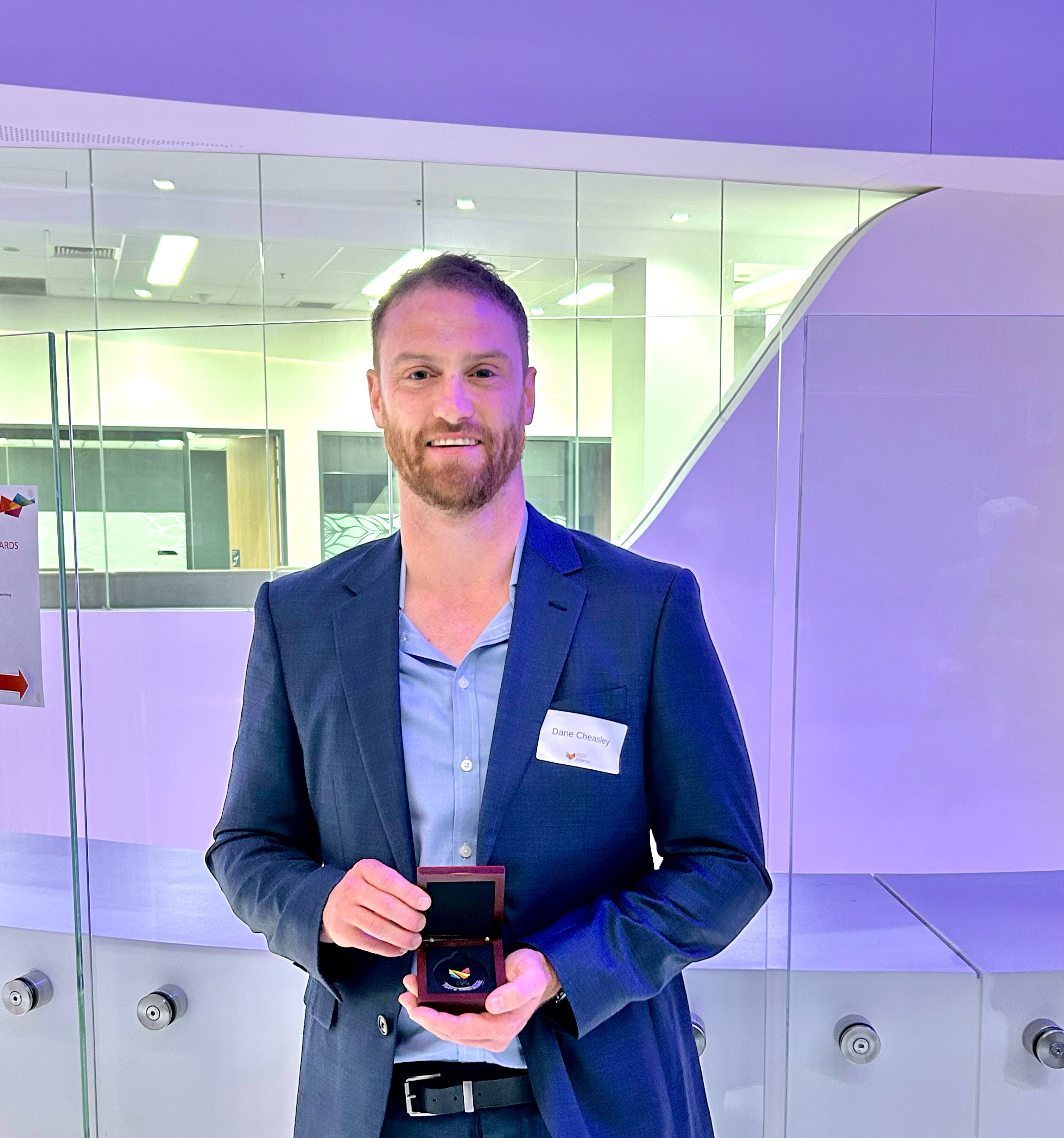
- Dr Dane Cheasley from the Peter MacCallum Cancer Centre has been awarded the Victorian Comprehensive Cancer Centre (VCCC) Alliance Tony Burgess Medal for his collaborative research program, developing new treatments for rare low-grade serous ovarian cancers.
- One year into OCRF funding, the team are already making significant strides with new data revealing the drivers of some low grade serous ovarian cancers, as well as demonstrating a new treatment solution — data they hope will lay the groundwork for a future clinical trial.
- By matching patients with this rare ovarian cancer with therapies most likely to work for them, this research boosts precision medicine potential for patients who currently have limited options.
Reading time: 3.5mins
Image: Dr Dane Cheasley, VCCC Alliance Tony Burgess Medal recipient
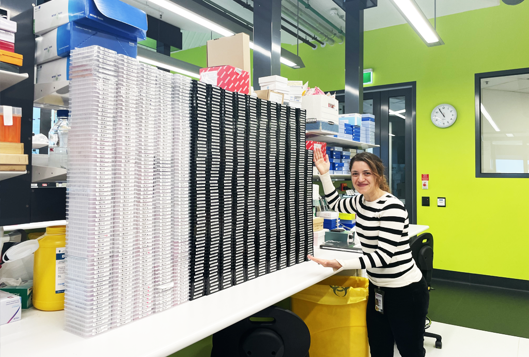
Over a year ago, Dr Dane Cheasley’s team looked up at their towering stack of plates—approximately 3500 drug compounds ready for screening. They had their haystack, now they needed to find the needle: a new treatment approach for low-grade serous ovarian cancer (LGSOC) and, with the help of OCRF funding, they believe they’ve found it!
There are around five subtypes of LGSOC, all of which are rare and predominantly impact younger women. Sadly, most people are diagnosed once the disease has already spread, and it commonly comes back after treatment. When this happens, fewer than one in ten patients respond to the treatments currently available and become resistant to chemotherapy.
Data produced from the team’s OCRF grant highlights not only a promising new treatment approaches for all LGSOC subtypes, but also crucial knowledge of how to target the drivers of rare LGSOC subtypes called ‘no specific molecular profile’ (NSMP) — fittingly named because previously researchers didn’t know what was driving these cancers, which make up ~40% of LGSOC cases.
While researchers around the world have made progress for some low-grade serous ovarian cancer subtypes, others have been left behind until now. Thanks to the support of the OCRF, our team has made amazing headway in closing this treatment gap and revealing new hope for women affected by this disease.
Dr Dane Cheasley
Using an AI-based tool and state-of-the-art robotics, thousands of drug compounds were tested against 12 low-grade serous ovarian cancer cell lines, which include 5 NSMP cell lines. The team looked at the molecular pathways in the samples that showed effective drug responses and identified a pattern of drugs targeting specific cancer signalling pathways. Refining their drug candidates, the team tested 20 drugs (some of which have been used to stop the function of this pathway in other cancers) in tiny 3D LGSOC “mini-tumours” grown in the lab that closely mimic real patient tumours and identified the most promising with which to develop a combination treatment. The team also found many of their combinations bound irreversibly in their samples, which indicates the treatment may be help prevent recurrence.
In next steps, the team hope to test their combination in larger patient groups before seeking approval for a clinical trial that they hope will be expedited because the drugs tested are already approved by the US Food and Drug Administration (FDA) for use in other cancers.
With Dr Cheasley and other international groups on the cusp of new precision medicine treatments for multiple LGSOC subtypes, understanding which patient has which subtype is key to tailored treatment. For this reason, Dr Cheasley has leveraged his OCRF-funded data to secure $50,000 from the Australian and New Zealand Gynaecological Oncology Group (ANZGOG), which will help pave the way for development of a kit to help determine a patients LGSOC subtype.
Additionally, Dr Cheasley shared his OCRF-funded data with Associate Professor Pilar Blancafort, from Harry Perkins Institute of Medical Research in Western Australia, who noticed additional patterns worth investigating. In 2024, together they applied for and received a National Health and Medical Research Council (NHMRC) grant of over $2 million dollars, bolstering the Dr Cheasley’s ovarian cancer research Australia-wide.
Offering hope for those with LGSOC, this significant progress was recently recognised with Dr Cheasley awarded the VCCC Alliance Tony Burgess Medal.
Image: Dr Kathleen Pishas of Dr Cheasley's team with towers of plates ready for screening
Recognition through the VCCC Tony Burgess Medal reflects the incredible teamwork behind our research. It’s the result of a truly amazing collaborative network that brings together scientists, clinicians, and advocates across Australia and around the world who share a common goal to find better treatments for women living with low-grade serous ovarian cancer.
Dr Dane Cheasley
This progress also exemplifies the important launchpad the OCRF provides researchers — with community funding continuing to give researchers the leg-up required to investigate ideas and generate promising data that can lead to the larger grants and collaborations that provide better outcomes for patients. We look forward to bringing more news of Dr Chealsey’s research as it continues to progress.
Wish to support researchers like Dr Cheasley’s team? Donate to OCRF today.

Get the latest news, stories & updates.
