Developing an early detection test for ovarian cancer using circular RNAs
Overview
By focusing on circular RNAs and better understanding their role in both healthy cells and cancer progression, Associate Professor Jason Lee’s team seek to harness them as biomarkers to develop an early detection test.
Lead researcher: Associate Professor Jason Lee
Grant received: $852,342 for three years
OCRF research pillar: Early Detection
Primary institution: Frazer Institute, The University of Queensland

Latest update
Since beginning the project in 2023 we have successfully identified a circRNA that can be used to detect high-grade and low-grade serous ovarian cancer in the early stages using our digital PCR with only a couple of drops of blood. We are hoping to identify other circRNAs that we can combine with the one we’ve already identified to form a set that will collectively provide more accurate early detection. We have recently moved our lab to The University of Queensland and are now testing further patient samples to ensure the circRNA we’ve identified can distinguish accurately between ovarian cancer and other non-cancerous conditions and healthy samples. The work we’ve done to date has allowed us to obtain more early-stage ovarian cancer samples from biobanks and samples from individuals at high risk. These samples will help us determine exactly how early we can identify ovarian cancer with this circRNA. The next step will be to work with an epidemiologist to identify those at a high risk of developing cancer, such as people with a family history or BRCA gene mutations, to see how early the circRNA can be detected.”
Associate Professor Jason Lee, June 2024
Project details
Associate Professor Lee is investigating the potential of circular RNA (circRNA) molecules, which can be found in the blood, saliva and sweat, as the foundations of an early detection test. Most ovarian cancer diagnoses occur in the later stages when it is more difficult to treat so an early detection test is urgently needed to increase survivability.
As the name suggests, circRNAs are circular, making them quite stable in the blood, less likely to degrade, and easier to analyse as a biomarker. There are many types of circRNAs and, with OCRF funding, Associate Professor Lee’s team will narrow down which of them perform best as indicators of early stage high-grade serous ovarian cancer (HGSOC).
Associate Professor Lee explained that “CircRNAs are expressed in all tissues and their normal function is to regulate genes by mopping up tiny microRNAs. Additionally, circRNAs are tissue-specific, which means they differ depending on which part of the body they are in”.
CircRNAs are a relatively new area of research and Associate Professor Lee’s lab is one of the first to look at circRNAs from the start of their journey to find those presenting in high levels in ovarian cancer tumours.
In a two-pronged approach, the team seek to identify a set of circRNAs associated with early detection of ovarian cancer and analyse circRNAs that could make effective treatment targets.
Aims:
The team aim to identify which circRNAs most accurately indicate early ovarian cancer, and identify patients with recurrent ovarian cancer, for those who have already received treatment. Specifically, the team aim to:
- Determine which circRNAs, and at what level, indicate early-stage ovarian cancer: To identify the circRNAs most closely associated with early-stage ovarian cancer the team scanned over 14,000 circRNAs to narrow down to the 20 most promising. Now, they will further investigate how well those 20 perform as biomarkers by analysing approximately 90 high-grade serous ovarian cancer blood and plasma samples, comparing them to healthy samples. The aim is to determine how accurately and how early each circRNA level can indicate ovarian cancer.
- Determine if circRNAs can identify ovarian cancer early enough: The team will investigate whether the circRNAs they have identified can signal ovarian cancer at stages that are early enough to increase survival outcomes. They will do this by using some of the more than 200,000 samples collected during the UK Collaborative Trial Ovarian Cancer Screening trial. The team will look at samples taken from patients more than two years before their cancer was recorded as relapsed so that they can tell if their circRNA analysis can identify ovarian cancer at least two years earlier than currently available methods.
- Establish the functional role that circRNAs play in both early-stage ovarian cancer and ovarian cancer recurrence: Although the team have already identified that circRNAs could indicate ovarian cancer, they do not know exactly why nor how circRNAs promote cancer on a cellular level. Here, they will identify how circRNAs promote ovarian cancer tumours. This knowledge could open possibilities for both early detection and treatment. They will examine 20 circRNAs in 14 ovarian cancer in vivo models to identify the two most closely associated with ovarian cancer. They will then analyse the top two in cell lines using CRISPR technology and undertake RNA sequencing, a process to calculate the number of and types of RNA within a biological sample. This will help them determine which circRNA had the most impact on tumour growth and highlight the circRNA that could make an effective treatment target.
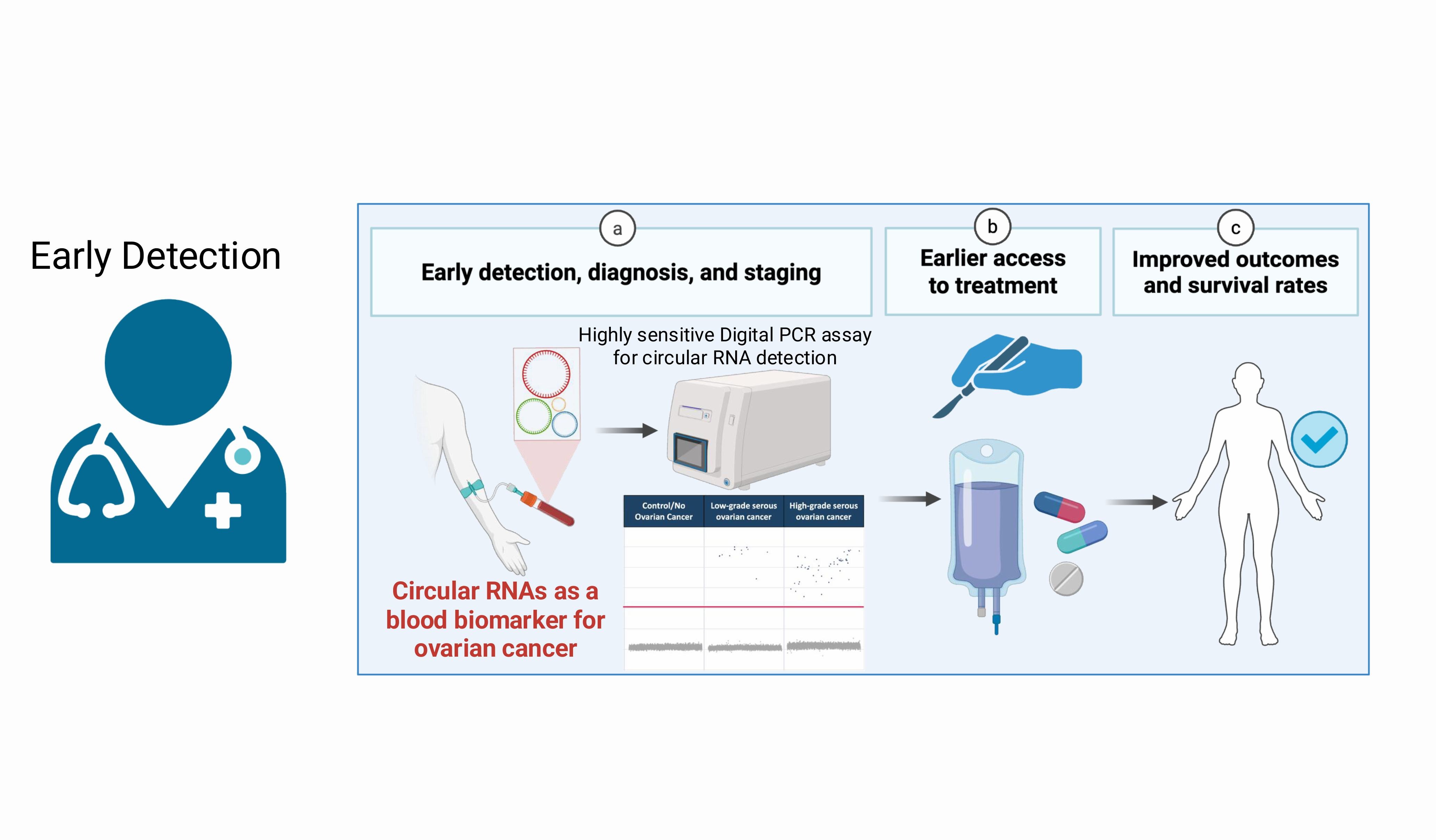
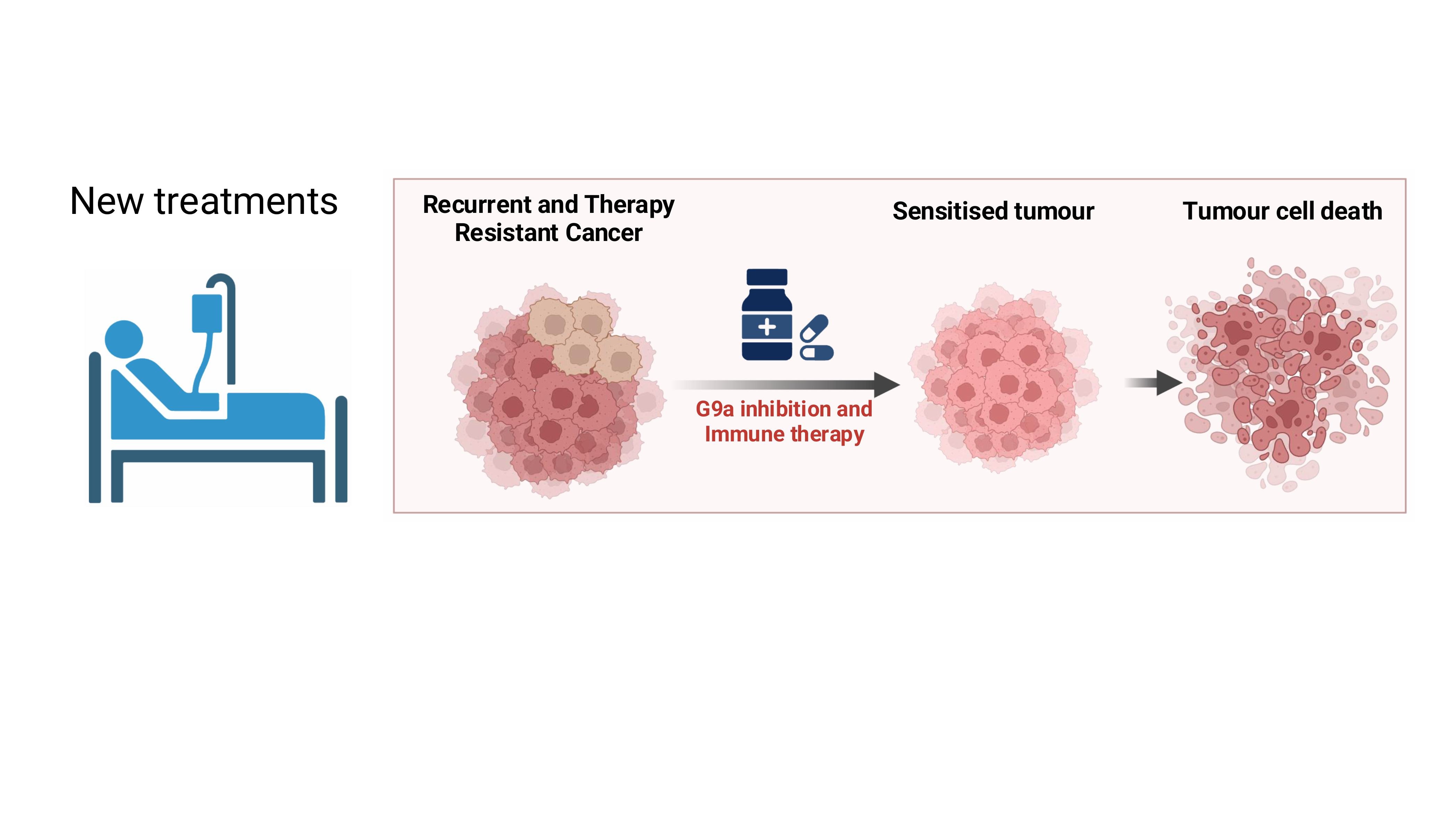
(Infographic provided by Associate Professor Lee and his team)
Approach:
Examining circRNAs for diagnostics is a relatively new area so to identify whether a specific circRNA is present in a sample the team developed a research tool: a digital PCR-based method that can specifically detect circRNAs, and the first digital PCR test for circular RNA using RNA isolated from ovarian cancer patient blood.
It can not only indicate whether a particular circRNA is present in a sample but also measure how much of that circRNA is present. This helps the team measure the level of specific circRNAs in healthy samples as compared to ovarian cancer samples to identify which circRNAs are most highly associated with early-stage ovarian cancer. With this approach, they will also observe which circRNAs have the highest impact on tumour growth. The team will also analyse circRNA levels in blood samples from the KConFab trial, which contains samples from patients that have a high risk of developing ovarian cancer.
In addition to their early detection work, the team will leverage their knowledge of circRNAs to test new treatment approaches. CircRNAs are impacted by epigenetics, and the G9a protein that Associate Professor Lee has previously studied with OCRF funding, has been found to control the expression of certain circRNAs. Therefore, the team will trial the impact of a G9ai drug they developed following their OCRF-funded study to determine whether it can both cause tumour cell death and stop the circRNAs that are helping tumour cells survive.
The team are collaborating with groups, including Monash University, that are developing mRNA vaccines to see if they can develop a circRNA vaccine that could be delivered to awaken the immune system and block an ovarian tumour from coming back, or block metastasis of a tumour.
Ambition and outcomes:
As there is no early detection test for ovarian cancer, and recurrence occurs in approximately 80% of cases, this project could provide an urgently required approach to identifying ovarian cancer early in the first instance, and a way to identify whether a patient is likely to experience recurrence.
In the short term, this project could provide the preliminary data required to determine the suitability of circRNAs as biomarkers for ovarian cancer and assist in obtaining further funding for validation in larger sample sets.
Long term, Associate Professor Lee hopes to develop an early detection test that has a 24-hour turnaround and for which samples are taken via a simple blood test. This work could also see clinicians alerted sooner if a patient’s ovarian cancer has recurred so that they can be treated faster and more effectively.
Utilising the team’s specialist expertise in epigenetics and circRNAs, this promising and innovative project could yield significant progress across both ovarian cancer early detection and risk of recurrence.
Current status:
This ovarian cancer research project is at the preclinical stage where researchers are conducting extensive studies in the lab with samples and models to verify the effectiveness of their approach as well as evaluating how safe it is likely to be for humans *
*Want to learn more about the medical research pipeline? Read more here.

For every project like this, many more can’t get underway due to a lack of funding. Support research like this to help them move forward.
Share page

Get the latest news, stories & updates.
