Disrupting ovarian cancer’s ‘safe zones’ to improve treatments and prevent relapse in ovarian cancer
Overview
This project focuses on understanding protective environments that form around small pockets of treatment-resistant cancer cells after chemotherapy, allowing the cancer to come back. By uncovering how these ‘safe zones’ work, this research could lead to new therapies and tools to personalise follow-up care for patients and reduce the chance of relapse.
Lead researcher: Dr Maree Bilandzic
Grant received: $260,000 for 1.5 years
OCRF research pillar: Treatment, Prevention
Primary institution: Hudson Institute of Medical Research

Latest update
We tend to think of cancer cells as being passive bystanders to treatment, but what we're observing is that these cells are actually shaping the environment they live in to create protected areas to prevent immune cells from coming in.”
Dr Maree Bilandzic, April 2026
Project details
Recurrent and resistant ovarian cancer remains the leading cause of death for people diagnosed with high-grade serous ovarian carcinoma (HGSOC). One reason that ovarian cancers come back is that a small number of tumour cells manage to survive treatment. These cells can’t be detected with standard scans and tests, remaining hidden in an altered environment that stops immune cells from entering the ‘nest’, protecting them from further treatment and immune attack. This ‘survival niche’ becomes the foundation for cancer relapse, making it an important but underexplored therapy target.
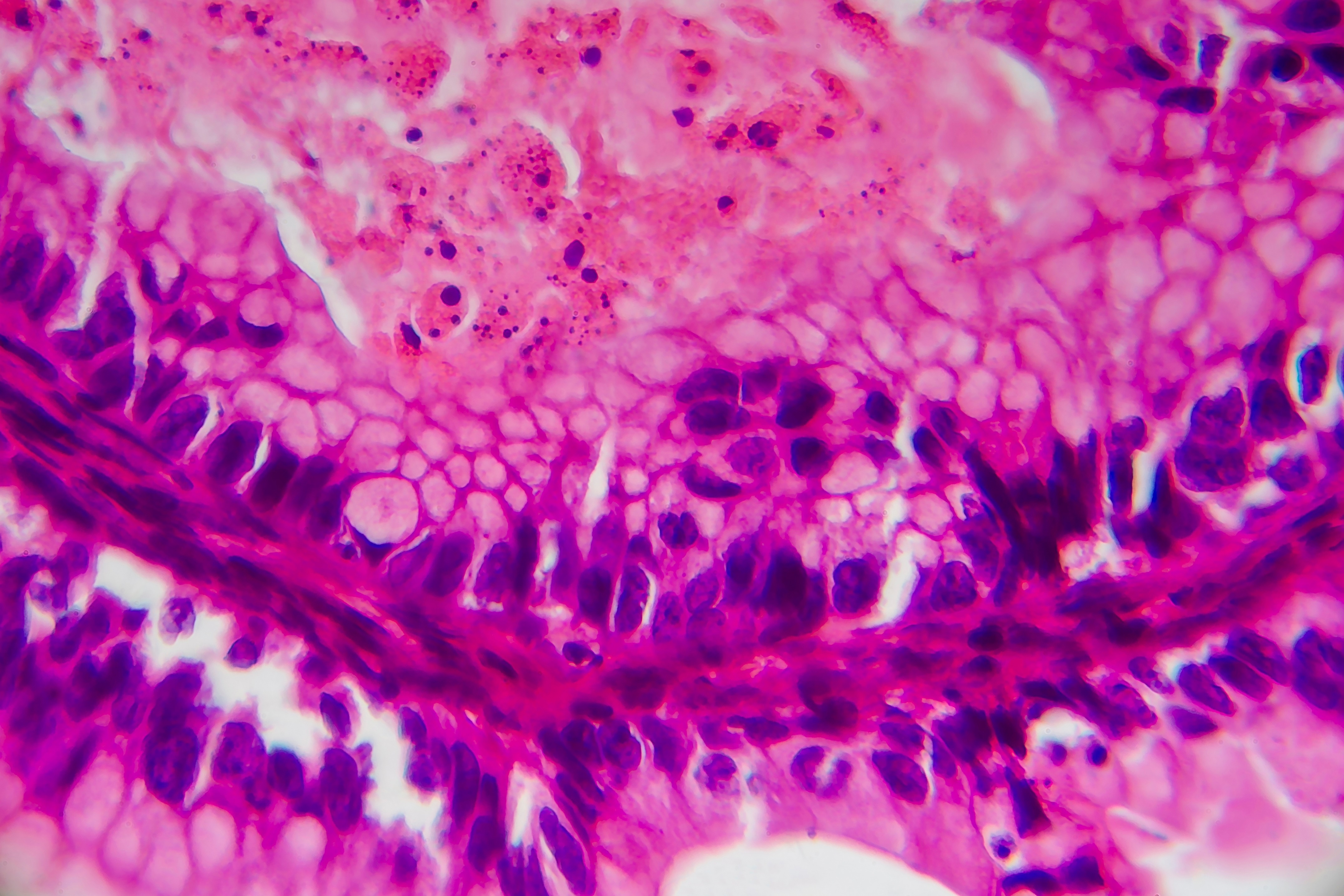
(Pictured above: High-grade serous ovarian cancer)
Aims:
This project aims to understand and break down the protective environments that form after chemotherapy, causing cancer recurrence. The team previously identified a small group of treatment-resistant ovarian cancer cells, called leader cells, that tend to survive treatment and are linked to worse outcomes. These cells are protected by changes in the area surrounding them, including a support structure (called the extracellular matrix - ECM), a lack of anti-cancer immune cells, and the activation of several survival molecular signals. Together, these changes create a ‘safe zone’ that helps leftover cancer cells survive.
Using advanced spatial mapping techniques, this project will build a detailed, multi-layered picture of these safe zones and identify which biological features are most consistently linked to treatment resistance, producing a ranked list of priority targets for future investigation.
Approach:
Dr Maree Bilandzic says the approach will use tissue samples from an OCRF-funded biobank, which includes samples taken before treatment, during treatment, and some that are indicative of recurrent disease. This will enable researchers to examine the environmental changes that happen before and after treatment.
The researchers will apply a combination of advanced techniques like spatial proteomics to map these changes in fine detail, while keeping track of where each change occurs within the tissue. Some techniques will reveal which genes and proteins are switched on or off across the different cell types in the tumour. Others will confirm the location of key immune and signalling activity. A specialised imaging method will measure physical changes in the collagen scaffold, the structural ‘fencing’ around cancer cells, including how densely packed and organised the fibres are, which can physically block immune cells from reaching the tumour.
All of these datasets will then be brought together to find the common threads: biological features that consistently appear across patients at the boundaries where immune cells are locked out. The team will use a structured scoring approach to rank these features based on how reliably they appear, how consistently they show up across different patients, and how biologically meaningful they are. The result will be a clear roadmap showing which targets are most worth pursuing in future studies.
Ambition and outcomes:
This project will deliver a detailed dataset showing how chemotherapy reshapes the environment around surviving cancer cells. It will also produce a ranked shortlist of the most robust biological features of these protective niches, with clear benchmarks to guide future therapeutic development. Together, these outputs will lay the groundwork for follow-on studies aimed at breaking down these safe zones, paving the way for future therapies and predictive tools that could help monitor HGSOC patients for relapse.
Current status:
This ovarian cancer research project is at the preclinical stage where researchers are conducting extensive studies in the lab with samples and models to verify the effectiveness of their approach as well as evaluating how safe it is likely to be for humans *
*Want to learn more about the medical research pipeline? Read more here.

For every project like this, many more can’t get underway due to a lack of funding. Support research like this to help them move forward.
Share page

Get the latest news, stories & updates.
