Dr Holly Barker
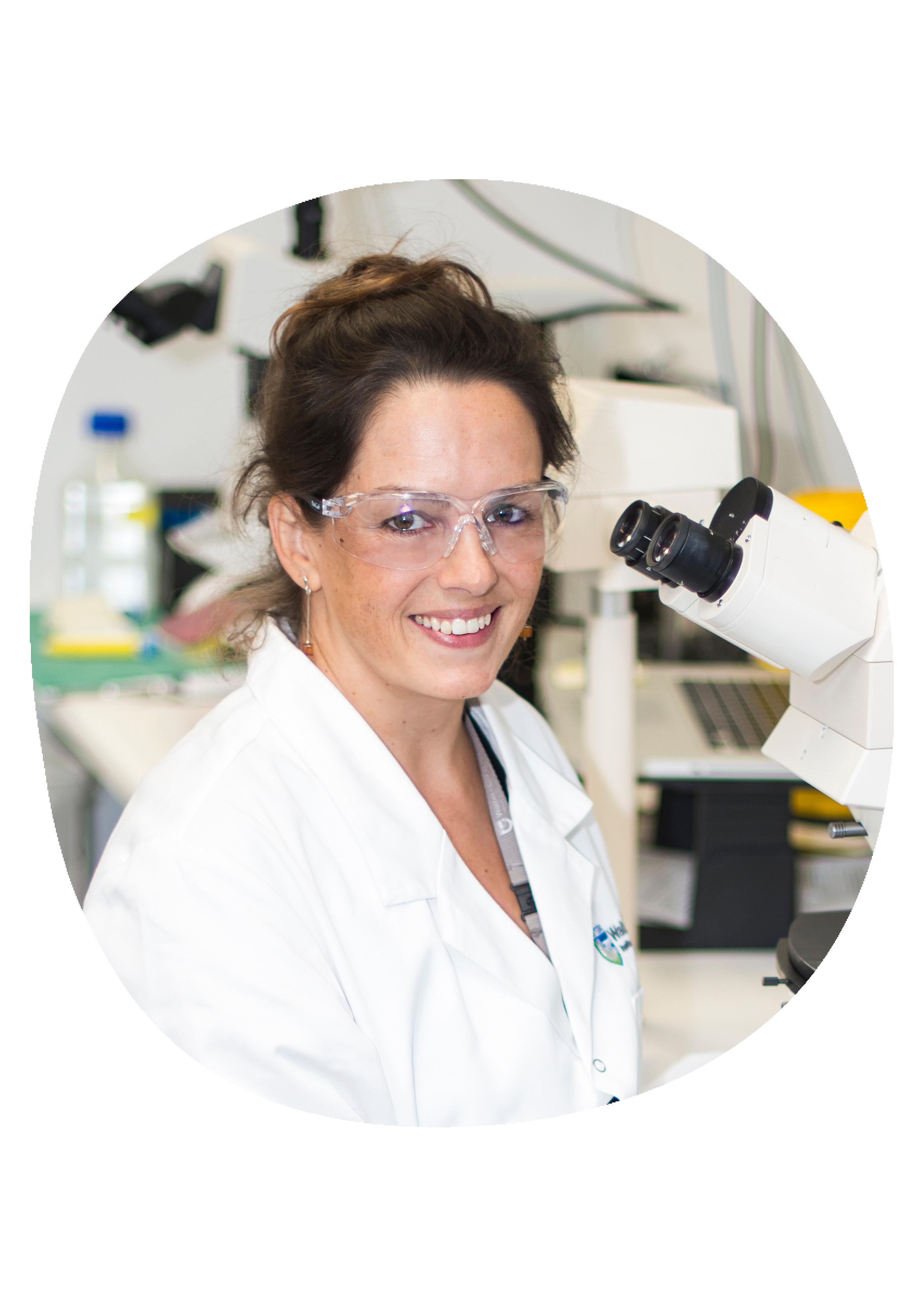
Research Institution: WEHI
OCRF priorities the researcher addresses: Treatment
Their OCRF-funded research projects: Identifying new treatment options for rare and aggressive ovarian carcinosarcoma
I want to better understand these rare and aggressive ovarian cancers so that we can find more effective treatments and provide improved options for people with rare cancers. I love being involved in translational research, seeing directly how our research is helping a patient.”
About Dr Holly Barker’s research
Dr Holly Barker is focused on identifying targeted treatments for people with rare cancers, including ovarian cancers. She specialises in laboratory models of cancer, including organoids. Organoids are crucial for testing personalised treatments, understanding whether a patient is likely to respond to a particular treatment, and why.
Tumour organoids are 3D tissue cultures grown from cancer cells in the lab. They can be used as models to test new treatments because they replicate some of the complexity of the cancer environment, as it occurs in the human body. Ovarian cancer organoids can be difficult to develop and keep alive as they require a complex set of factors for growth. This is why Dr Barker’s expertise is such an asset to the ovarian cancer research community.
Background
During school, Dr Barker loved maths and physics before attending the University of Melbourne where genetics and biology piqued her interest.
She loved the feeling she got when she, “… found something new that nobody else knew about yet.”
A move towards medical research also aligned with her desire for purposeful work, particularly having experienced the loss of a friend who passed away when Dr Barker was eighteen from a rare cancer called osteosarcoma.
While at university, Dr Barker was determined to work in health and medical research as soon as possible. She completed her PhD at the WEHI on breast cancer, examining the proteins inside breast cancer cells. This led her to pursue post-doctoral research at the Institute of Cancer Research in London, studying the proteins that breast cancer cells secrete and the changes that occur around tumour cells, which helped her better understand what drives breast cancer to spread around the body. She also developed expertise in screening for possible targeted therapies for head and neck cancers, before studying genomics and DNA make-up.
Dr Barker’s path into research has been broad, something she was concerned could limit her career prospects. However, her diverse set of expertise was exactly what Professor Clare Scott, leader of WEHI’s ovarian and rare cancer laboratory, was looking for to bolster the team behind the Stafford Fox Rare Cancer Program.
Career highlights
Dr Barker was part of the team who uncovered details of breast cancer metastasis including how changing the environment around a tumour can impact its ability to grow and spread. This was an important finding in 2011, as it suggested that if the tumour environment could be altered (for example using targeted treatments), it could inhibit cancer spread and help many cancer patients.
At WEHI, Dr Barker finds that working with patients and hearing from those who have the overwhelming diagnosis of a rare cancer, motivates her to ensure her research can make a difference in the clinic.
Dr Barker also completed a seven-year research program that led to the EPOCH trial, trialling eribulin and pembrolizumab to treat rare ovarian carcinosarcoma. Follow OCRF collaborative funding, the trial was funded by Eisai, Merck Sharpe & Dohme (MSD) and the Australian and New Zealand Gynaecological Oncology Group, and involved three collection sites across Australia and one in Canada with published results.
Collaborative impact
Dr Barker works in Professor Scott’s lab, which until 2016 was solely focused on ovarian cancer, and now focuses on rare cancers. The Stafford Fox Rare Cancer Program at WEHI collaborates with many researchers in the gynaecological cancer research sector as it is renowned for excellent laboratory models and access to rare samples that are essential for research. The Program, with its national framework, has ethics approval in place to allow sample donors to remotely consent to the use of their samples for research. This means Dr Barker’s team and the program have a significant impact by helping many in the ovarian cancer community.
For every project like this, many more can’t get underway due to a lack of funding. Support research like this to help them move forward.
Share page

Get the latest news, stories & updates.
