Targeting leader cells to effectively treat ovarian cancer
Overview
Building on the prior discovery of a novel population of cells called ‘leader cells’, Dr Maree Bilandzic and her team confirmed that these cells are key drivers of metastasis and chemo-resistance in high-grade serous ovarian cancer. They are now investigating how and why these cells avoid currently available treatments and are investigating new therapies to stop them.
Lead researcher: Dr Maree Bilandzic
Grant received: $669,638 for 3 years
OCRF research pillar: Treatment
Primary institution: Hudson Institute of Medical Research
Latest update
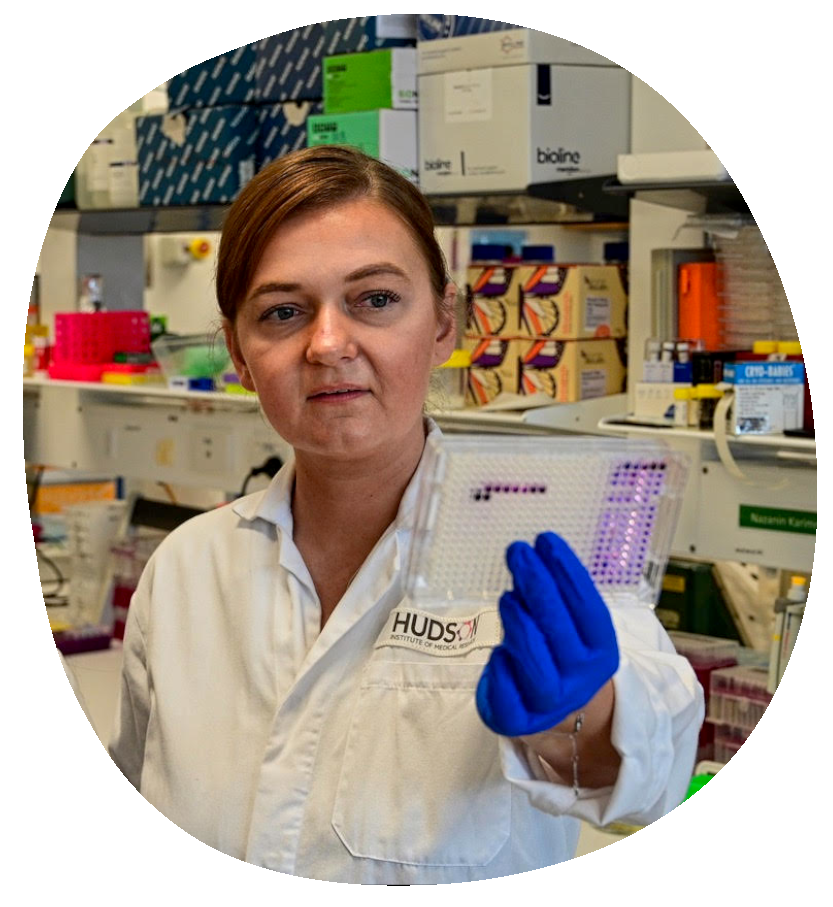
“We are working to develop a novel treatment that directly targets leader cells. This involves an entirely new antibody we’ve developed that targets a leader cell-specific epitope, a tiny part of an antigen that immune system cell antibodies can recognise and is expressed on the surface of leader cells and we hope to progress this into phase -1 clinical trials in the coming year.”
Dr Maree Bilandzic, December 2024
Project details
Ovarian cancer is often diagnosed late as there is no early detection test. A late diagnosis also increases the chance that the cancer has spread or ‘metastasised'. When ovarian cancer has spread and is in advanced stages the chance of the cancer returning after initial treatment is high in ovarian cancer and when it returns it can be resistant to chemotherapy. This is why Dr Bilandzic’s work is especially important as it seeks to develop new treatments that target metastatic and chemo-resistant ovarian cancers.
Dr Bilandzic’s research focuses on a population of cancer cells called ‘Leader Cells’, which have been identified in all epithelial ovarian cancer subtypes. A small sub-population of cancer cells, often comprising less than 10% of a tumour, leader cells are powerful as they can survive standard ovarian cancer treatments, such as chemotherapy, and guide other ‘follower’ cells to invade healthy tissue. Although leader cells had been found in other cancers including breast and bladder, Dr Bilandzic was the first to discover and detail their characteristics in ovarian cancers and determine their role in the progression and spread of high-grade serous ovarian cancer.
With OCRF funding, the team will determine how exactly leader cells work, and why they promote ovarian cancer progression and metastasis. By understanding more about how they work, they aim to gain the knowledge required to develop a targeted and effective therapy to stop them. Dr Bilandzic believes that if leader cells can be neutralised the other ovarian cancer cells can be re-sensitised to chemotherapy, enabling effective, long-term treatment of ovarian cancer.
Aims:
Dr Bilandzic’s team aim to:
- Define the molecular makeup of ovarian cancer leader cells and identify markers on the surface of leader cells. These markers could allow them to develop a tool to help clinicians monitor ovarian cancer progression in patients. Secondly, uncovering the molecular structure of leader cells will give the team the information they need to develop an effective therapy to target them.
- Screen epithelial ovarian cancer cell lines that include leader cells, against FDA approved drugs to determine if any approved drugs could be repurposed for use against leader cells. Because leader cells will often need to be treated after chemotherapy, the team will also screen leader cells cultured in chemotherapy against FDA approved drugs.
- Test the most promising drugs in pre-clinical models and monitor their effectiveness in reducing tumours and in resensitising cancer cells to chemotherapy. To see whether leader cell populations are responding to treatment, the cells will be marked with green fluorescent protein so that anything that has the potential to become a leader cell will go green and be visible. This will help the team demonstrate the effectiveness of the two most promising FDA approved drugs that could be repurposed to target leader cells.
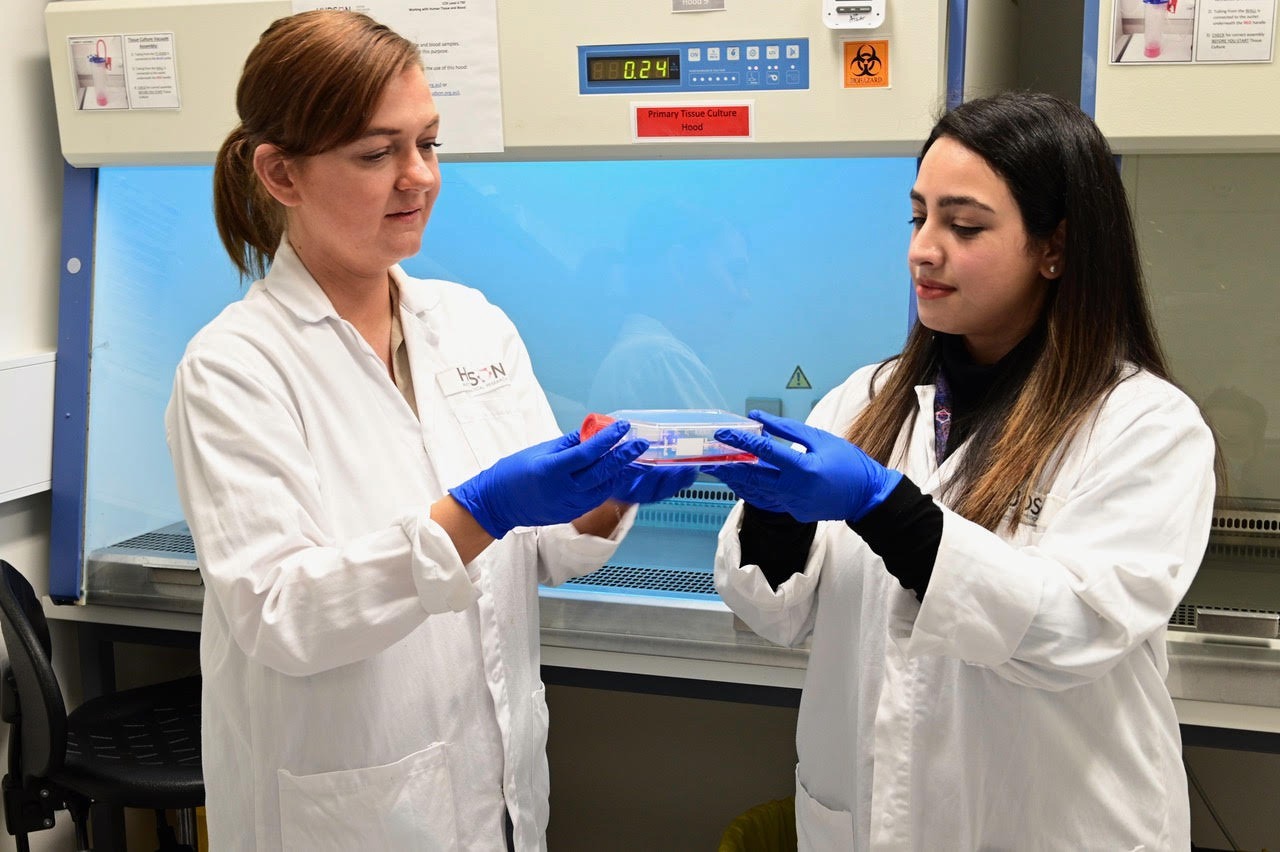
(Pictured above: Dr Maree Bilandzic and a colleague)
Approach:
Discovering leader cells
Prior to OCRF funding, Dr Bilandzic worked with Professor Tom Jobling (an OCRF founder and surgeon) who supplied patient samples of healthy and ovarian cancer tissue. Dr Bilandzic took healthy peritoneal tissue and then put ovarian cancer cells on top, observing and timing how long it took for ovarian cancer cells to invade into the healthy tissue. Dr Bilandzic then examined the tissue samples at different stages of this process, specifically the point at which ovarian cancer cells were beginning the invasion process. By looking at the first ovarian cancer cells to invade into healthy tissue, she identified ovarian cancer leader cells. The team’s previous studies showed that the presence of a specific marker on leader cells in ovarian cancer, Keratin-14 (KRT14), was associated with poor response to therapy and survival.
Characterising ovarian cancer leader cells and how they drive cancer progression
Dr Bilandzic’s team determined that during ovarian cancer metastasis, various types of tumour cells interact with the tumour microenvironment and then invade as a cohesive unit. This process, called ‘collective invasion’ is driven by leader cells. Leader cells then coordinate cell-to-cell interactions to form new tumour deposits in healthy tissue.
To evaluate the structure and makeup of ovarian cancer leader cells, the team isolated high-grade serous ovarian cancer leader cells from non-leader cells, extracted RNA from these cells lines, to identify the differences between ‘leader cells’ and ‘follower cells’. When they identified the combination of unique protein markers that define ‘leader cells’, they developed a leader cell marker panel, simplifying identification of leader cells. The panel was then tested on different types of ovarian cancer samples extracted from ascites fluid, which is fluid from the abdomen, to determine whether it could effectively predict the proportion of leader cells present and therefore how likely a patient is to experience drug resistance.
The team also tested what happened when leader cells were ‘silenced’ or genetically removed from ovarian cancer cell lines, then treated with chemotherapy. Cells that had leader cells present were resistant to chemotherapy, but upon genetic silencing of leader cells, the remaining cancer cells were eliminated. These experiments confirmed that leader cells were responsible for chemotherapy resistance.
Investigating the most effective treatment for ovarian cancer leader cells
During this project the team developed a fluorescently-labelled leader cell-ovarian cancer model, and screened over 1000 FDA approved drugs to determine which ones impacted the pathway they had discovered leader cells rely on — the PI3K/mTOR signaling pathway. Dr Bilandzic and her team identified 26 FDA approved drugs that were effective against ovarian cancer leader cells, and none of them had previously been used for ovarian cancer treatment. The top four were tested in combination with existing treatments, and proved promising in eliminating leader cells and sensitising cells to chemotherapy, then the top two were tested in preclinical models to determine whether these drug combinations could be effective at treating epithelial ovarian cancer in patients.
While one of the drugs was very effective, it was also too toxic, so they reduced the dosage and combined it with the other promising drug and chemotherapy to form an effective treatment approach against leader cells. The team saw impressive results over a 71-day period where there was a significant reduction in both leader cells and metastatic deposits.
Ambition and outcomes:
Dr Bilandzic and her team were the first to identify leader cells in ovarian cancer, and thanks to OCRF funding, they’ve been able to characterise them and confirmed that leader cells are the key drivers of metastasis and chemo-resistance.
With OCRF funding Dr Bilandzic and her team:
- Confirmed that if you can target and eliminate leader cells, existing tumours and the cancer’s ability to spread is reduced.
- Identified a ‘pathway’ through which leader cells could be targeted and which FDA approved drugs could effectively target this pathway to stop leader cells.
- Identified how leader cells control the ability of cancer cells to resist chemotherapy and demonstrated how they could be ‘re-sensitised’ once again by treating them with the promising drugs identified. Additionally, they found less chemotherapy needed to be used when leader cells were removed, which may minimise side effects for patients.
- Demonstrated that when leader cells are removed, and remaining ovarian cancer cells are wiped out, they do not return. This suggests that targeting leader cells is an effective approach for preventing ovarian cancer recurrence.
The team are now investigating treatment approaches and have developed a new antibody that can effectively target leader cells and have established a commercial company to validate it and develop it into an ovarian cancer treatment. This work is supported by a Medical Commercial Research Fund-backed CUREator grant.
By discovering leader cells in ovarian cancer, and exactly how they work, Dr Bilandzic’s research has made significant strides towards effective treatment of advanced metastatic and chemo-resistant disease.
Current status:
Clinical Research - Preclinical *
*Want to learn more about the medical research pipeline? Read more here.

For every project like this, many more can’t get underway due to a lack of funding. Support research like this to help them move forward.
Share page

Get the latest news, stories & updates.
