Advancing treatment approaches for a rare type of ovarian cancer
By focusing on the FOXL2-C134W mutation and its interaction with SMAD proteins present in adult granulosa cell ovarian tumours, Associate Professor Simon Chu’s team hope to develop a new treatment for this disease.
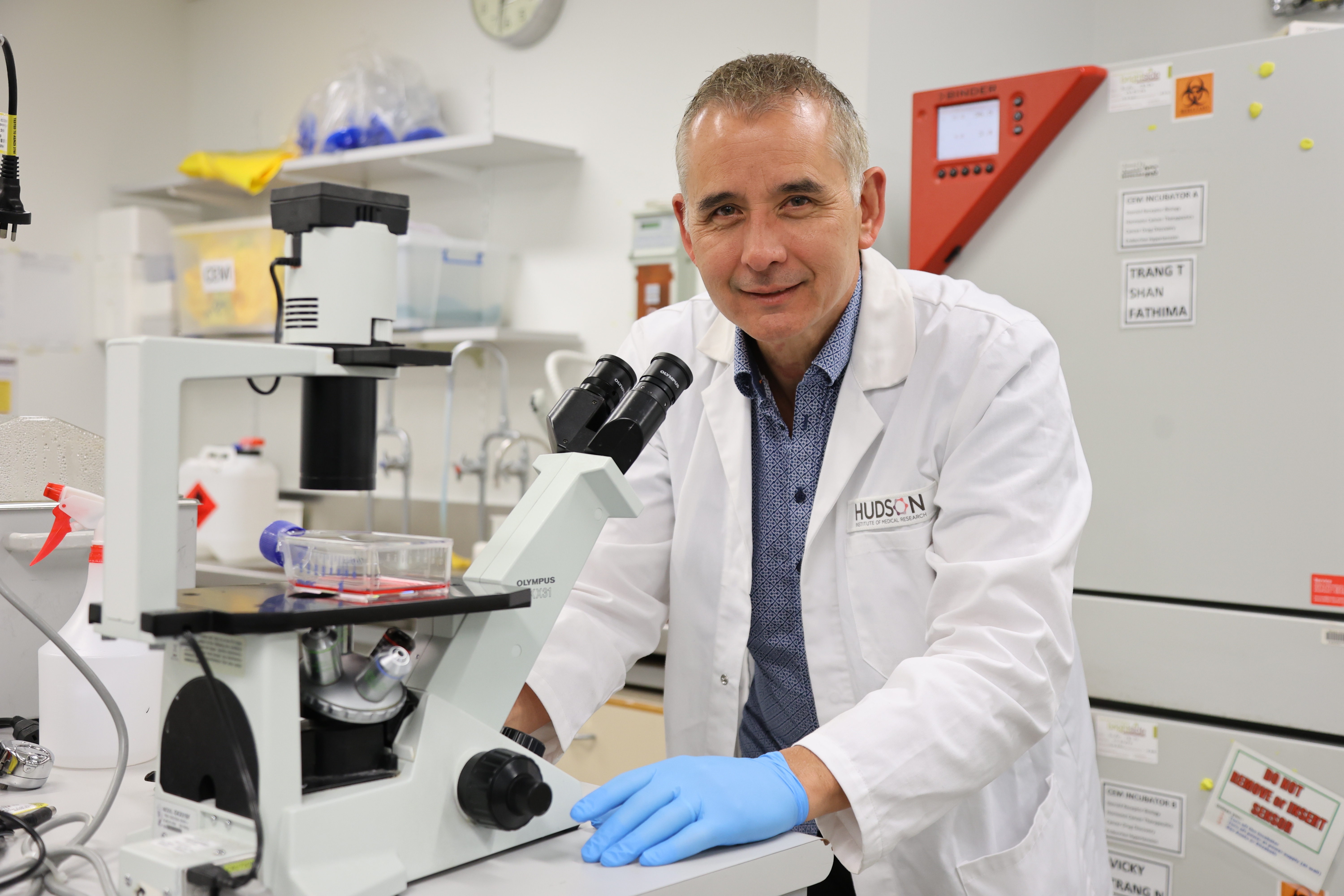
Lead researcher: Associate Professor Simon Chu
OCRF research priorities: Finding new and effective treatments, Managing Recurrence
Grant received: $724,293 over three years
Research institution: Hudson Institute of Medical Research
Image: Associate Professor Simon Chu
Project Details
Adult granulosa cell tumours (aGCT) are a rare form of ovarian cancer that can come back even decades after initial treatment; Associate Professor Chu’s team are therefore investigating a more effective and targeted treatment approach to address this challenge.
A mutation called FOXL2-C134W is present in nearly all aGCT tumours, and studies, including A/Prof Chu’s previously funded OCRF work, have demonstrated that it plays an early and significant role in tumour growth. However, exactly how this mutation drives aGCT remains unknown.
At the early stages of aGCT development, the mutated FOXL2protein interacts strongly with a family of proteins called SMAD proteins. This interaction alters the function of FOXL2, causing it to bind to different parts of the DNA than what is normal, and thus potentially triggering tumour growth. Therefore, A/Prof Chu’s team will investigate whether this interaction is a major contributor to aGCT development, and if so, whether there’s a way to block the interaction to prevent tumour formation and progression.
Progress update: March 2025
In the short term, this research will identify compounds that disrupt the FOXL2-SMAD interaction, potentially including drugs already used in other cancers, providing a strong foundation for new treatment combinations.
Associate Professor Simon Chu
Aims
With OCRF funding, the team will:
- Investigate the interaction between the FOXL2 mutation and SMAD proteins to understand precisely how this interaction promotes cancer development.
- Conduct high-throughput drug screening to identify drugs that could disrupt the FOXL2-SMAD interaction. This may include drugs that could be used alone or in combination with a class of drugs called “Smac mimetics”. Supported by the OCRF, the team previously demonstrated that Smac mimetics affect another important pathway, but only when there is a ”second hit” as a combination therapy. Therefore, identifying complementary drugs could enhance the effect of Smac mimetics or provide an alternative treatment.
- Perform large-scale genomic editing screens to identify genetic dependencies in aGCT cells, helping to identify new drug targets that could make these tumours more vulnerable to treatments.
Approach
Using ‘cryo-electron microscopy’ to observe DNA-protein interactions:
A/Prof Chu’s team includes experts in visualising DNA interactions under a specialised microscope, known as cryo-electron microscopy, a cutting-edge technology that allows scientists to visualise the interaction between FOXL2-C134W and SMAD proteins. Because DNA is extremely small, cryo-electron microscopy uses electrons rather than light to generate detailed molecular structures. To study the FOXL2-SMAD interaction, the team will combine the proteins together so that they interact naturally; freeze the interaction in time, and generate detailed molecular images. While the actual proteins aren’t visible, the shadows are: and using AI technology, the shadows are reconstructed resulting in molecular 3D structures. From there, the researchers can examine the ‘pocket’ of the interaction between the FOXL2 and SMAD proteins, effectively a molecular “lock” that drives tumour growth. The next step will be to identify a drug that acts as a “key” to block this interaction and stop tumour progression.
High-throughput drug screening to identify effective drug combinations:
The team will screen approximately 300,000 small molecule drugs to find those that could ‘fit’ the pocket they identified using cryo-electron microscopy. A drug that ‘fits’ could prevent the binding between FOXL2 and SMAD proteins and therefore prevent the interaction in the DNA that appears to drive aGCT growth. The team will narrow down their results to the most promising five drugs or drug combinations, as well as testing these in combination with Smac mimetic drugs. This approach maximises the chances of identifying an effective and clinically relevant treatment for aGCT.
Examining the broader genome to identify other ways that FOXL2 could be promoting aGCT ovarian tumours:
Even if blocking the FOXL2-SMAD interaction proves effective, some tumours may rely on alternative survival pathways. To uncover these additional mechanisms, the team will perform a large-scale genomic screen to determine which genes the FOXL2 mutation activates or suppresses, and how these changes contribute to tumour growth.
The team will use CRISPR screening to analyse the FOXL2 mutation’s function. Usually, CRISPR screens look at every single gene in the genome, knocking out one gene per cell in a process of elimination until the researcher can see which genes allow ovarian cancer cells to survive (therefore telling them which genes to target with treatment). Here the team will identify where the FOXL2 mutation activates the genes and where the mutation is causing a gene to deactivate, as this deactivation may also have a role in aGCT developing.
Ambition and outcomes
This project aims to lay the foundation for future clinical trials in aGCT treatment. By blocking the FOXL2-SMAD interaction, the project could lead to a completely new class of targeted therapies for this rare ovarian cancer subtype.
If successful, the study will:
- Identify promising drug candidates that can disrupt the FOXL2-SMAD interaction, preventing tumour growth.
- Determine the most effective drug combinations, potentially incorporating Smac mimetics or other targeted therapies.
- Uncover additional genetic vulnerabilities in aGCT, which could provide alternative treatment strategies for resistant tumours.
- Generate important preclinical data, accelerating the development of new treatment options for patients with aGCT.
By focusing on a rare and often overlooked ovarian cancer, this project highlights the importance of funding research into rarer cancer subtypes, ensuring that all patients—regardless of how common or rare their cancer is—have access to innovative, life-changing treatments.
Project status
This ovarian cancer research project is at the preclinical stage where researchers are conducting extensive studies in the lab with samples and models to verify the effectiveness of their approach as well as evaluating how safe it is likely to be for humans.
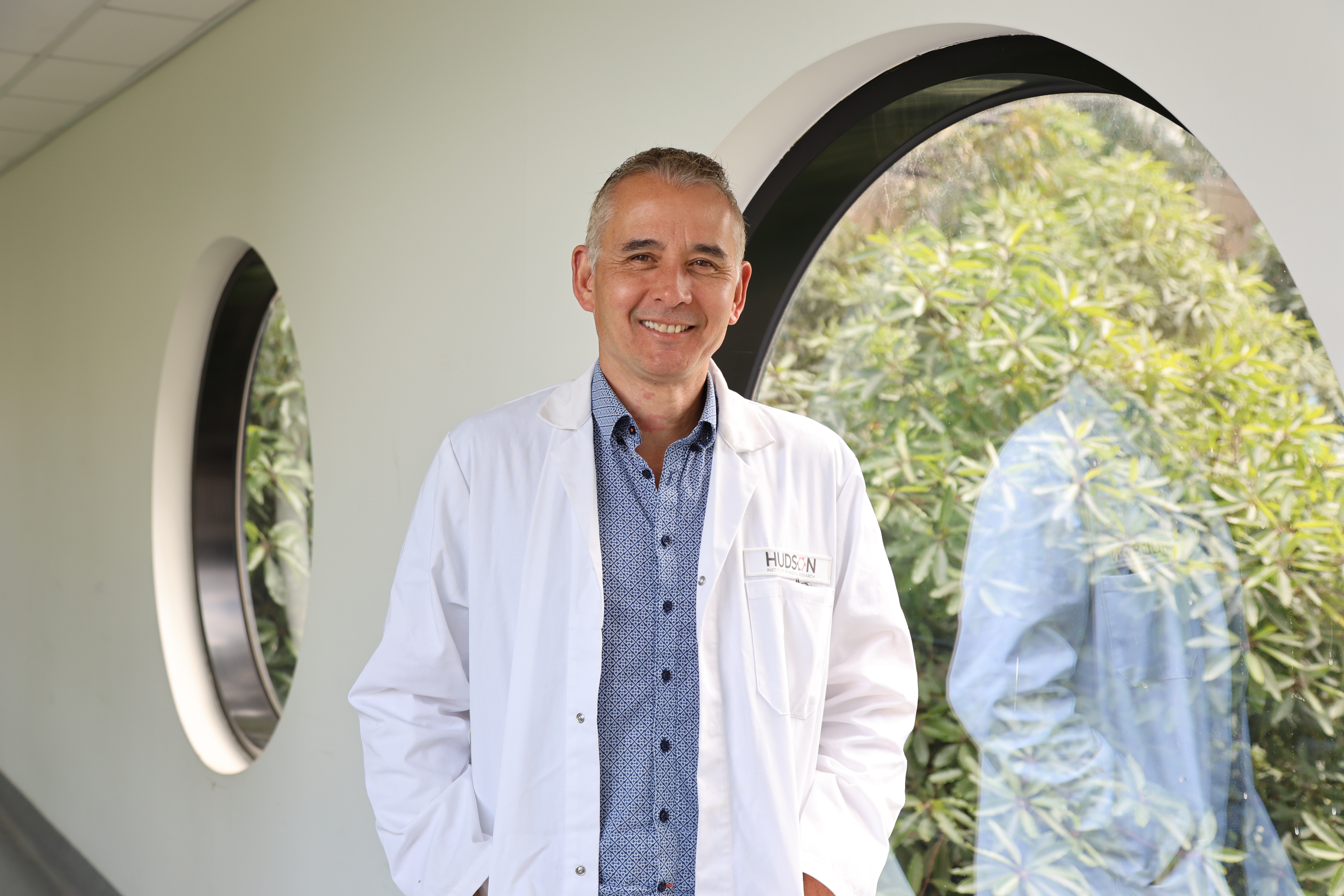
Image: Associate Professor Simon Chu
Key terms
Genetic mutation: a change in the DNA sequence.
Read more
- Hudson Institute of Medical Research: Associate Professor Simon Chu Lecture on GCT
- Journal of Proteome Research: Targeting XIAP and PPARy in granulosa cell tumours alters metabolic signalling
- Molecular Cancer Research: Mutational Landscape of Ovarian Adult Granulosa Cell Tumours from Whole Exome and Targeted TERT Promoter Sequencing

Get the latest news, stories & updates.
