South Australian researchers identify potential new treatment targets for ovarian cancer on multiple fronts
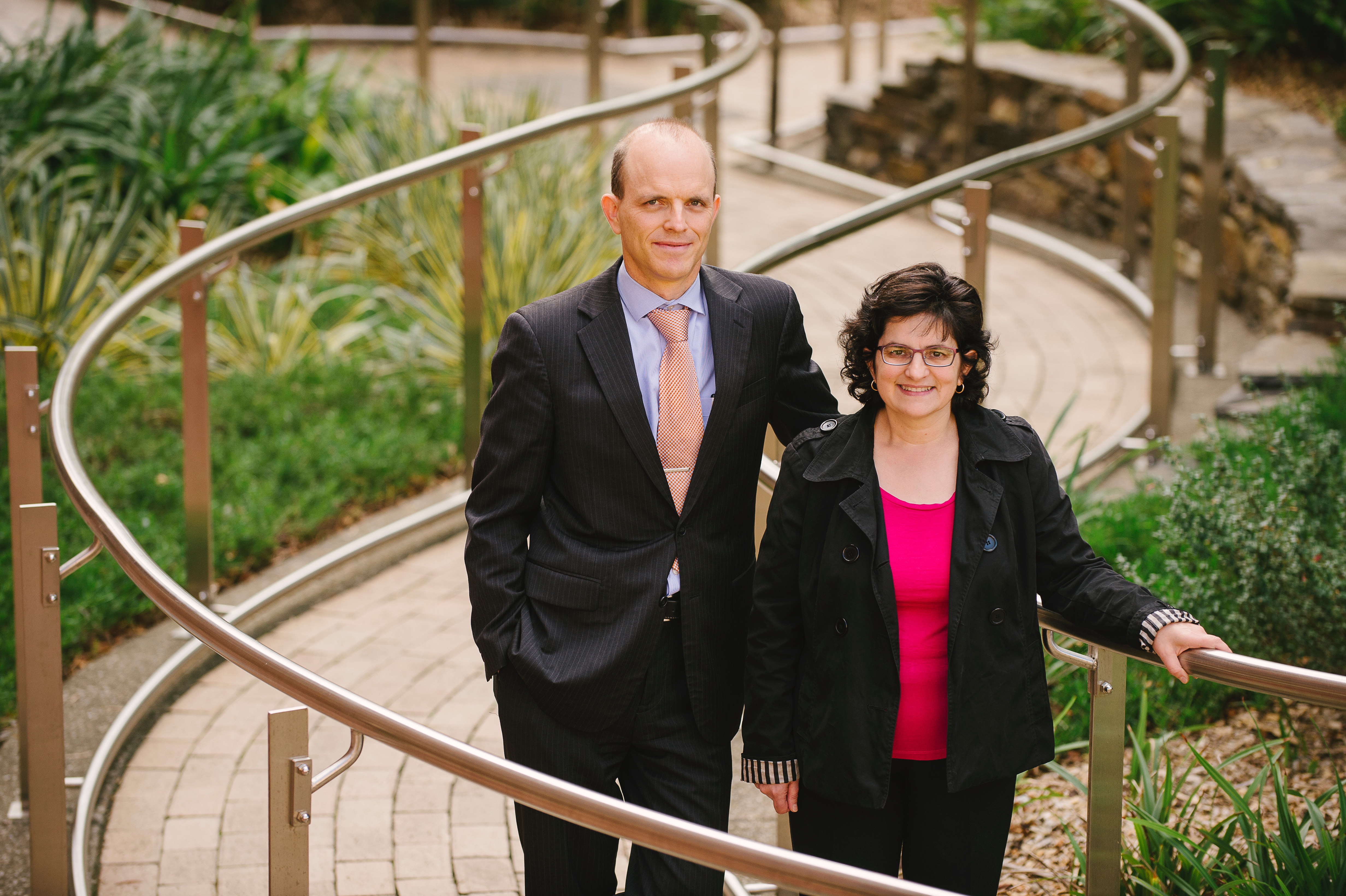
South Australian researchers have identified two biological targets that could offer new ways to treat ovarian cancer. Using samples from an Ovarian Cancer Research Foundation-funded tissue bank, the teams from the University of Adelaide and the University of South Australia recently published findings from their studies in the International Journal of Molecular Sciences and the British Journal of Cancer.
Reading time: 3 minutes
Image of Professor Martin Oehler and Dr Carmela Ricciardelli provided by Professor Oehler
Because there is no early detection test, ovarian cancer is often diagnosed at a late stage, when it has spread or metastasised making it more difficult to treat. Additionally, it often becomes resistant to current treatments like chemotherapy, so there’s an urgent need to find new ways to target cancers that have developed treatment resistance.
Professor Martin Oehler from the University of Adelaide is a researcher and clinician at the Royal Adelaide Hospital. He was involved in both studies and spoke to us about what these findings could mean for the patients he treats.
Study 1: A new target that could inform better ovarian cancer treatments and identify those at risk of metastasis, recurrence and chemoresistance
The first study, led by Dr Hugo Albrecht from the University of South Australia, focused on a receptor on the surface of ovarian cancer cells called, ‘coagulation factor II thrombin receptor’ or F2R. Researchers found high levels of F2R in ovarian cancer, particularly those that have metastasised and are chemo-resistant—indicating that it has a key role in ovarian cancer progression. The researchers also found that F2R causes cancer growth, and helps ovarian cancer cells spread and invade healthy cells. The team determined this by:
- Using large-scale databases to analyse genomic data and DNA of over 1600 ovarian cancer patients, across multiple ovarian cancer subtypes.
- Analysing RNA, looking at all the molecules and how they interact in 374 ovarian cancer samples, comparing them to 133 healthy samples—which highlighted that F2R promoted cancer progression, especially in samples where the cancer had metastasised or was no longer responsive to chemotherapy.
- In experiments with ovarian cancer cells, they then stopped F2R’s functions to see if this would halt cancer progression. When F2R levels were reduced or blocked, the cancer cells couldn’t invade healthy cells and spread, and some cells became responsive to chemotherapy again.
Results suggested that a treatment targeting F2R could be effective for multiple ovarian cancer subtypes, including low-grade serous, high-grade serous, clear cell, mucinous and endometroid ovarian cancers.
Professor Oehler discussed how this study may improve personalised medicine, “It provides important insight into F2R’s dual role in ovarian cancer’s aggressiveness. A treatment targeting F2R could help patients who currently have very few options — those with metastatic ovarian cancer and those with cancer that is resistant to chemotherapy. By understanding a patient’s F2R levels, it would also help clinicians like me understand sooner if a patient is likely to be at risk of metastasis or chemoresistance.”
Study 2: Towards a new high-grade serous ovarian cancer treatment
The second study identified a marker that could inform a treatment for high-grade serous ovarian cancer, the most common subtype.
By comparing serum samples from high-grade serous ovarian cancer patients and healthy controls, the team found 28 proteins at high levels in extracellular vesicles (EVs), which are released by ovarian cancer cells into the blood stream. They then tested 104 high-grade ovarian cancer samples to see which of these 28 proteins was most associated with poor outcomes, identifying UCHL1 as the leading marker. They also examined the behaviour of UCHL1 in ovarian cancer tissue samples at diagnosis and at the point of cancer returning, then investigated what factors were likely controlling the levels of UCHL1 in 70 samples, including controls and 31 high-grade tissue samples from the OCRF-funded tissue bank.
In the lab, the team then used a drug that stops the function of UCHL1 and found that it inhibited the ability of ovarian cancer cells to invade and grow, eventually causing them to die.
How could these findings lead to benefits for the ovarian cancer community?
“These findings have the potential to accelerate the development of urgently needed targeted therapies for women with chemo-resistant ovarian cancer and lay the foundation for ways to deliver personalised, effective, and durable treatments.”
Professor Oehler

Next steps
Both projects were conducted as pre-clinical studies in the lab and next steps would involve a larger scale pre-clinical validation in more advanced lab models. For the F2R study the team hopes to be able to develop a test to measure the levels of F2R in ovarian cancer biopsies to help identify those at most risk of metastasis, chemoresistance, and recurrence. Additionally, they are considering developing F2R-based antibody drug conjugates, which are little carriers that can deliver drugs right to cancer cells, as a new specific treatment approach.
These studies represent momentum building across ovarian cancer treatment and provide hope for those patients most in need of new options as well as underscoring the impact of OCRF initiatives beyond funding projects, including supporting researchers access to invaluable samples.
Learn more via the University of South Australia’s website and via the publications below.
References
1. Lokman NA, Macpherson AM, Thompson AR, Price ZK, Goonetilleke L, Condina MR, Young C, Hoffmann P, Oehler MK, Ricciardelli C. Proteomics analysis of serum extracellular vesicle identifies UCHL1 as a potential therapeutic target for high grade serous ovarian cancer. Br J Cancer. 2025 Nov 5.
2. Khetan R, Lokman NA, Eldi P, Price ZK, Oehler MK, Brooks DA, Blencowe A, Garg S, Ricciardelli C, Albrecht H. Protease-Activated Receptor F2R Is a Potential Target for New Diagnostic/Prognostic and Treatment Applications for Patients with Ovarian Cancer. Int J Mol Sci. 2025 Sep 2;26(17):8529.

Get the latest news, stories & updates.
