Investigating new treatments for mucinous ovarian cancer
Associate Professor Kylie Gorringe’s team will examine the proteins present in mucinous ovarian cancer samples to identify ways to target the disease, and will screen drugs to find promising new treatment approaches for this rare subtype.
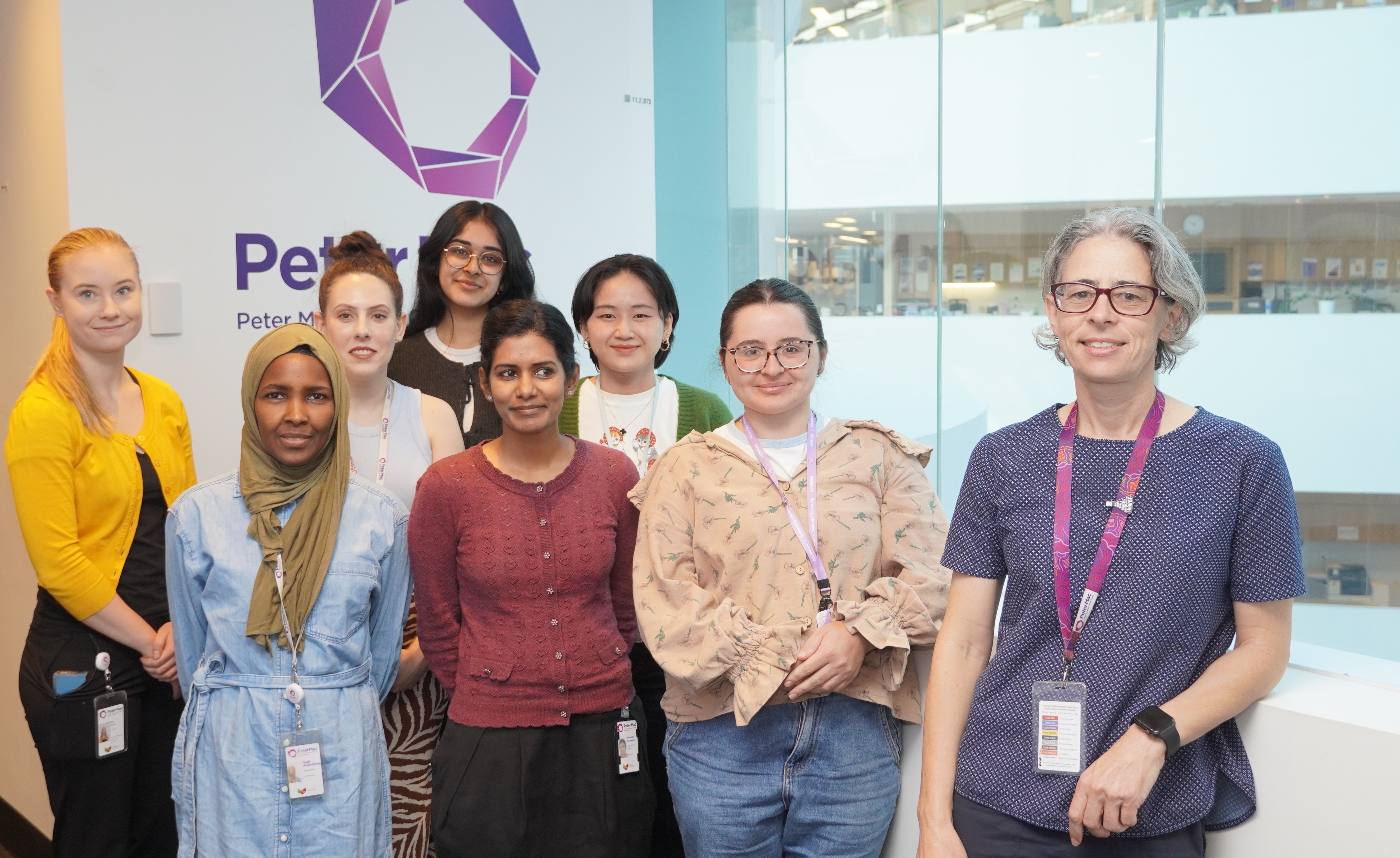
Lead researcher: Associate Professor Kylie Gorringe
OCRF research priorities: Finding new and effective treatments, managing recurrence
Grant received: $481,667 over three years
Research institution: The Peter MacCallum Cancer Centre
Associated institutions: The University of Melbourne
Image: Gorringe Lab (left to right) My Kvist, Suad Abdirahman, Olivia Craig, Nikita Dalvi, Nividetha Rajadevan, Cat Uyen-Phan, Irina Gorobets and Associate Professor Kylie Gorringe.
Supported by the Mother’s Day Classic Foundation in association with the Ovarian Cancer Research Foundation.
Project Details
Mucinous ovarian carcinoma (MOC) is a rare subtype of epithelial ovarian cancer, making up approximately 2-3% of cases. There are various forms of MOC that can behave differently, however there is still much unknown about this rare subtype. MOCs don’t respond well to current treatments, meaning discovery of new treatment options is critical.
A/Prof Gorringe’s lab is one of the only in the world with a dedicated MOC research program. Recently, they were awarded a National Health and Medical Research Council grant to investigate the cell of origin for MOC, as currently its cause and origins remain unclear. Despite the lack of clarity on why MOC tumours occur, OCRF funding will enable the team to find out how to stop it and identify new treatment approaches.
Progress update: March 2025
We hope that by understanding more about the tumour microenvironment around MOC tumours, we’ll be able to identify new ways to target MOCs and therefore the most effective drugs to fit those pathways. The best-case scenario would be that a drug already approved for use in other cancers proves promising, as it means we could quickly move it into the clinic for individuals with MOC who don’t have any other options.
Associate Professor Kylie Gorringe

Aims
With OCRF funding the team will:
- Examine proteins on the surface of the MOC cells to find key proteins or ‘pathways’ that could be targeted using therapies.
- Test the effectiveness of many drugs on MOC organoids using high-throughput screening. This will allow them to identify drugs that could effectively treat MOC, by targeting the proteins and pathways identified in the first aim.
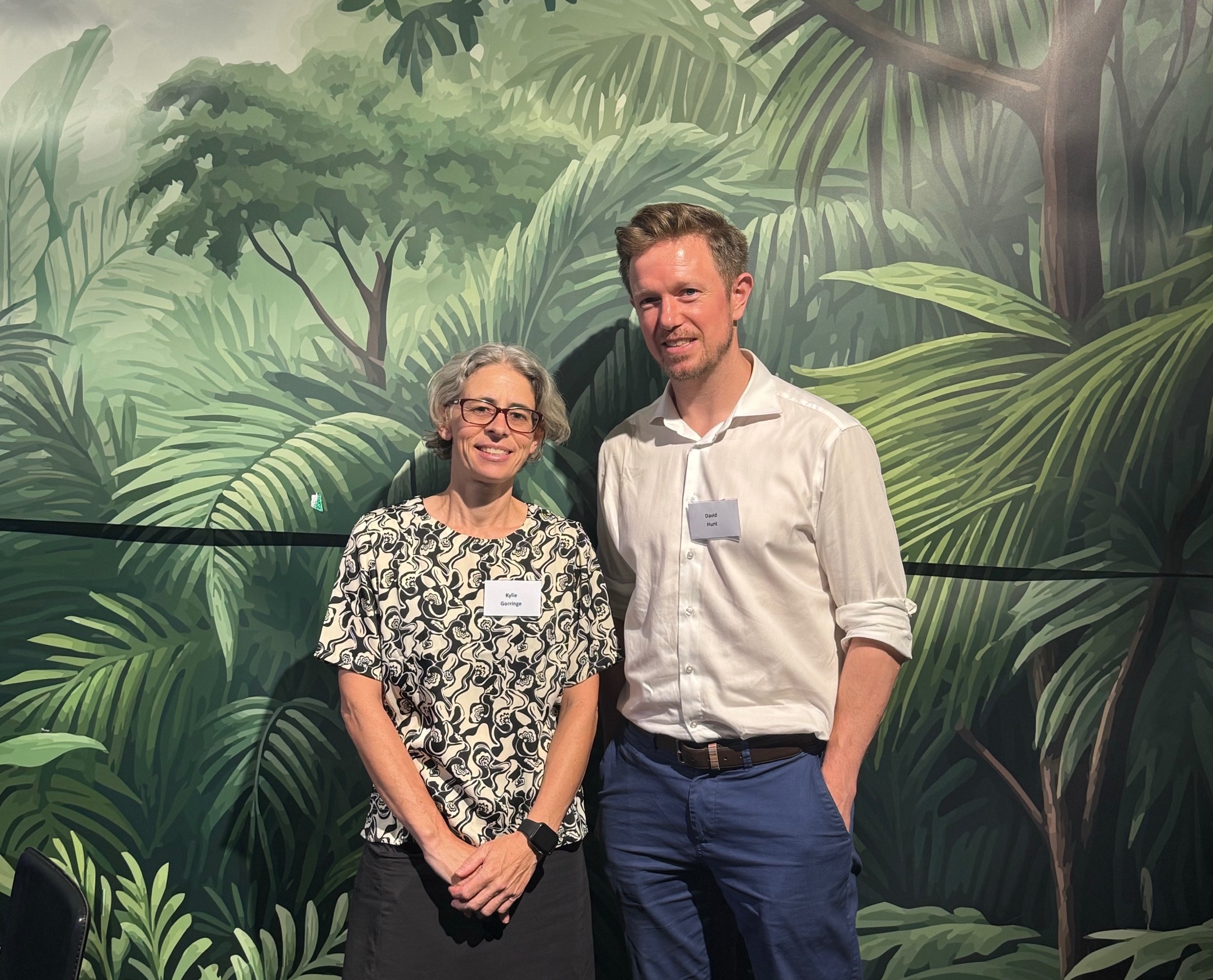
Image: Associate Professor Kylie Gorringe with OCRF Research Director David Hunt
Approach
Using proteomics to identify ways for treatments to target MOCs:
MOC tumours can have different genetic mutations compared to other ovarian cancers. For example, MOCs don’t include BRCA1 or BRCA2 mutations and are often not homologous recombination deficient, meaning PARP inhibitors rarely work on them. MOCs do often have a mutation in the gene KRAS, yet this mutation is rare in more common types of ovarian cancer, such as high-grade serous, and no drugs targeting this mutation are approved specifically for MOC. Even MOC that appears similar in genetic make-up can respond differently to treatment. Additionally, in previous studies the team completed RNA sequencing in both MOC organoid and tissue samples and saw differences not caused by the MOC tumour itself, but from the microenvironment surrounding it.
One of the ways that tumour cells interact with their environment is through the proteins that are present on their surface. Therefore, in this project the team will look at surface proteins (“surfaceome”) in MOC samples with different types of local environment. This could help determine what is influencing the various ways MOCs grow or evolve and point to effective treatment pathways.
A/Prof Gorringe will also perform one of the first dedicated in-depth protein analyses (proteomics) of MOC organoid models. Patient-derived MOC samples are processed into single cells and then grown in the lab in special conditions that preserve their tumour structures. The surfaceome of these organoids will further help to discover effective targets for treatment.
Screening FDA approved drugs that could be repurposed to treat MOC:
Using the information collected through their proteomic analysis, including new knowledge of the most effective pathways for drugs to target MOC, the team will conduct a high-throughput drug screen of approximately 500 FDA approved drugs. The most promising 20-50 drugs that can target different pathways on MOC cells will be then tested in the same MOC organoid models that were analysed in the proteomics study. From there, the team will test how effective the 10 most promising drugs are in combination with currently used chemotherapies to identify the most promising drug that could form a new treatment approach for MOC.
Ambition and outcomes
Due to its rarity, and because the molecular make-up of MOCs differs from more common forms of ovarian cancer, MOCs are not often examined in larger trials. This project therefore provides a unique and important opportunity for focused investigation into this disease.
The team hope to identify a therapy that is already approved for use in other cancers, as this could expedite the process to bring a new treatment option to MOC patients. If the team do find a suitable drug at the end of this project, they will validate it in preclinical lab models before proceeding to either a Phase I or II clinical trial. This may require international collaboration to meet the participant numbers required.
Longer term, the team’s analysis of the proteins and interactions involved in MOC could lead them to find a promising pathway to target. In the case that no FDA-approved drugs target this pathway, they would investigate developing a new drug to specifically target it. More broadly, the lab is investigating the mechanisms of chemotherapy resistance in MOC and information from these studies may also inform any new treatment they develop so that it could also work for individuals with recurrent or resistant MOCs.

Project status
This ovarian cancer research project is at the preclinical stage where researchers are conducting extensive studies in the lab with samples and models to verify the effectiveness of their approach as well as evaluating how safe it is likely to be for humans.
Image: Associate Professor Kylie Gorringe
Key terms
Tumour microenvironment: cells and molecules around a tumour cell that also can feed it or affect how it grows or spreads.
Proteomics: the study of function and structure of proteins.
Read more
- OCRF News: OTTA/OCAC Consortium meets during Ovarian Cancer Awareness Month
- International Journal of Gynaecology: Targeted therapy for mucinous ovarian carcinoma: evidence from clinical trials. Nugawela, D. Gorringe, K. 2023

Get the latest news, stories & updates.
