SIERRA study: Specificity of a new test for ovarian cancer
This project will determine whether the OCRF-7 test can detect ovarian cancer with the highest level of accuracy, and if so, position it to progress as a diagnostic test for ovarian cancer.
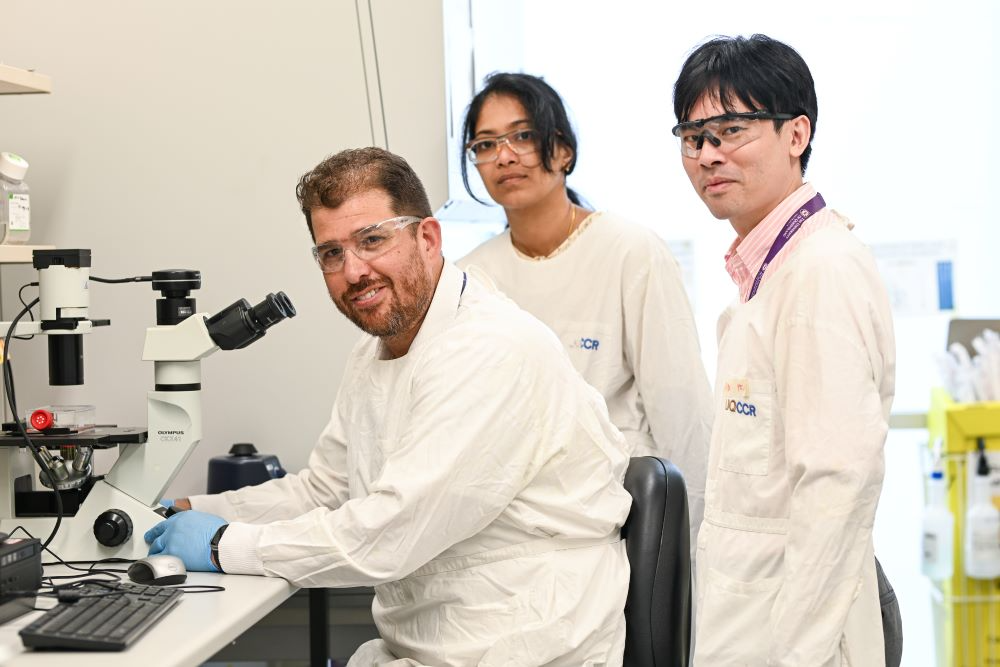
Lead researcher: Professor Carlos Salomon Gallo
OCRF research priorities: early detection
Grant received: $940,000 over three years
Research institution: Centre for Clinical Research, The University of Queensland
Associated institutions: Mater Research Institute, Western Sydney University, Melbourne Royal Women’s Hospital, Mercy Hospital, The University of Western Australia Medical School, University College London, National University of Singapore, The Australian National University.
Image provided by Professor Carlos Salomon Gallo
Project details
Professor Salomon Gallo’s team has developed the OCRF-7 ovarian cancer test, named in recognition of the OCRF’s previous funding. The test, which involves a combination of biomarkers, has outperformed the CA-125 biomarker, which is currently clinically used to signal the potential presence of ovarian cancer. This project allows the team to validate the OCRF-7’s diagnostic accuracy in larger and more complex sample groups. A previous OCRF-7 study suggested that the OCRF-7 has over 90% accuracy in identifying stage I and II ovarian cancer in a 465-sample case-control cohort, while CA-125 identified ovarian cancer in approximately 60% in the same patients.
Professor Salomon-Gallo
In a multidisciplinary and multi-institute effort across Australia and overseas, we have access to a large number of samples from patients with different types of cancers and other pro-inflammatory conditions. This will enable us to establish the disease specificity of OCRF-7 and determine its accuracy in distinguishing ovarian cancer from other types of cancers.
Aims:
This project will test OCRF-7’s ability to:
- Accurately differentiate ovarian cancer from other types of cancer, including breast and endometrial,
- Accurately distinguish between ovarian cancer and non-cancerous conditions such as endometriosis,
- Expand testing for the best way to conduct the OCRF-7 in a standard clinical pathology lab, ensuring it is accessible and economic, and
- Collate preliminary data that will contribute to an application for regulatory approval by defining how and for what purpose the test is intended to be used.
Approach:
Professor Salomon Gallo’s approach focuses on extracellular vesicles. He believes they can show indications of cancer presence at the earliest stages. They can be extracted and tested through blood samples rather than tumour samples, which are often collected through invasive surgery. Therefore, they could potentially identify ovarian cancer earlier than is currently possible, and (where ovarian cancer is not present) negate the need for invasive diagnostic surgery.
The OCRF-7 is currently being tested in over 3000 patient samples with ovarian cancer as part of a Medical Research Future Fund (MRFF) project in partnership with the OCRF. However, in this phase of the project, the test will be tested in over 1000 patient samples of other cancerous conditions and non-cancerous conditions collected from hospitals across Australia. By trialling the test on other cancerous conditions, it helps determine whether the test can specifically identify ovarian cancer or whether it returns false positives when faced with other conditions.
The results of tests conducted in this project will be compared to the tests conducted during the MRFF study to confirm whether the test maintains a high accuracy.
The project will be focused on high-grade serous ovarian cancer, the most common and lethal subtype, and may be expanded to detect rarer subtypes in future.
Ambition and outcomes:
A test that can accurately identify ovarian cancer at the earliest stages, has the potential to boost survivability above 90%. Yet currently less than half of those diagnosed survive beyond five years. The team will determine if the OCRF-7 can detect accurately enough for it to progress towards a test for those with a high-risk of ovarian cancer, with the long-term goal of developing a population screening test.
Without OCRF funding the team would not be able to determine how specific the OCRF-7 test is nor collate the data required to define it’s intended use – an important step towards progressing the test towards trials.
This article has been reviewed and approved by Professor Carlos Salomon Gallo.
Professor Salomon Gallo discusses
Why ovarian cancer research?
Video provided by Professor Salomon Gallo
Key Terms
Biomarker: Characteristics within the body that can be measured to provide information about biological processes, such as the presence of disease.
Extracellular Vesicles: Tiny structures containing biomarkers that communicate between cancer cells and normal cells.
Exosomes: a type of extracellular vesicle which represent a ‘fingerprint’ of their cell of origin, which can signal if that cell is cancerous.
Diagnostic: Identification of an illness.
Early Detection: Detecting symptomatic patients as early as possible to give best chance of survival after treatment.
Screening: Identification of unrecognised disease in an apparently healthy, or asymptomatic person.
Read more
OCRF News: A rapid blood test for the early detection of ovarian cancer
Cells Journal Article: Ovarian-Cancer-Associated Extracellular Vesicles: Microenvironmental Regulation and Potential Clinical Applications
The University of Queensland: Test Shows 90% early ovarian cancer detection
Medical Journal Australia: Ovarian Cancer: Silent, deadly, no diagnostic test - yet

Get the latest news, stories & updates.
