Ovarian cancer early detection, monitoring and therapeutic intervention using extracellular vesicles
Overview
By focusing on tiny extracellular vesicles, Professor Carlos Salomon Gallo hopes to uncover ways they can be used in the early detection and treatment of ovarian cancer.
Lead researcher: Professor Carlos Salomon Gallo
Grant received: $60,000 of OCRF funding for four years in addition to $1 million from the government’s Medical Research Future Fund
OCRF research pillar: Early Detection, Treatment
Primary institution: The University of Queensland
Latest update
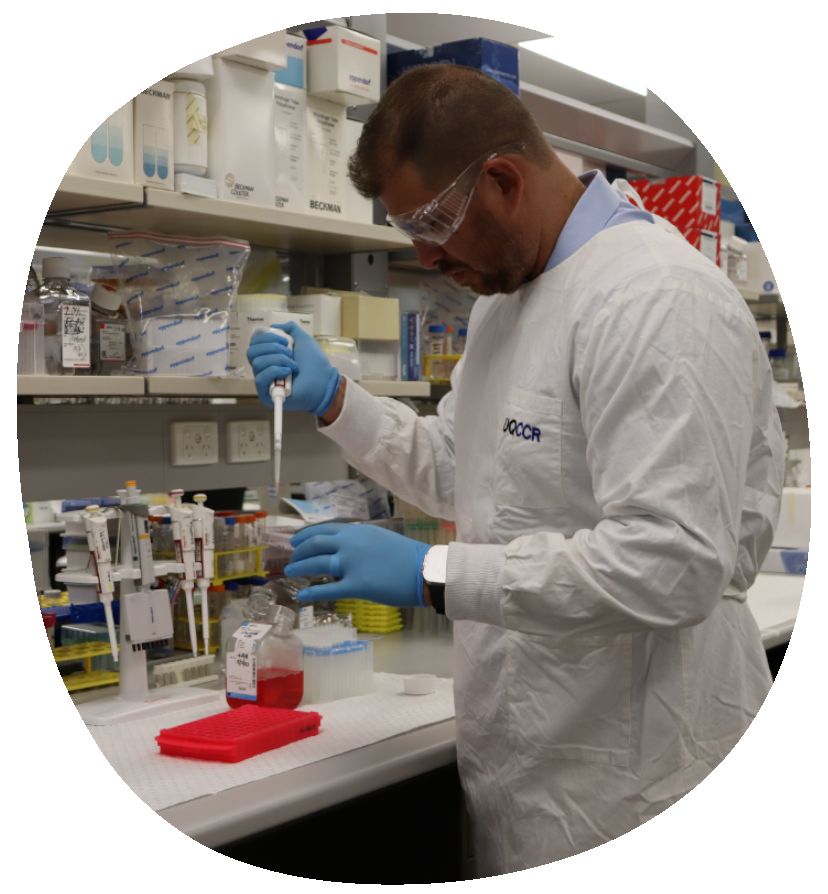
We’ve made excellent progress in advancing a solution for earlier and more accurate diagnosis of epithelial ovarian cancer. Additionally, we've developed methods to monitor treatment response, offering substantial advantages over current approaches. Over the 4 years of the project, we have successfully optimized a platform for quantifying specific proteins and miRNAs encapsulated within exosomes. The concentrations of these biomarkers can effectively identify ovarian cancer patients. We also identified a set of biomarkers linked to chemotherapy resistance in ovarian cancer and assessed their role in tumour formation. Our next steps involve conducting experiments to evaluate the functions of EV-associated proteins and miRNAs in vivo. Additionally, we developed a nanoparticle delivery system designed to deliver chemotherapy in a way that only targets cancer cells. This comprehensive approach encompasses early diagnosis, treatment monitoring, and targeted therapy delivery, all contributing to improved patient outcomes.”
Professor Carlos Salomon Gallo, June 2024
Project details
A leading international expert in the study of extracellular vesicles (EVs), Professor Carlos Salomon Gallo is investigating whether they can be harnessed for both ovarian cancer early detection and treatment solutions.
EVs are released from cells during natural biological processes and they play an important role in cell-to-cell communication by travelling around the body carrying information, in the form of proteins and miRNAs, between sites. Exosomes are a type of EV.
The team have shown that exosomes can act as ‘fingerprints’ of the cell they originate from, suggesting that they could be useful in early detection. This is because EVs released by tumour cells carry biomarkers that can indicate the presence of ovarian cancer, potentially during early-stage disease.
In a previous OCRF-funded project, the team developed a multi-biomarker model that measures proteins and miRNAs in circulating exosomes. This model could identify different stages of ovarian cancer, including stage one, and distinguish cancerous from non-cancerous control samples with over 90% accuracy.
In the treatment space, these tiny EVs could potentially be used to target and attach to ovarian cancer cells. They have been shown to target pancreatic cancer cells, indicating they could act as vehicles for precision treatment.
Aims:
Progressing their previously OCRF-funded research, the team will:
- Test a platform they are developing which enables quick and convenient analysis of EVs from blood samples. They want to ensure the platform is compatible with processes used in a standard pathology laboratory as, ultimately, any successful early detection test for ovarian cancer would need to be undertaken in a normal laboratory to ensure accessibility.
- Use EVs to identify factors that contribute to chemoresistance, which may help in predicting those likely to relapse or inform treatment strategies
- Determine how effective extracellular vesicles are at selectively targeting ovarian cancer cells, so that the team can determine if they could be engineered to deliver treatments directly to ovarian cancer cells.
Approach:
- Currently, isolating EVs from samples and analysing them can be a time-consuming process. In this project the team will create and validate, in 300 samples (from both patients with and without ovarian cancer), a rapid, on-chip platform to ensure it can accurately identify ovarian cancer early detection biomarkers in EVs and do so with a process that could be carried out in a normal pathology lab. They will also ensure that the platform is capable of simultaneously evaluating the multiple biomarkers in their model.
- The team previously identified that the levels of a specific set of proteins and miRNAs, within EVs, change with ovarian cancer progression and recurrence. The team identified a set of molecules, specifically encapsulated in extracellular vesicles from cancer cells, that contribute to ovarian cancer tumour formation and progression of the disease. This observation prompted the team to consider that molecular EV patterns could be used to identify cancer recurrence and help predict how well a patient will respond to treatment.
- To determine how well EVs can target ovarian cancer cells, the team will engineer a set of EVs, installing a ‘targeting unit.' This targeting unit consists of a protein called Lamp2b which is attached to a membrane layer on the outside of the EV. A connective protein, called ephrin-b2, is then also attached to act as an ‘anchor.' Ephrin-b2 targets the ephrin-b4 receptors that naturally sit on the exterior of ovarian cancer cells — essentially, these engineered EVs are primed to home in on ovarian cancer cells. The team will test how well their engineered EVs attach to ovarian cancer cells while leaving normal healthy cells alone. They will do this in pre-clinical models using fluorescent proteins, which allow them to observe how well the engineered EVs bind to and are taken up by ovarian cancer cells compared to control ‘un-engineered’ EVs.
Ambition and outcomes:
The ovarian cancer five year survival rate is currently 49% and there has been little improvement over the past two decades. This indicates a crucial need for progress across both early detection (as there is currently no early detection test) and treatment.
This research has the potential to uncover a non-invasive method of early detection. While the use of extracellular vesicles for early detection shows significant potential to increase early diagnoses and therefore improve survival rates, this research will determine whether EVs could also provide a more precise and less toxic delivery method for treatment — which could also improve patient outcomes. This is because treatment using EVs may not only provide a treatment with less side effects that normal chemotherapy, because the targeting unit focuses on only ovarian cancer cells, but the team also hypothesise that better targeting will ensure more ovarian cancer cells are treated in the first place — reducing the rate of recurrence.
Current status:
This project is being collaboratively funded by the government’s Medical Research Future Fund and the OCRF. It is at the preclinical stage where researchers are conducting extensive studies in the lab with samples and models to verify the effectiveness of their approach as well as evaluating how safe it is likely to be for humans *
*Want to learn more about the medical research pipeline? Read more here.

For every project like this, many more can’t get underway due to a lack of funding. Support research like this to help them move forward.
Share page

Get the latest news, stories & updates.
