Investigating ROR1, a novel receptor molecule, as a basis for a targeted treatment for high-grade serous ovarian cancer
Overview
Professor Caroline Ford’s team are investigating whether ROR1 molecules could make an effective target for new treatments, and if so, what kind of treatment could best target it to prohibit ovarian cancer growth and spread.
Lead researcher: Professor Caroline Ford
Grant received: $717,156 for five years (2013-2018)
OCRF research pillar: Treatment
Primary institution: The University of New South Wales

Latest update
This project wouldn’t have happened without OCRF funding because it provided salaries for the team to investigate the potential of ROR1 as a target for high-grade serous ovarian cancer treatments. Now, we continue to advocate, working with industry and in future hope to see a clinical trial for an antibody drug conjugate treatment that could really help high-grade serous ovarian cancer patients by targeting ROR1.”
Professor Caroline Ford, May 2025
Project details
Professor Caroline Ford’s team are investigating whether a specific receptor molecule could serve as the basis for a targeted ovarian cancer treatment. Receptor tyrosine kinase-like orphan receptors (ROR receptors) play an important role in early childhood development but are typically switched off naturally in adulthood. However, ROR1 is turned back on in several cancer types, and Professor Ford’s team are investigating whether this is also the case for high-grade serous ovarian cancer.
During her post-doctoral research, Professor Ford investigated the ligand that cancer cells use to connect and activate a pathway that is key for ovarian cancer development: the Wnt signalling pathway. She came to understand more about both ROR1 and ROR2 receptor molecules. ROR receptors sit on the surface of ovarian cells and help regulate the Wnt signalling pathway that aids ovarian cancer development. At the time, no one knew how they were activated or how they assisted ovarian cancer cells in multiplying, but there were indications in the research field that ROR1 and ROR2 could be good targets for other cancers — so Professor Ford thought, why not ovarian cancer?
In previous OCRF-funded studies the team confirmed that both ROR1 and ROR2 presence is increased in ovarian cancer. This project will allow the team to further understand how these ROR receptors control genes that assist ovarian cancer. The team will investigate whether targeting ROR1 and ROR2 receptors could lay the foundations for a promising new treatment approach.
Aims:
With OCRF funding, the team seek to uncover how ROR1 and ROR2 receptors contribute to ovarian cancer progression — and importantly, how they could be blocked — by:
- Conducting analysis, with techniques including immunohistochemistry, to determine which ovarian cancer patients have the highest presence of ROR1 or ROR2 and therefore which ovarian cancer patients might benefit from ROR-targeting treatments.
- Confirming that silencing ROR1 or ROR2 is effective at stopping ovarian cells from adhering to other cells and multiplying and therefore determine if targeting these receptors is likely to prevent metastasis.
- Confirming which methods of switching off ROR1 and ROR2 are most effective in ovarian cancer samples.
- Identifying the genes that differ between healthy control samples and ovarian cancer samples to identify if other potential genes are impacted when ROR1 and ROR2 are stopped.
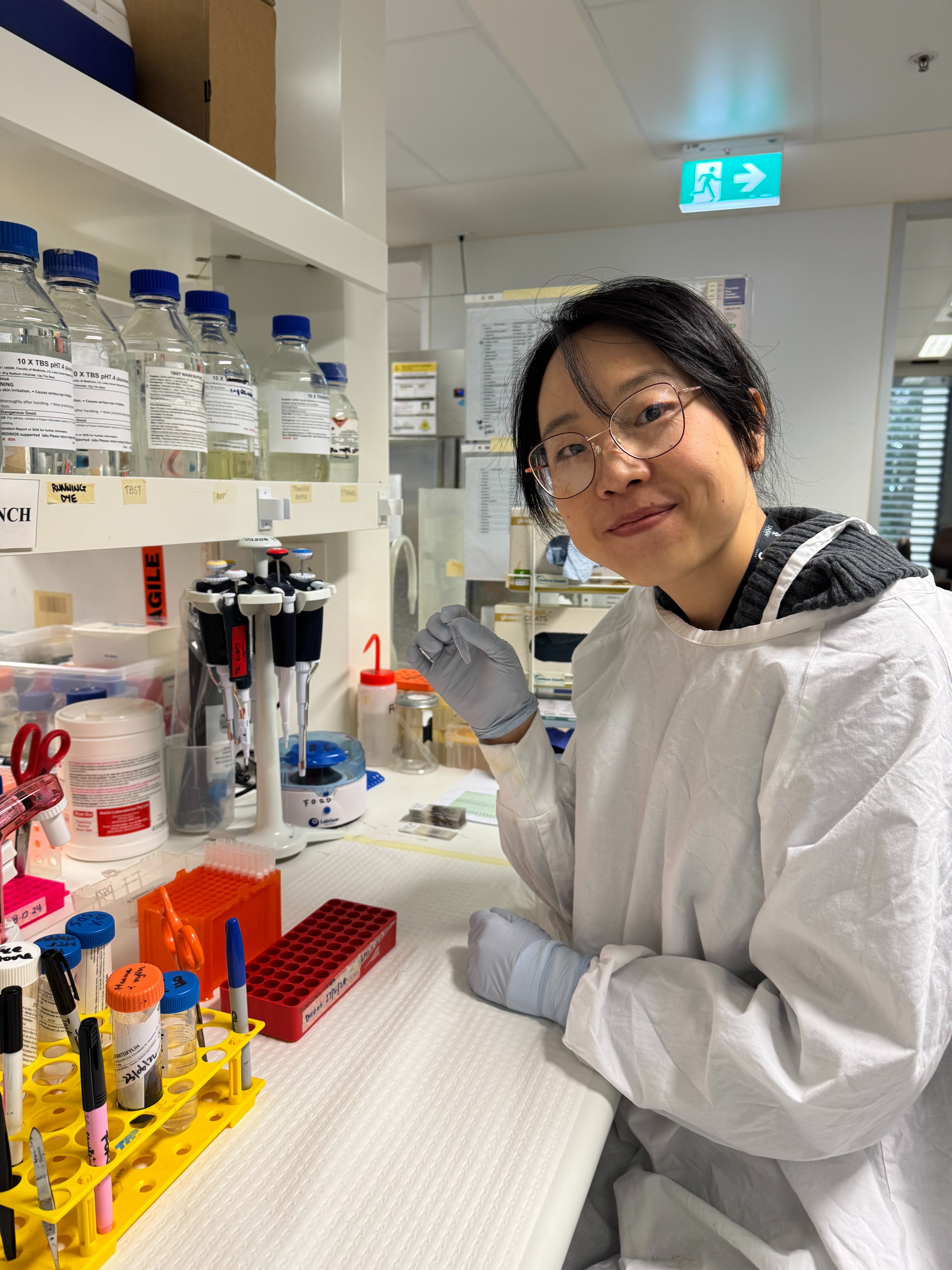
(Pictured above: Dr Dongli Liu is an integral member of Professor Ford's team)
Approach:
One of Professor Ford’s team members, Dr Claire Henry, worked with researchers at the University of Chicago to hone a new type of lab model. They collected tissue lining that connects the stomach to other organs which is where ovarian cancer commonly metastasises to. This involved collecting samples from people having non ovarian cancer-related surgery and extracting some of the cells from the site to grow them in a 3D gel, before then adding ovarian cancer cells to it.
This type of model helped the team better understand tumour spread and how the environment around the tumour (tumour microenvironment) contributes to metastasis, enabling them to examine how ROR1 and ROR2 were working in this environment.
The team also conducted investigations with chemists to test whether nanoparticles could be effective at targeting the ROR receptors. They then worked with a number of pharmaceutical companies to test antibodies and an antibody drug conjugate (ADC) — a type of treatment that guides a drug directly to cancer cells using a monoclonal antibody, therefore sparing healthy cells and reducing side effects.
Ambition and outcomes:
This project, now completed, resulted in crucial data that is still used by pharmaceutical companies to understand who would benefit from a therapy that targets ROR1 and ROR2.
Overall, the team established that ROR1 was likely to be a more beneficial target than ROR2. The team were able to demonstrate that in addition to other cancers, high-grade serous ovarian cancer patients would likely benefit from a treatment that targets ROR1. Therefore, this project has been instrumental in setting the groundwork for preclinical testing for ROR1 targeting therapies for ovarian cancer.
By establishing that ROR1 is a promising target for ovarian cancer patients, and that stopping its impact also contributes to stopping ovarian cancer cells multiplying, they have provided important evidence to advocate that some ovarian cancer patients should be included in future trials for treatments targeting ROR1.
In 2025 the team published findings that an antibody drug conjugate could be used as a type of treatment that selectively targets the ROR1 on cancer cells and hits them with treatments like chemotherapy.
Although the treatment used in this published study is no longer available to progress to an ovarian cancer clinical trial, the team continue to advocate and seek industry backing to develop a new ROR1-targeted treatment.
Current status:
This ovarian cancer research project is at the preclinical stage where researchers are conducting extensive studies in the lab with samples and models to verify the effectiveness of their approach as well as evaluating how safe it is likely to be for humans *
*Want to learn more about the medical research pipeline? Read more here.

For every project like this, many more can’t get underway due to a lack of funding. Support research like this to help them move forward.
Share page

Get the latest news, stories & updates.
