OCRF-7: Validating an exosome-based biomarker panel for ovarian cancer early detection
Overview
This project seeks to confirm whether tiny exosomes found in the bloodstream could be used as the foundation for an ovarian cancer early detection test.
Lead researcher: Professor Carlos Salomon Gallo
Grant received: $570,383 over three years
OCRF research pillar: Early Detection
Primary institution: The University of Queensland
Latest update
Over the last two years, we have been able to obtain data about the accuracy of our OCRF-7 testing in plasma and serum samples from the same patient. This will allow us to evaluate the test performance in samples from the large UKCTOCS ovarian cancer screening trial. At 98% specificity, the OCRF-7 test demonstrated an overall sensitivity for all stages of HGSC (high-grade serous ovarian cancer) at 91.9%, with a sensitivity of 85.4% for early-stage HGSC, which is significant better than CA-125 that identified around 60% of stage I cases and 70.2% of stage II cases among all HGSC.”
Professor Carlos Salomon Gallo, June 2024
Project details
Professor Carlos Salomon Gallo’s project will validate a panel of biomarkers to determine if it can provide an accurate ovarian cancer early detection test.
With OCRF funding, Professor Salomon Gallo’s team previously discovered biomarkers associated with exosomes: tiny bubble-like structures that are secreted or spat-out by cancerous cells into the bloodstream.
Currently, tumours are often found in the tricky-to-reach abdomen area, and invasive surgery is currently the only way to definitively diagnose ovarian cancer. Exosomes can be accessed via a blood test so the research team considered they could provide a non-invasive early detection approach to ovarian cancer.
They also discovered that exosomes travel around the bloodstream allowing cells to communicate with each other, offering insights into how ovarian cancer spreads.
Aims:
In this project, the team seek to answer two key questions:
- How accurately, when compared to healthy samples, can their exosome-based approach detect ovarian cancer?
- How early can it detect ovarian cancer? This is because to increase survivability, ovarian cancer must be detected and treated at the earliest stages, when most patients are asymptomatic.
Approach:
Previously the team analysed ovarian cancer samples, from stage one (early) through to stage four (late) and compared them to samples from patients with non-cancerous disease.
In the cancerous samples, they found a pattern of specific markers (proteins and miRNAs) within exosomes.
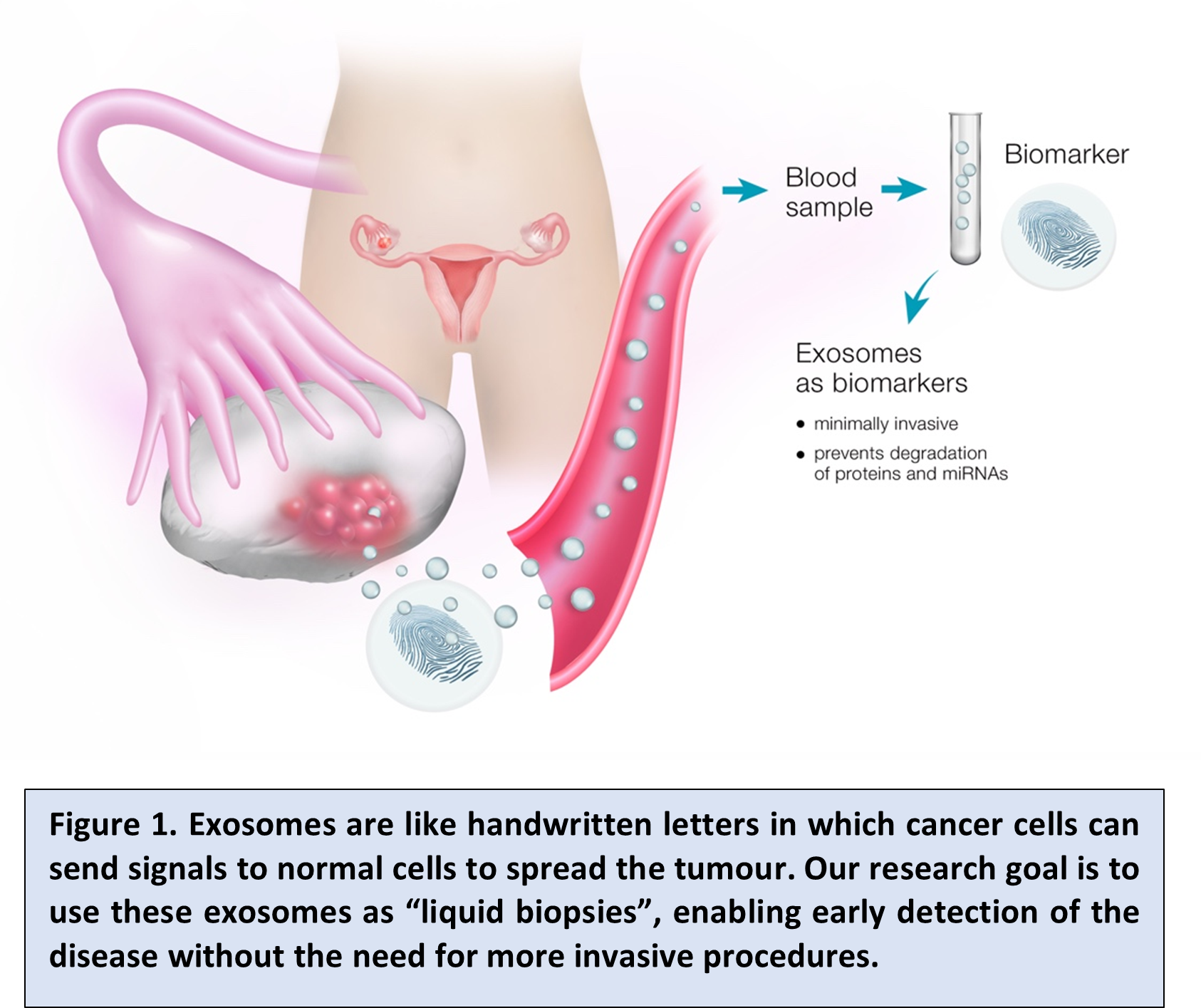
(Infographic provided by Professor Salomon Gallo and his team)
Because exosomes remain stable as they travel around bodily fluids, the team realised that these exosomes act as ‘fingerprints’ of the tumour they originally came from.
Professor Salomon Gallo’s team analysed several thousand potential protein and miRNA biomarkers in exosomes, to identify the biomarkers that contribute the most to the identification of women with early stages of ovarian cancer. When the quantities of these biomarkers were measured, they could indicate the presence of all stages of HGSC (high-grade serous ovarian cancer), and — depending on the levels — indicate early stages of the disease.
Due to the OCRF’s early support of Professor Salomon Gallo’s work, the exosome-based biomarker algorithm is called ‘OCRF-7.'
This OCRF-7 study involves a total of 956 patients across discovery, training and validation aspects of the research. This includes validation of 465 patient samples to validate not only how accurately the test can detect ovarian cancer compared to healthy samples, but how early it can detect it — therefore indicating whether it is suitable to develop into an early detection test.
The team will work with manufacturers specialising in diagnostics to develop a tool that uses magnetic beads to isolate the exosomes, which is usually a complex feat, so that the proteins and miRNAs within them can be examined in any lab. This is important as ensuring that the test can be replicated in a regular pathology lab will make it, if validated and approved, accessible to more people.
Ambition and outcomes:
The fact that ovarian cancer is often diagnosed in the late stages contributes to the low five-year survival rate of only 47.1%. An accurate early detection test could improve this rate to above 90%. This project allows the team to demonstrate that OCRF-7 is a promising foundation for an urgently needed early detection test. Ultimately the team hope that OCRF-7 can be used as a population screening test, in the same way that cervical screening is widely available and routinely used.
Current status:
The team will first seek approval for the OCRF-7 to be used as a diagnostic test to confirm whether ovarian cancer is present, focusing on early stages of the disease, before pursuing it as an early detection or population screening test depending of the sensitivity and specificity results of the current, on-going studies*
*Want to learn more about the medical research pipeline? Read more here.

For every project like this, many more can’t get underway due to a lack of funding. Support research like this to help them move forward.
Share page

Get the latest news, stories & updates.
