Professor Brian Gabrielli
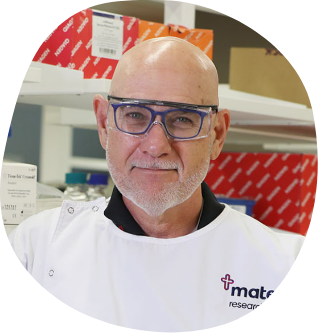
Research Institution: Mater Research Institute, The University of Queensland
OCRF priorities the researcher addresses: Treatment, Managing Recurrence
Their OCRF-funded research projects: A new treatment that increases immune response to ovarian cancer
Having the OCRF involved gives us the opportunity to connect with the people that we’re trying to help. It reminds us why we’re doing this. It’s not an academic pursuit, we want to make a difference. As scientists we’re judged everyday by our sector, and these are hard problems to solve. It is incredible to speak to supporters who appreciate what we’re trying to do. It keeps me going.”
About Professor Gabrielli’s research
Renowned for his expertise in cell cycle responses (what happens in a cell when it is dividing) and melanoma research, Professor Brian Gabrielli is head of the Smiling for Smiddy Cell Cycle Research Group at Mater Research. He investigates multiple cancers, advancing knowledge of melanoma, lung, and cervical cancers. Now, he brings this expertise to ovarian cancer research.
Background
During school, Professor Gabrielli was intrigued by the logic of science and problem-solving, which still drives the curiosity he brings to the lab every day.
After studying at James Cook and La Trobe University, his postdoctoral research took him to the USA where he investigated cell cycle regulation: a process that ensures cells divide at the right time and place, preventing uncontrolled growth and cancer. He returned to Australia as a researcher at QIMR Berghofer Medical Research Institute, before joining the University of Queensland’s Frazer Institute. He then established his lab at Mater Research in 2016.
Professor Gabrielli is passionate about contributing to the research sector through education and mentorship, ensuring the next generation of researchers are equipped to continue and advance the progress that came before them. He was a founder of the SPARQed student program that gives high school students the opportunity to experience life as a researcher, both its highlights and challenges. He was also Chair of the Mater Student Research Committee.
Career highlights
Among his many achievements, Professor Gabrielli’s career highlights include:
Contributing three decades of knowledge to the cancer sector on cell cycle regulation, and how specific points in the cell cycle can be targeted for more effective cancer treatments.
Defining the role of ultraviolet radiation in inducing skin cancers, particularly melanoma.
Mentorship: Considering the extensive time, knowledge and resources it takes to get research from the lab to the clinic, Professor Gabrielli believes mentoring the next generation of researchers is essential to future proofing the sector and ensuring long-term research and medical advancement.
Collaborative impact
As a cancer treatment researcher, Professor Gabrielli acknowledges that Mater Hospital clinicians have acted as a powerful bridge between the lab and the clinic. Clinicians often cannot invest time in research due to their commitment to patient care. However, gynae-oncologists from Mater highlighted the urgent need for new ovarian cancer treatment options and continue to support his OCRF-funded research.
For every project like this, many more can’t get underway due to a lack of funding. Support research like this to help them move forward.
Share page

Get the latest news, stories & updates.
