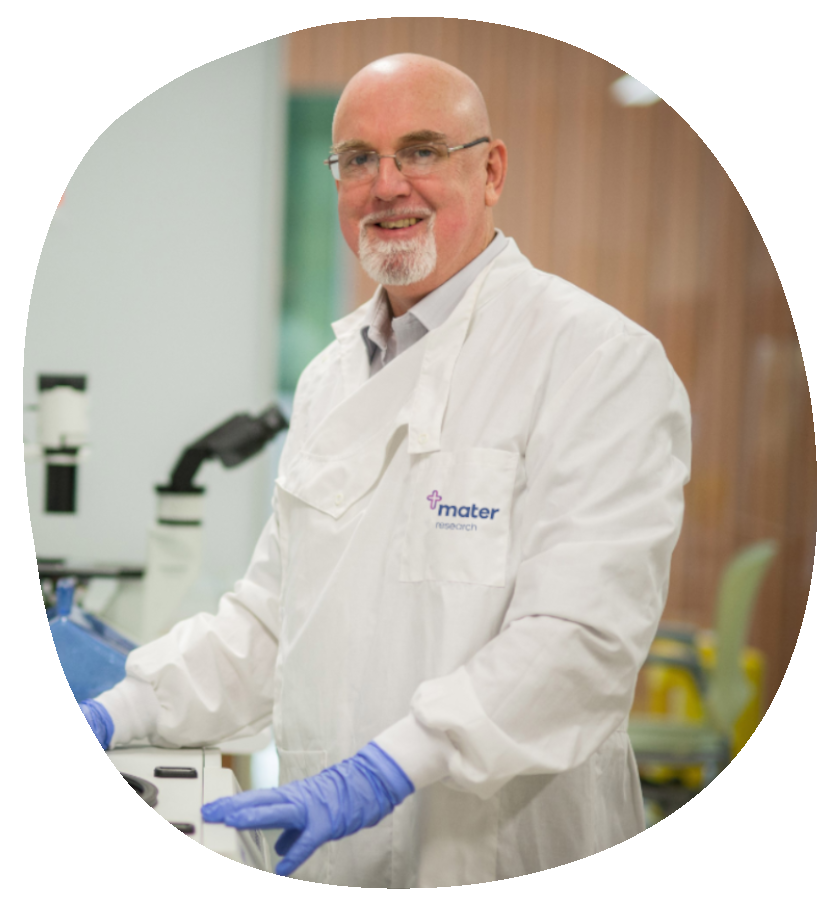
Professor John Hooper
Research Institution: Hudson Institute of Medical Research
OCRF priorities the researcher addresses: Early Detection, Treatment
Their OCRF-funded research projects: A new radio-imaging, diagnostic agent to guide targeted therapy for epithelial ovarian cancer
Without the OCRF, ovarian cancer research in Australia would struggle. Not-for-profit funding has kept ovarian cancer researchers and their discovery research going, which is crucial for breakthroughs — we’re grateful that community funding has provided the bridge to help move our lab discoveries into a clinical trial.”
About Professor Hooper’s research
Professor John Hooper leads the Cancer Biology Research Group at Mater Research where his team study cancers including prostate, colon, pancreatic and ovarian. Decades of researching antibodies in ovarian cancer has led to innovative detection and treatment research, supported by the OCRF and the government’s Medical Research Future Fund.
Background
Professor Hooper was always interested in science at school, thanks to a wonderful teacher. However, his path to research has been unconventional. After ten years as a chartered accountant, and relocating to Europe, he returned wondering, “what’s next?”
This is when he turned his attention to research, and pursued a second career that he is still, after over two decades, immensely passionate about.
Professor Hooper completed his PhD at The University of Queensland on a project analysing and cataloguing specific enzymes called proteases. He aimed to understand their role in cancer progression. His science degree had been mainly chemistry focused, so this was the first step of Professor Hooper’s training in molecular biology.
His post-doctoral research in the early 2000s at Scripps Research Institute in San Diego was an extension of this work questioning: “What is it on the surface of cells that promotes cancer progression, and can whatever it is be used to detect and treat cancer?”
Career highlights
Professor Hooper is excited about the progress of a phase 1 clinical trial, resulting from OCRF and MRFF-funded research, for a new imaging agent that could help detect and treat epithelial ovarian cancers more accurately, including high-grade serous ovarian cancer.
For Professor Hooper, a career-defining moment occurred when he joined Mater Research in 2010 — he met clinical teams from Mater Hospital who work on the frontline with patients every day. These clinicians were crystal clear about the fact that research needed to positively impact patients. It highlighted the practical importance of his work and the need to progress it to clinical trials; it wasn’t only about discovering new information, it was about ensuring it made a difference in practice for patients.
Collaborative impact
Professor Hooper remembers attending his first multidisciplinary gynaecological oncology meeting at Mater Research. In these meetings, clinicians with diverse expertise typically discuss specific patients and collectively consider what treatments patients should receive. Initially, he didn’t know anyone in the room but clinician and researcher, Professor Lewis Perrin, welcomed him. From the back of the room, Professor Hooper would listen intently, identifying all the issues arising for clinicians and their patients — gathering better understanding what advances would most help them saves lives or what types of technologies and processes were most practical for use in the clinic. It gave him a new way to scrutinise what would make his research most impactful.
These connections also led to an important network that has since facilitated easier access to samples and collaboration for Professor Hooper’s research.
A natural interest in wanting to work with others, including other researchers, has led Professor Hooper to become a central networking facilitator. He regularly connects researchers with clinicians in Queensland to ensure as many researchers as possible can ask the questions of clinicians that may lead to the most relevant new advances.
His advice for early-career researchers? “Do all you can to engage with clinicians.”
For every project like this, many more can’t get underway due to a lack of funding. Support research like this to help them move forward.
Share page

Get the latest news, stories & updates.
