Targeting drug resistance to improve outcomes in ovarian cancer
Overview
Associate Professor Caldon’s team will aim to uncover why a type of treatment called PARP inhibitors stops working for some patients with high-grade serous ovarian cancer, and investigate a new treatment approach.
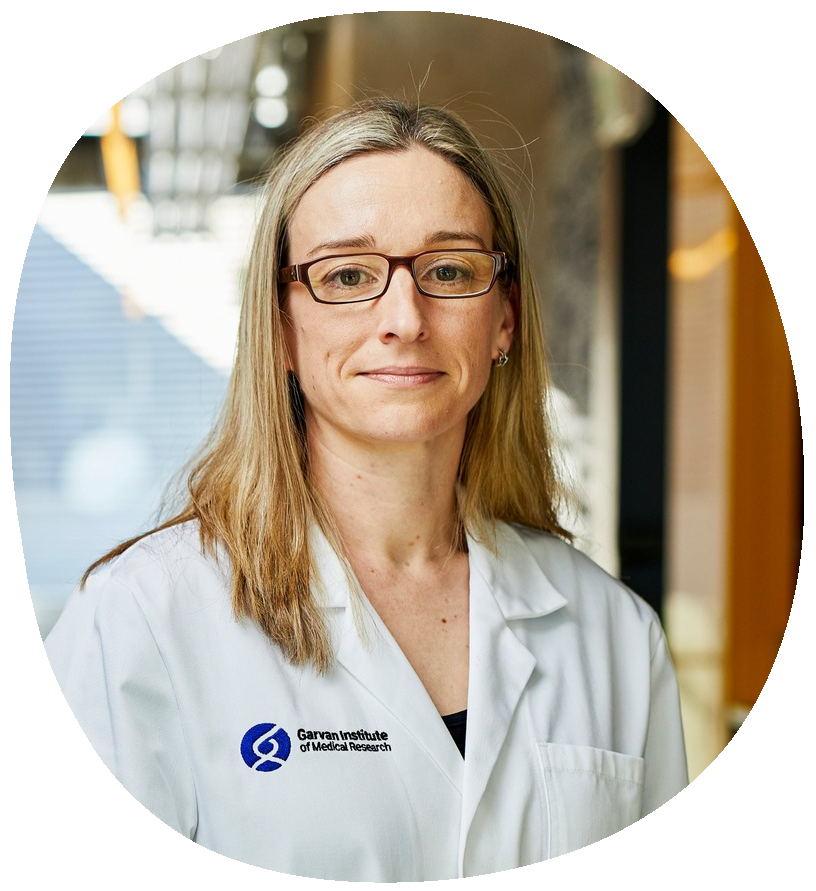
Lead researcher: Associate Professor Liz Caldon
Grant received: $517,000 for three years
OCRF research pillar: Treatment
Primary institution: Garvan Institute of Medical Research
Latest update
The OCRF grant means we can commit to this work in ovarian cancer for three years, rather than only being able to think six months at a time. The funding is absolutely critical because I can keep Zoe, my post-doctoral researcher, employed for three years, providing continuity for the project.”
Associate Professor Liz Caldon, April 2026
Project details
Associate Professor Caldon’s team are investigating why a type of ovarian cancer treatment called Poly ADP-ribose polymerase (PARP) inhibitors stop working for some people, in order to develop a new and more effective approach for these patients.
PARP inhibitors are a type of targeted treatment that stops cancer cells with faulty DNA repair pathways from fixing themselves, and a benefit is that they also have limited side effects because they are targeted and therefore spare healthy cells. They are often found to be initially effective for patients who have BRCA1 or BRCA2 genetic variants.
When treatment works initially but then stops working, it’s said that the cancer has developed ‘resistance’ to that treatment — the cancer has outsmarted the therapy. In this case, after the PARPi treatment has worked initially, a process called ‘reversion’ occurs in some patients where the BRCA1 or BRCA2 genetic variants fix themselves or return to their original state. This stops the treatment working because the mutated site the PARP inhibitors took advantage of has been repaired, rendering the therapy ineffective.
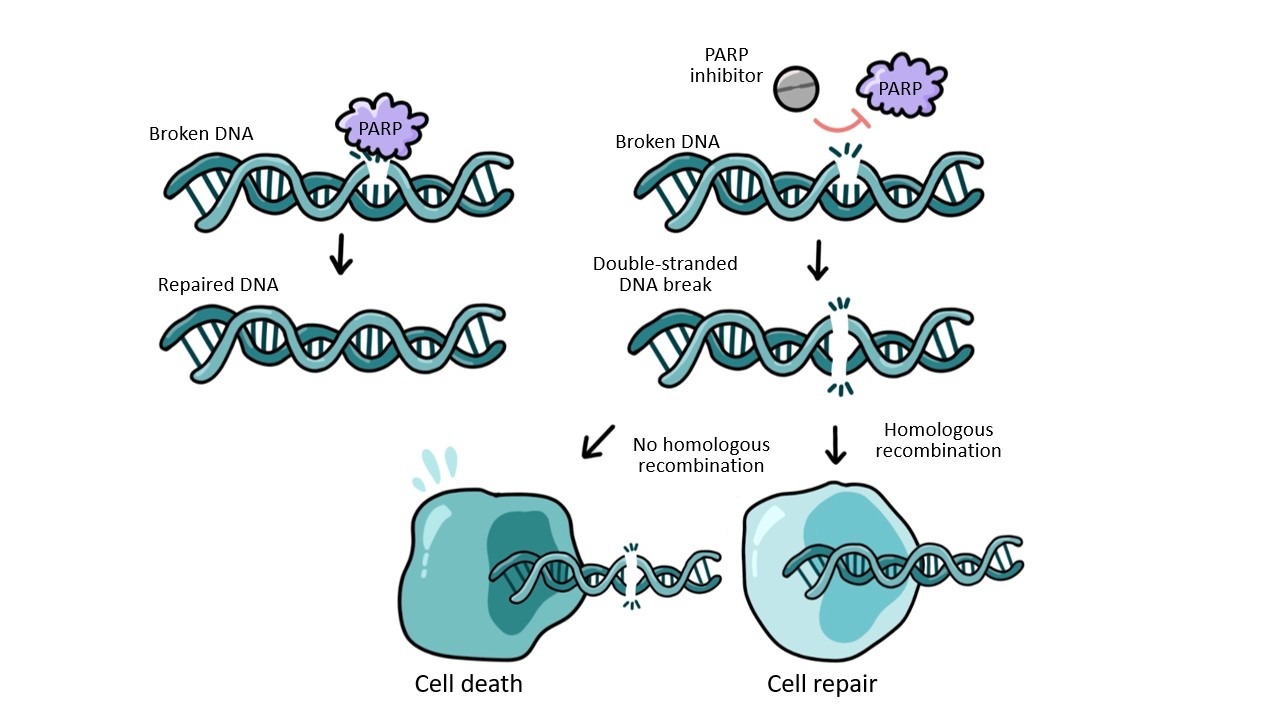
(Pictured above: A diagram illustrating the effects of PARP inhibitors)
Associate Professor Caldon’s team work closely with a panel of people with lived experience of ovarian cancer who highlighted the need for PARP inhibitors to work effectively for more patients with ovarian cancer, and to find a way for them to work long-term—this guidance was key to shaping Associate Professor Caldon’s project.
While the reversion process is one of the ways high-grade serous ovarian cancer becomes resistant to PARP inhibitors, there are other ways it can become resistant.
The team previously undertook a discovery project where they used engineered models that could not undergo the reversion process, because BRCA genes had mostly been removed from the cells. This meant they would then be able to see if there was anything else that that was causing ovarian cancer resistance.
This is how they found out that the metabolic process showed changes during ovarian cancer resistance, including an enzyme called LDHB that was at high levels in the drug resistant ovarian cancer models.
Now, the team will investigate what other factors associated with metabolism might also be associated with ovarian cancer treatment resistance.
Aims:
With their OCRF grant the team will:
- Conduct CRISPR screens, which help the team examine thousands of genes in a systematic and targeted way, focusing on metabolism genes that may be causing ovarian cancer's resistance to treatment.
- Test the genes, identified through CRISPR screens, in ovarian cancer cells lines to confirm they are driving resistance through a metabolic change or process, and whether stopping the function of those genes makes the cancer sensitive to treatment again.
- Take the genes they find are most responsible for treatment resistance and test them in more sophisticated lab models that closely replicate some of the complexities of cancer in the human body, to reveal how these genes stop treatment working and enable tumour growth. They will also test what happens when they combine ways to stop these genes with PARP inhibitors.
- Check to see if the genes they identify can also help them understand which patients will responds well to PARP inhibitors and which won’t.
Approach:
Often it can be difficult to predict if a patient will become resistant to PARP inhibitors until that resistance has taken hold and the drugs no longer work. That’s why Associate Professor Caldon’s team hopes that in addition to finding a new way to approach treatment, they can also use the genes as ‘biomarkers’ or indicators of cancer resistance, enabling clinicians to know as quickly as possible if PARP inhibitor treatment is no longer working for the patient. This may also mean their discoveries could help with diagnosing ovarian cancer recurrence earlier, prompting faster treatment decisions for patients when cancer has returned, potentially improving survival.
Complementary to the OCRF grant, Associate Professor Caldon’s team member Dr Zoe Phan, who is undertaking her postdoctoral studies, was awarded funding to conduct scanning and testing of FDA-approved drugs, already approved for use in other diseases, that could target the genes they find in this project. New treatments can take a long time to develop and trial for safety, but drugs already approved for human use can sometimes be expedited. This repurposing of treatments already available could see a new approach to ovarian cancer treatment in the clinic sooner.
Ambition and outcomes:
By targeting different drivers of ovarian cancer resistance, the team hope this project will produce both better ways to treat high-grade serous ovarian cancer and faster ways to tell if someone has cancer returning and becoming resistant to their current treatment. With high-grade serous, the most common form of ovarian cancer, this project could provide important data that will hopefully enable the team to progress a new treatment to trials.
Current status:
This ovarian cancer research project is at the preclinical stage where researchers are conducting extensive studies in the lab with samples and models to verify the effectiveness of their approach as well as evaluating how safe it is likely to be for humans *
*Want to learn more about the medical research pipeline? Read more here.

For every project like this, many more can’t get underway due to a lack of funding. Support research like this to help them move forward.
Share page

Get the latest news, stories & updates.
