Investigating a new way to treat ovarian cancer by targeting the DNA damage response
Overview
By focusing on stopping a protein called SSB, the team hope to create a new, targeted treatment for high-grade serous ovarian cancer.
Lead researcher: Professor Derek Richard
Grant received: $200,000 for eighteen months
OCRF research pillar: Treatment
Primary institution: Queensland University of Technology
Latest update
In this project we hope to test and improve three promising drugs, to see which can best stop a protein called hSSB1 which we know to be integral to high-grade serous ovarian cancer survival because it helps the cancer repair its DNA. If we can design a treatment to stop hSSB1 functioning, it may also mean treatments like PARP inhibitors can work for longer and may help prevent recurrence.”
Professor Derek Richard, February 2026
Project details
While completing post-doctoral studies at St Andrew’s University in Scotland, Professor Derek Richard studied a particular type of archaea, micro-organisms that can survive in pools inside volcanoes. He wanted to understand how its DNA could live in these extreme climates, which led to the discovery of a protein called SSB that was essential for these archaea’s survival.
Then serendipity intervened. When the team were working out what else might be related to the SSB proteins in archaea using large-scale databases, they forgot to switch off associations to the human genome and unexpectedly found two copies of SSB in the human genome.
This SSB protein had barely changed in 1.5 billion years, and it was almost identical to SSB in humans. So, I wanted to follow this up in humans because I thought: if it’s not changed or needed to evolve in 1.5 billion years it’s clearly important.”
SSB is normally very low in human cells but is at high levels in cancer. The team then showed that ovarian cancer cells are somewhat ‘addicted’ to SSB, because when they remove SSB from the cancer cells, they fragment and die.
Ovarian cancer has many genetic instabilities that makes it hard to treat, because it often evolves to become resistant to treatments. Therefore, the team developed a tool called DKLO2, which mimics what the SSB protein attaches to on ovarian cancer cells, creating what they call a 'DNA trap,' because the SSB protein can’t remove itself again and function to help cancer. During these previous studies the team found that a key driver of cancer function within the SSB family is a protein called hSSB1.
Prior to OCRF funding, the team gained access to a pharmaceutical company library which contains drug chemicals that have already been shown to be safe in humans.
From this drug library, the team identified three molecules that have the ability to disrupt hSSB1 activity. They believe that if they’re able to block hSSB1, this will stop cancer cell DNA repair and lead to cancer cell death.
Aims:
Now, with OCRF funding the team will:
- Test the three drugs they’ve sourced from the library in various ovarian cancer cells lines, including high-grade serous, though they hope to expand testing to as many ovarian cancer subtypes as they can. This will determine which drugs can most effectively bind and stop the effects of hSSB1.
- Optimise the most promising chemical drug compounds from the screening to make them as effective as possible at targeting hSSB1.
- Test all three drug molecules together, and also in combination with chemotherapy and PARP inhibitors, to determine the best treatment option.
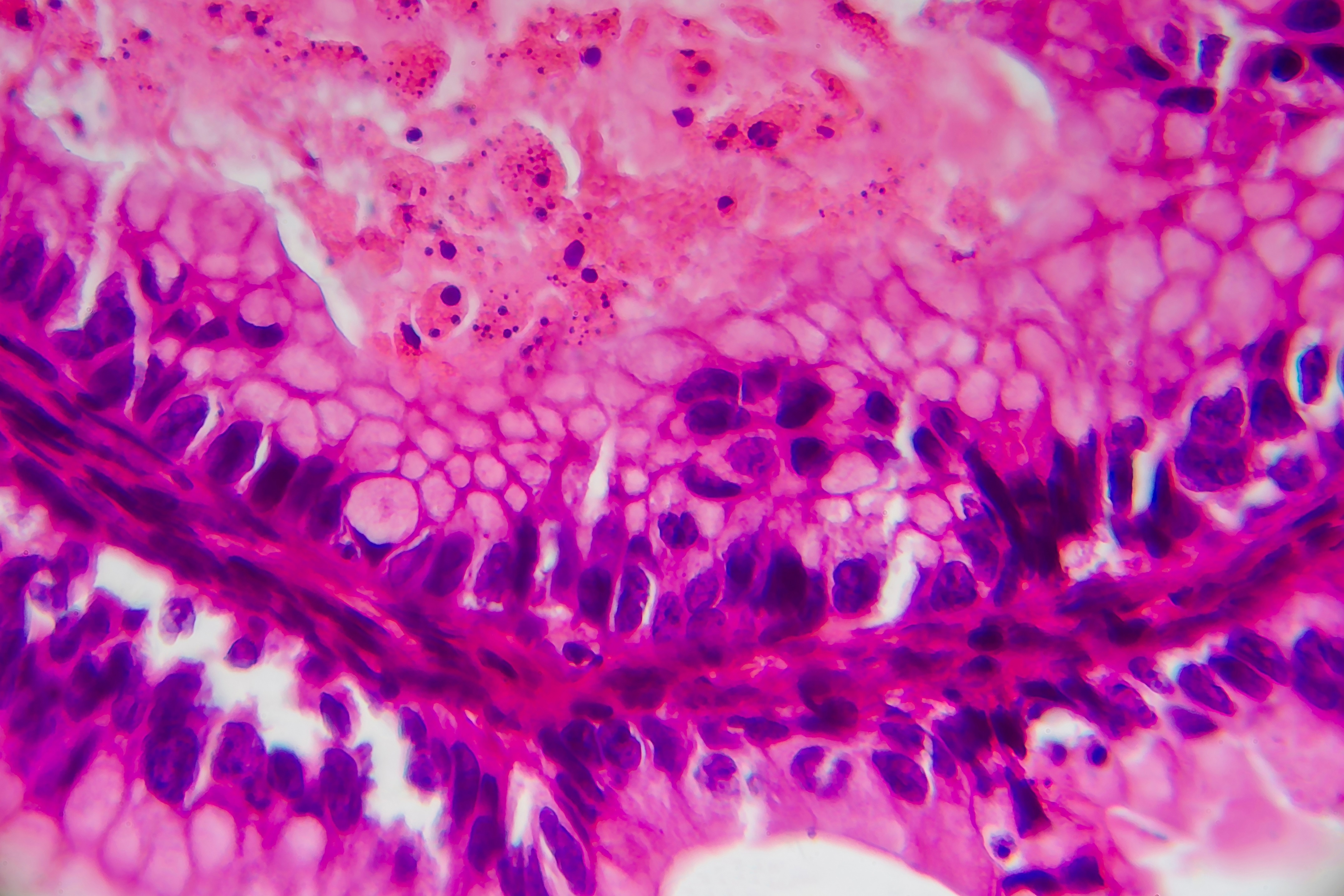
(Pictured above: High-grade serous ovarian cancer under a microscope)
Approach:
Improving drug compounds in the lab
To improve the drug compounds to target hSSB1 the team will take the drugs bound to SSB, then observe if there are other amino acids (protein building blocks) close by that they could target with a new improved molecule, essentially improving the way it binds to hSSB1. This will also make the treatment drug better able to target cancer cells and spare healthy cells, leading to less side effects.
How will the treatments work against hSSB1?
The team plan to design treatments that will stop the cancer cells’ ability to repair when their DNA gets damaged. 'Oligonucleotide/oligosaccharide-binding' fold proteins or OB fold proteins are important for DNA repair, replication and stability factors in the cancer genome. OB fold proteins can bind to damaged DNA. The team believe they can use this OB fold to trap molecules, stopping hSSB1 proteins from working, and forcing ovarian cancer cells to degrade.
Ambition and outcomes:
The team hope their treatment approach will be able to not only stop the function of the hSSB1 protein, but also SSB2, another protein in the SSB family, so that the cancer can’t become resistant or return after treatment. The new treatment may also be able to strengthen the effectiveness of PARP inhibitor treatments.
If successful, the project could lead to further studies in more sophisticated lab models, and ultimately new treatments for high-grade serous ovarian cancer, particularly for those patients whose cancer no longer responds to currently available treatments.
Current status:
This ovarian cancer research project is at the preclinical stage where researchers are conducting extensive studies in the lab with samples and models to verify the effectiveness of their approach as well as evaluating how safe it is likely to be for humans *
*Want to learn more about the medical research pipeline? Read more here.
For every project like this, many more can’t get underway due to a lack of funding. Support research like this to help them move forward.
Share page

Get the latest news, stories & updates.
