Targeting unique features of cells with whole genome doubling to improve treatments for ovarian cancer
Overview
By targeting ovarian cancer cells that have undergone a process called whole genome doubling, Dr Elizabeth Christie’s team hope to develop better treatments for high-grade serous ovarian cancer that also have limited side effects.
Lead researcher: Dr Elizabeth Christie
Grant received: $120,000 for one year
OCRF research pillar: Treatment
Primary institution: Peter MacCallum Cancer Centre
Funded and associated institution: The University of Melbourne

Latest update
We are currently finalising the panel of compounds, and profiling additional cell lines to identify the best models for use in the drug screen.”
Dr Elizabeth Christie, February 2026
Project details
Dr Elizabeth Christie’s team aim to improve ovarian cancer treatment for the most common subtype, high-grade serous carcinoma, by targeting one of the most common features of ovarian cancer cells that helps them to survive the effects of treatment, thereby making the tumour resistant.
Treatment resistance unfortunately occurs for many ovarian cancer patients leaving them with few treatment options, underlining the importance of this project.
While conducting a previous study, using samples from a program called CASCADE where, with consent, ovarian cancer tumours were collected during an autopsy performed for research purposes, the team noticed that these samples had a high rate of whole genome doubling (WGD) - a process that creates twice the amount of DNA in the cancer cells. In the end-stage ovarian cancer samples that were resistant to treatment, the rates of WGD were much higher than had been seen in primary surgical samples collected prior to chemotherapy treatment.
This prompted the team to review whether WGD contributes to high-grade serous ovarian cancer treatment resistance.
Dr Nikki Burdett, a clinician researcher who works in Dr Christie’s team, investigated the specific features of samples with and without WGD and found that there was a set of patients for whom WGD began very early in the cancer’s development, and this group also had very poor survival outcomes.
These preliminary studies indicated that WGD plays a significant role in causing treatment resistance and contributes to poor survival.
Now, the team hope to work out which types of drugs could be used to target cancer cells with WGD, taking advantage of their unique weaknesses to find treatments that are specific and therefore should have fewer side effects.
Aims:
- Conduct a high-throughput screen of up to 110 drugs, to see which can take advantage of the vulnerabilities associated with WGD and are therefore effective in eliminating ovarian cancer cells with WGD.
- Test the 20 most effective drugs in nine high-grade serous ovarian cancer cell lines to find the most effective drug alone and in combination with chemotherapy, generating key data for future studies.
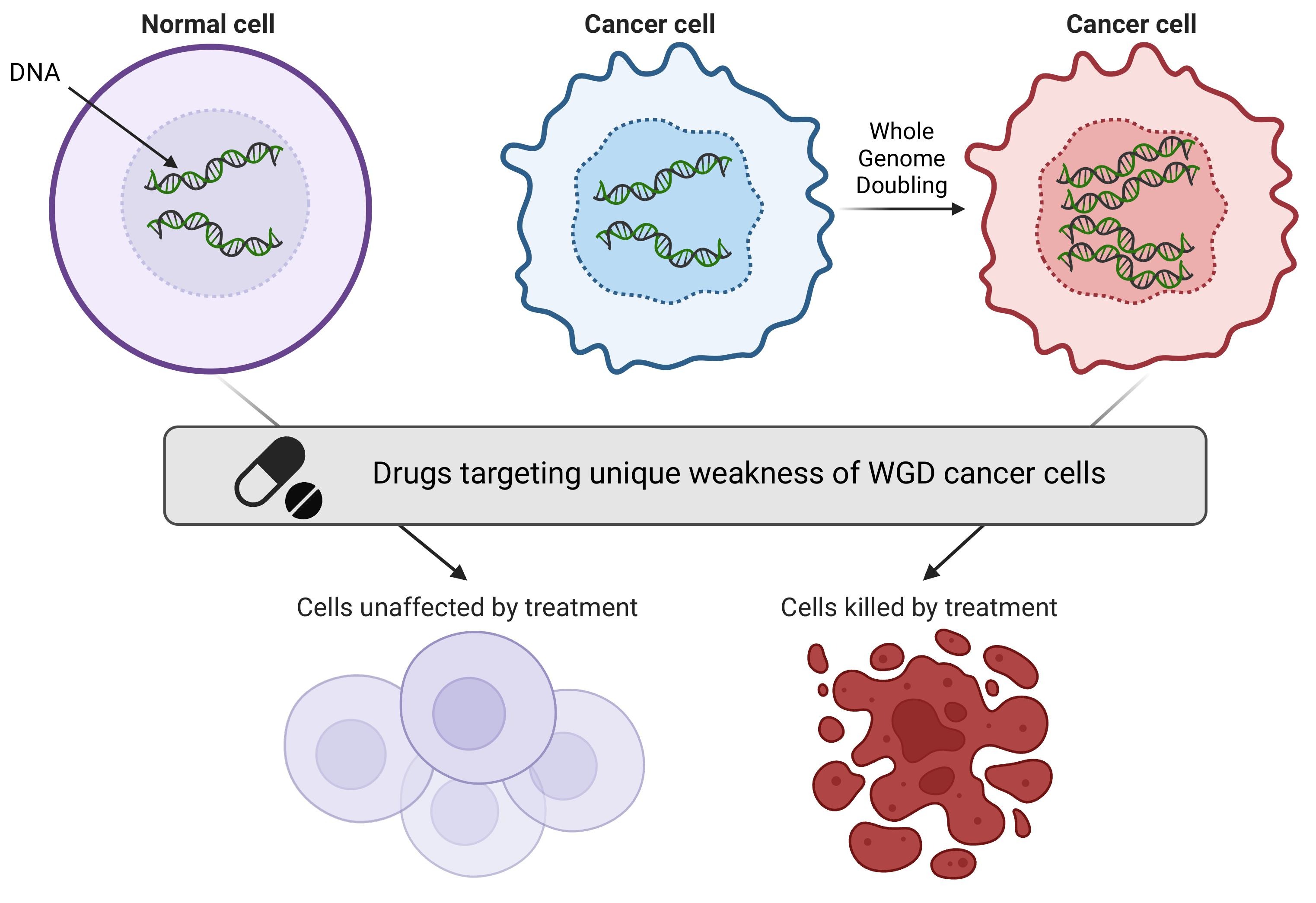
(Pictured above: Infographic provided by Dr Elizabeth Christie)
Approach:
In their high-throughput screen, the team will test drugs that can either target WGD ovarian cancer cells, or drugs that target a pathway in high-grade serous cells that regulates how quickly cancer cells can replicate and grow.
Some of the drugs they will test are already Food and Drug Administration (FDA)-approved for use in other diseases which means they could be expedited into the clinic, while others they will test are in clinical trials for other purposes. If possible, the team will also test newly developed compounds, for example KIF18A inhibitors that are a type of drug that targets the KIF18A gene which is present in high levels in WGD cells.
Ambition and outcomes:
The team hope to find a treatment approach that effectively eliminates WGD ovarian cancer cells but has a limited effect on normal cells and works well with other treatments such as chemotherapy.
This project could result in multiple promising treatment combinations for further verification. If the team can eventually progress through trials, it could lead to new treatment options for high-grade serous ovarian cancer that are more effective than current treatments at preventing resistance and recurrence.
Current status:
This ovarian cancer research project is at the preclinical stage where researchers are conducting extensive studies in the lab with samples and models to verify the effectiveness of their approach as well as evaluating how safe it is likely to be for humans *
*Want to learn more about the medical research pipeline? Read more here.

For every project like this, many more can’t get underway due to a lack of funding. Support research like this to help them move forward.
Share page

Get the latest news, stories & updates.
