New treatment targeting high-grade serous ovarian cancer and triple negative breast cancer
Overview
Professor Khanna is investigating a drug combination that could more effectively treat subtypes of both high-grade serous ovarian cancer and triple-negative breast cancer, with collaborative funding from the Ovarian Cancer Research Foundation and the National Breast Cancer Foundation.
Lead researcher: Professor Kum Kum Khanna
Grant received: Collaboratively funded with the National Breast Cancer Foundation to the value of $530,000 over three years
OCRF research pillar: Treatment
Primary institution: Mater Research
Associated institution/s: QIMR Berghofer Medical Research Institute
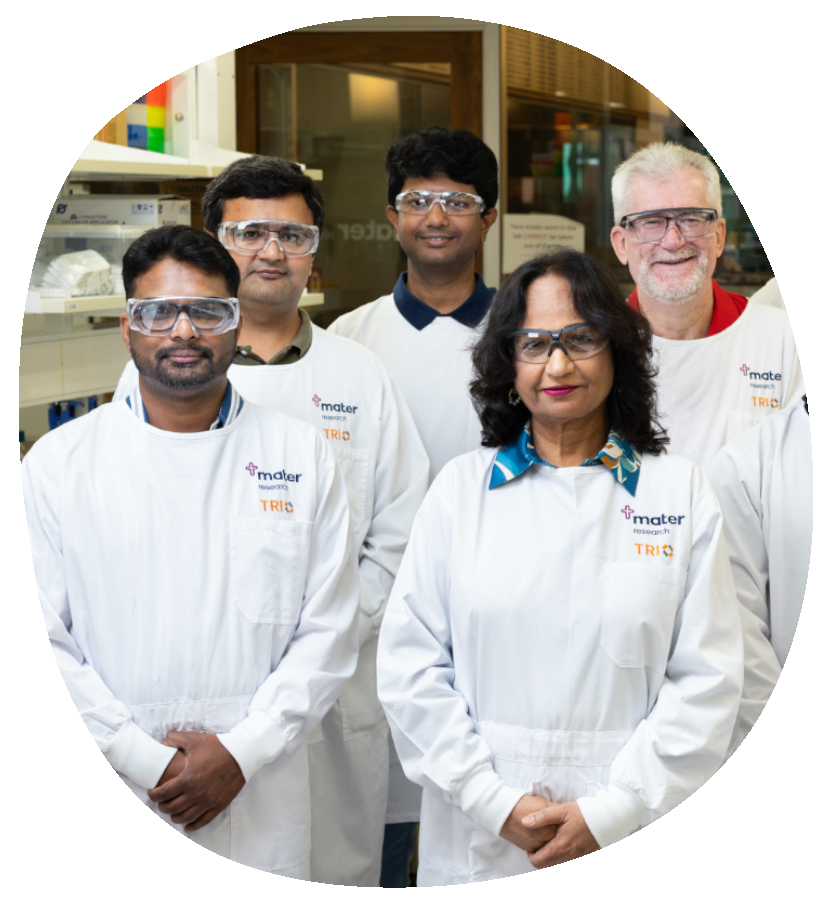
Latest update
With OCRF and NBCF funding we’ve been able to demonstrate that Marizomib could be an effective treatment for triple-negative breast cancer and high-grade serous ovarian cancer. Next, we will validate our combination therapy in more complex sample sets. I hope one day our discoveries will make a difference to patients in the clinic.”
Professor Kum Kum Khanna
Project details
Harnessing her specialist knowledge of how normal cells respond to DNA damage, and of the similarities between triple-negative breast cancer (TNBC) and high-grade serous ovarian cancer (HGSOC), Professor Kum Kum Khanna is investigating a new drug combination that could effectively treat both breast and ovarian cancer.
TNBC, biologically, has more in common with HGSOC than it does with some other breast cancers. Similar characteristics include the presence of mutations, such as TP53 and in some cases BRCA1. Contributing to the early stages of cancer, these mutations can often be caused when DNA tries to repair itself.
Proteasomes breakdown and degrade damaged proteins in the body, a bit like a recycling system. Professor Khanna’s work focuses on drugs called proteasome inhibitors, which block this degrading process.
Aims:
With OCRF and NBCF funding the team aimed to:
- Test the effectiveness of a proteasome inhibitor called Marizomib, as a treatment in combination with chemotherapy. They will compare results to treatment with chemotherapy alone, and Marizomib alone.
- Identify biomarkers that can predict whether cancer cells will respond or be resistant to Marizomib treatment.
- Collate data to determine if the treatment combination is effective enough at treating HGSOC and TNBC to warrant further trialing in more samples.
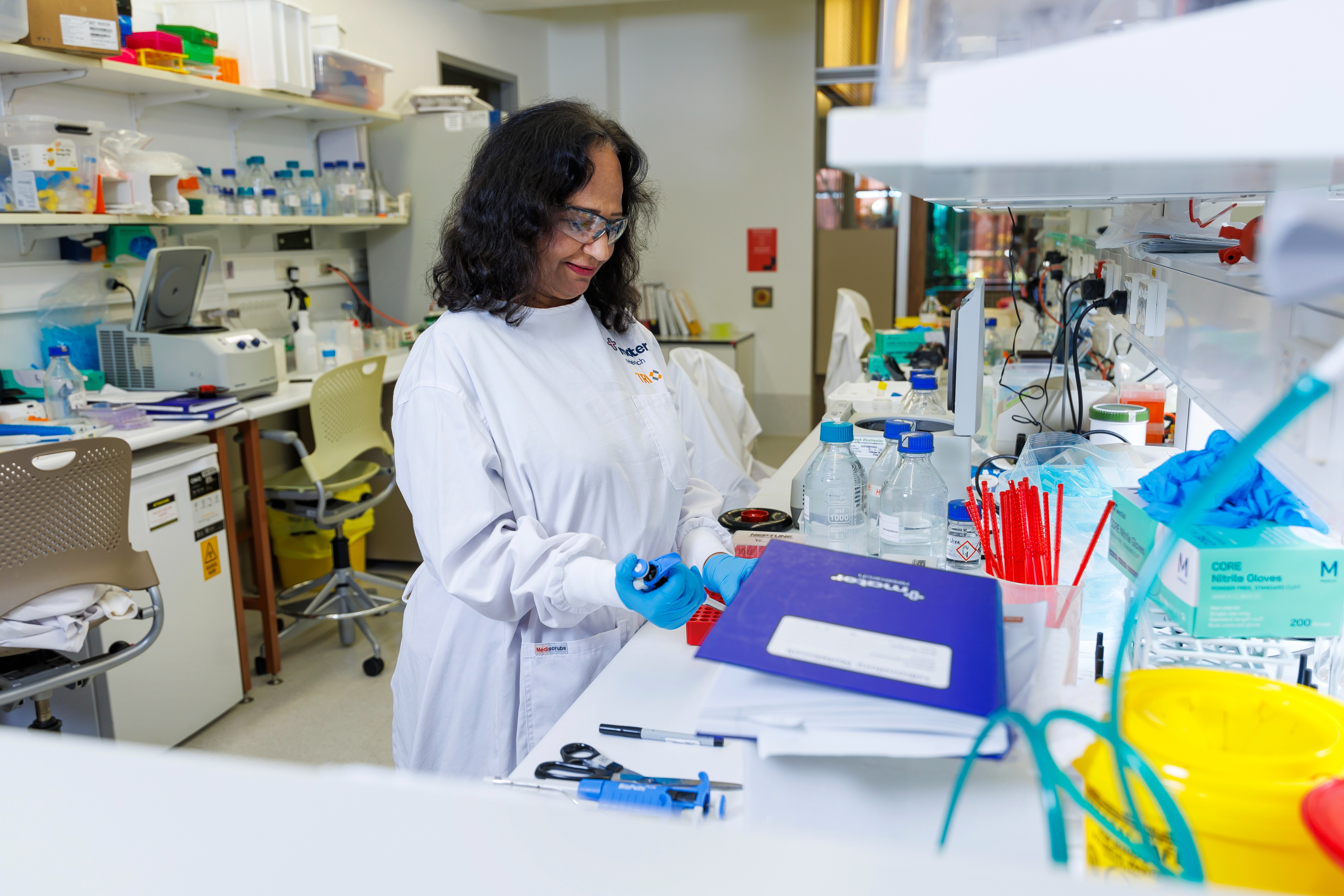
(Pictured above: Professor Khanna in the lab)
Approach:
Professor Khanna’s lab team of approximately ten researchers had previously screened 2400 Food and Drug Administration (FDA) approved drugs to narrow down the 20 most effective for targeting HGSOC and TNBC.
The team then built on this previous work during this project by:
- Completing screening that involved ‘knocking out’ or removing genes from the proteasome pathway one by one to determine which genes TBNC and HGSOC were dependent on. When they knocked out some of the genes, cancer cells died, meaning these genes are essential for the degradation process.
- Identifying Marizomib, a natural marine compound, as a promising proteasome inhibitor. Unlike other proteasome inhibitors which only stop one proteosome function and have been used in cancer treatment before, Marizomib can stop three key activities of proteasomes.
- Comparing the effectiveness of Marizomib as a treatment on its own on cells in a dish.
- Comparing the effectiveness of Marizomib in combination with chemotherapy.
Ambition and outcomes:
Professor Khanna sought to identify and validate a new drug combination that would give both triple-negative breast cancer and high-grade serous ovarian cancer patients a more effective treatment option. Towards this goal the project has:
- Demonstrated why proteasome inhibitors are key to effectively treating TNBC and HGSOC, and the team have published their findings on TNBC.
- Validated within in-vitro samples that Marizomib is an effective proteasome inhibitor that can also complement standard-of-care chemotherapy in treating both cancers.
- Identified that Marizomib is capable of interfering with the DNA repair pathway.
With promising initial data in small sample sizes, the next steps will include:
- Identifying the best biomarker within TNBC and HGSOC for Marizomib to target and the best drugs to combine with Marizomib to improve results.
- Testing the drug combination in patient samples and in larger sample sets.
- Determining the most effective and safe dosage of Marizomib when used alongside chemotherapy.
- Confirming which subtype of TNBC the drug combination treats most effectively.
- Trial another promising drug that the team has identified with Marizomib to determine if it is more effective than Marizomib and chemotherapy.
Current status:
This ovarian cancer research project is at the preclinical stage where researchers are conducting extensive studies in the lab with samples and models to verify the effectiveness of their approach as well as evaluating how safe it is likely to be for humans *
*Want to learn more about the medical research pipeline? Read more here.

For every project like this, many more can’t get underway due to a lack of funding. Support research like this to help them move forward.
Share page

Get the latest news, stories & updates.
