A smarter route: Direct treatment strategies could improve efficacy and reduce side effects in ovarian cancer
June 01, 2026
Imagine if cancer treatment worked more like an Uber trip than public transport – taking a specific rather than a general route to its destination – and directly targeting tumours while avoiding damaging the patient’s healthy tissues.
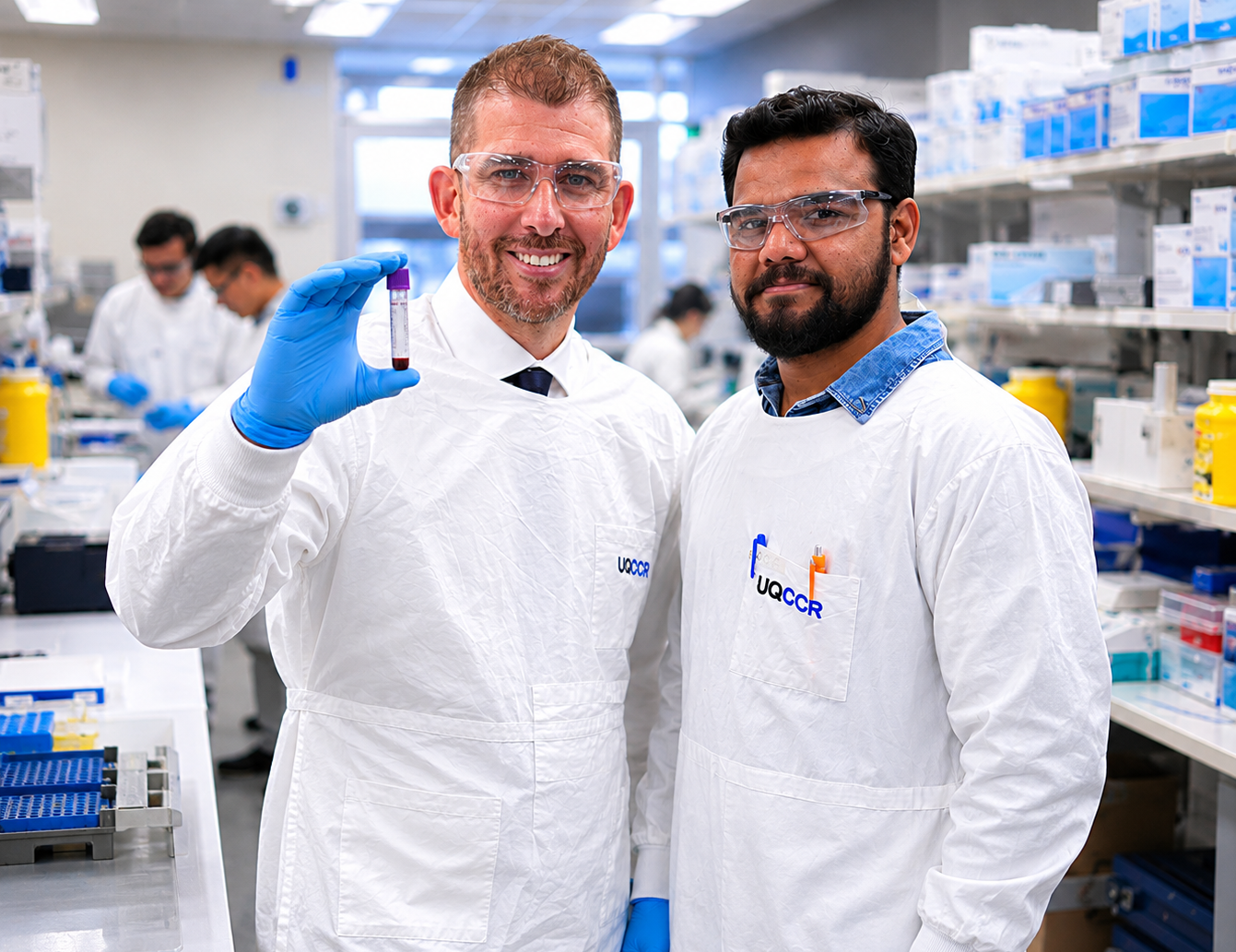
A newly published study led by OCRF-funded researcher Professor Carlos Salomon and recently graduated PhD student Nihar Godbole at the University of Queensland suggests this could one day be possible for ovarian cancer, using tiny biological “delivery vehicles” designed to seek out tumour cells.
For many women with ovarian cancer, for whom chemotherapy is still the standard of care, treatment can feel like a blunt instrument. This lack of precision often limits the effectiveness of treatment and contributes to added side effects.
Professor Salomon’s team discovered a way to deliver primary treatment directly to the tumour while sparing healthy tissue - an important step toward solving one of cancer’s most persistent problems.
Reading time: 3 minutes
Image: Professor Carlos Salomon Gallo and his recently graduated PhD student Nihar Godbole
The team led by Professor Salomon has developed tiny natural nanoparticles called extracellular vesicles (EVs) that can be engineered to act more like on‑demand delivery vehicles. These microscopic packages are designed to carry the correct treatment dose, recognise cancer cells, and deliver the contents directly where it is needed.
While still pre-clinical stage, the research shows how these smart systems could deliver treatment precisely where it’s needed, offering hope for more effective therapies with fewer side effects.
How do extracellular vesicles work?
To make these EVs more precise in ovarian cancer, Professor Salomon’s team added a targeting signal to their surface, known as EphB4. This signal allows the EVs to navigate their way towards ovarian cancer cells.
When tested in patient-derived ovarian cancer models, EVs with this targeting signal gathered at tumour sites, while EVs without targeting spread more broadly through the body.
Crucially, the researchers also showed that EVs can be produced at scale using current Good Manufacturing Practice (cGMP)-compliant methods, the same rigorous standards already used in pharmaceutical manufacturing, addressing a major barrier to clinical translation. EVs could potentially carry many different therapies in the future, including chemotherapy drugs, gene therapies, or RNA-based treatments.
A useful way to picture it:
- The cargo (a future drug or therapy) is the passenger
- The extracellular vesicle (EV) is the vehicle
- The tumour is the destination
- The targeting signal is the GPS address
“We know that most women with ovarian cancer are diagnosed at an advanced stage, and a significant proportion will stop responding to chemotherapy over time.
On top of that, because these drugs circulate through the entire body, patients endure serious side effects that affect their quality of life.
That's the problem we're trying to solve, and engineered extracellular vesicles offer a genuinely exciting path forward.”
Professor Carlos Salomon , University of Queensland, OCRF-funded researcher and senior author on the study.

What does it mean for patients?
For patients and their families, this research offers reassurance that while the search for new treatments continues, there is a growing awareness among researchers for the need for gentler treatments with fewer side effects. It reflects a deeper understanding that treatment should both extend and improve quality of life.
These findings suggest a future where a cancer diagnosis may not come at such a high physical and emotional cost, and where people with cancer can live their lives, rather than simply endure treatment.
What comes next?
While these findings are promising, the team cautions that the technology is still in pre-clinical stages. Further research to optimise the stability of the targeting signal and the loading of therapeutic cargo will be a critical next step towards unlocking the full potential of engineered EV delivery systems.
Even so, this work offers a glimpse of where ovarian cancer care may be heading. Future approaches may focus on getting the right therapy to the right place at the right time, meaning kinder more targeted treatments.
- Advanced Science article: Scalable Engineering of Bio-Manufactured Extracellular Vesicles for Selective Delivery in Ovarian Cancer Patient-Derived Models
- Researcher profile: Professor Carlos Salomon Gallo
- OCRF-funded research: Ovarian cancer early detection, monitoring, and therapeutic intervention using extracellular vesicles

Get the latest news, stories & updates.
