Former OCRF-funded researchers publish a new high-grade serous ovarian cancer treatment approach: repurposing a cystic fibrosis treatment
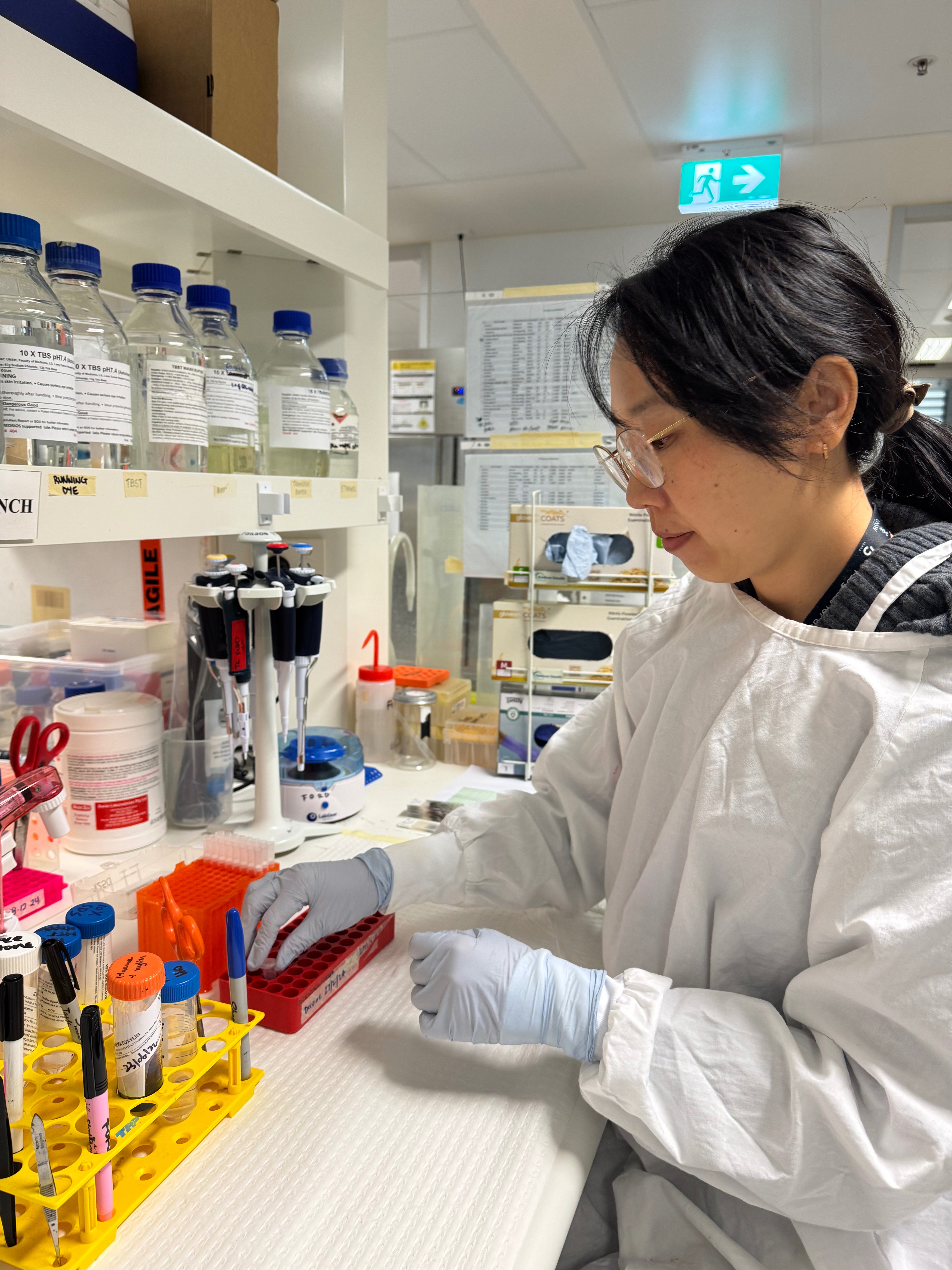
A study led by Professor Caroline Ford from the UNSW Sydney and Professor Nikola Bowden from the University of Newcastle has recently been published, showing that an FDA-approved drug already used to treat cystic fibrosis could also be effective in treating high-grade serous ovarian cancer (HGSOC).
Reading time: 3 minutes
Image: Dr Dongli Liu
HGSOC is the most common type of ovarian cancer. Treatments are limited because cancer cells can often become resistant to available treatments like chemotherapy. In laboratory models, the repurposed drug successfully treated high-grade serous ovarian cancer, and importantly, also appeared effective in samples that had developed resistance to chemotherapy. These findings are first step towards a promising strategy to fill a critical treatment ‘gap’.
What is most exciting is the efficiency of the drug repurposing approach in translating laboratory discoveries into real-life treatment options for patients. This is particularly important to high-grade serous ovarian cancer patients who frequently relapse and have limited therapeutic options.”
Dr Dongli Liu, the first author of the publication
Published in Therapeutic Advances in Medical Oncology in January, the study tested the ability a drug called ivacaftor to target molecules called receptor tyrosine kinase-like orphan receptor 1 (ROR1) on the surface of ovarian cancer cells. This Government-funded study was informed by previously OCRF-funded research in 2017, where Professor Caroline Ford confirmed that ROR1 played an important role in high-grade serous ovarian cancer development.
How did the researchers discover the new ovarian cancer treatment approach?
The team identified the drug, ivacaftor, by using a computer-based screening platform that compares the shape and features of thousands of different compounds. The system searches for drug compounds that look similar to the molecules already known to interact with ROR1. This is part of a process called ‘drug-repurposing’ — think matching a key to the right lock.
Of four potentially suitable drugs identified, ivacaftor performed the best. It caused more cancer cell death than chemotherapy drug, carboplatin, in three out of four ovarian cancer cell lines. Similar results were observed in two of the three organoid models, which are 3D lab models that replicate some of the complexities of the cancer environment in the human body.

What's next?
With these early yet promising results, the team hope to conduct testing to ensure the safety and effectiveness of this drug in larger sample sizes. Importantly, the researchers highlight that further testing is required to assess whether the treatment damages healthy cells. They also aim to test the effectiveness of combining ivacaftor with other standard-of-care chemotherapies.
On average, developing an entirely new treatment can take approximately 16 years according to the study. However, the team’s ‘drug-repurposing’ approach has the advantage of using FDA-approved drugs, which have already been found safe for human use for other diseases or conditions—meaning a new use of an existing drug can often be expedited.
Image: Professor Caroline Ford
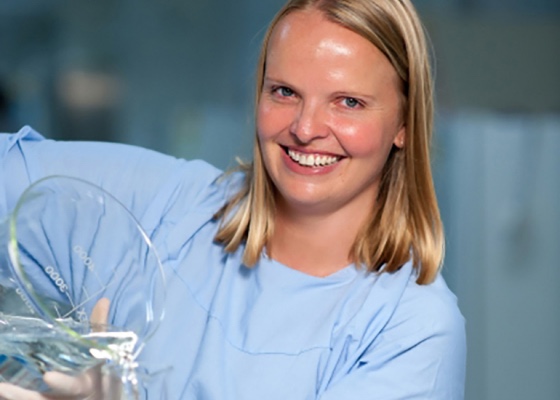
“For many years our team has been pursuing ROR1 as a potential drug target in ovarian cancer. Our latest collaborative research again confirms this potential, and highlights the speed and agility of drug repurposing for progressing and broadening therapeutic options for ovarian cancer patients,” reflected Professor Ford.
"Early funding from OCRF and its donors was crucial to the identification of ROR1 as a promising target in ovarian cancer. We, and others, have been able to build on this initial work by collaborating with biotech, pharmaceutical industry and researchers from other disciplines to progress multiple approaches to target it.”
By funding researchers for over two decades via our OCRF National Research Grants Program, the OCRF has been able to provide a launchpad for many researchers, allowing them test promising and innovative ideas. This study is one example of the longevity of impact that your donations can have in enabling researchers to build crucial knowledge and deliver research advances.
Learn more about Professor Ford, her team’s research or read about their investigations into another way to target ROR1, which we shared in June 2025.
Alternatively, check out this article for an overview of how research gets from the lab to the clinic.
References:
Liu D, Wong-Brown M, Sarker FA, Matthews B, Morrison J, Dickson KA, Alghalayini A, Stojanova J, Wan KM, Duggan J, Loo C, Stannard G, Powell E, Hodder B, Barlow E, Marsh DJ, Ford CE, Bowden NA. Repurposing of ivacaftor shows potential to treat ROR1 expressing high-grade serous ovarian cancer. Ther Adv Med Oncol. 2026 Jan 2;18:17588359251409010. doi: 10.1177/17588359251409010. PMID: 41487693; PMCID: PMC12759121.

Get the latest news, stories & updates.
