How to sort the facts from fiction in an era of misinformation
January 22, 2026
Every day, our social media feeds and TV news seem to be flooded with clickbait headlines claiming ‘world-first medical breakthroughs’. The sheer volume is hard enough to digest, let alone figuring out what is fact, fiction, and what’s somewhere in between.
To help you navigate the hype, we’ve collated our top tips – your guide to staying savvy in this era of misinformation.
The Ovarian Cancer Research Foundation (OCRF) is the leading independent funder of ovarian cancer research in Australia. We currently support 16 medical research projects at universities and institutions nationwide. The researchers we work with are passionate about sharing real progress — with hope, but without hype. They know that safe, high-quality research takes time to move from the lab to the clinic. Just as importantly, they care deeply about the ovarian cancer community and want to set honest, realistic expectations.
Reading time: 3 minutes
Let's be real— sorting fact from fiction online can be confusing
We’ve all seen wild health claims pop up on our feeds — a new “miracle” treatment, a wellness hack that sounds too good to be true, or promises of a breakthrough that’s still miles from actually helping anyone. A lot of that falls into what’s called “misinformation” — basically, information that’s false or misleading, even if the person sharing it doesn’t mean any harm. (If someone shares false information on purpose, that’s called “disinformation” — but that’s a bit rarer.)
Why it matters
After COVID-19, researchers noticed something big: misinformation online doesn’t just confuse people — it can actually change the way we think, behave, and the policies we support. That’s why it’s so important to pause before sharing or believing a post, video, or ‘hot take’ about health. Your choices matter, and you deserve solid, science-backed info to base them on.
What's making it harder
Even respected medical journals like The Lancet have called out this issue. They found that misleading content on social media — especially around cancer prevention and treatment — can cause real harm when people ditch evidence-based care for unproven ideas.
And here’s the tricky part: social media algorithms don’t always show us what’s true — they show us what keeps us scrolling. So it’s easy to get stuck in a loop of posts that reinforce what we already believe, rather than helping us see the full picture.
That’s why we’re here — to help you decode what’s out there and feel confident cutting through the noise. Because being informed shouldn’t be stressful, and you don’t have to do it alone.
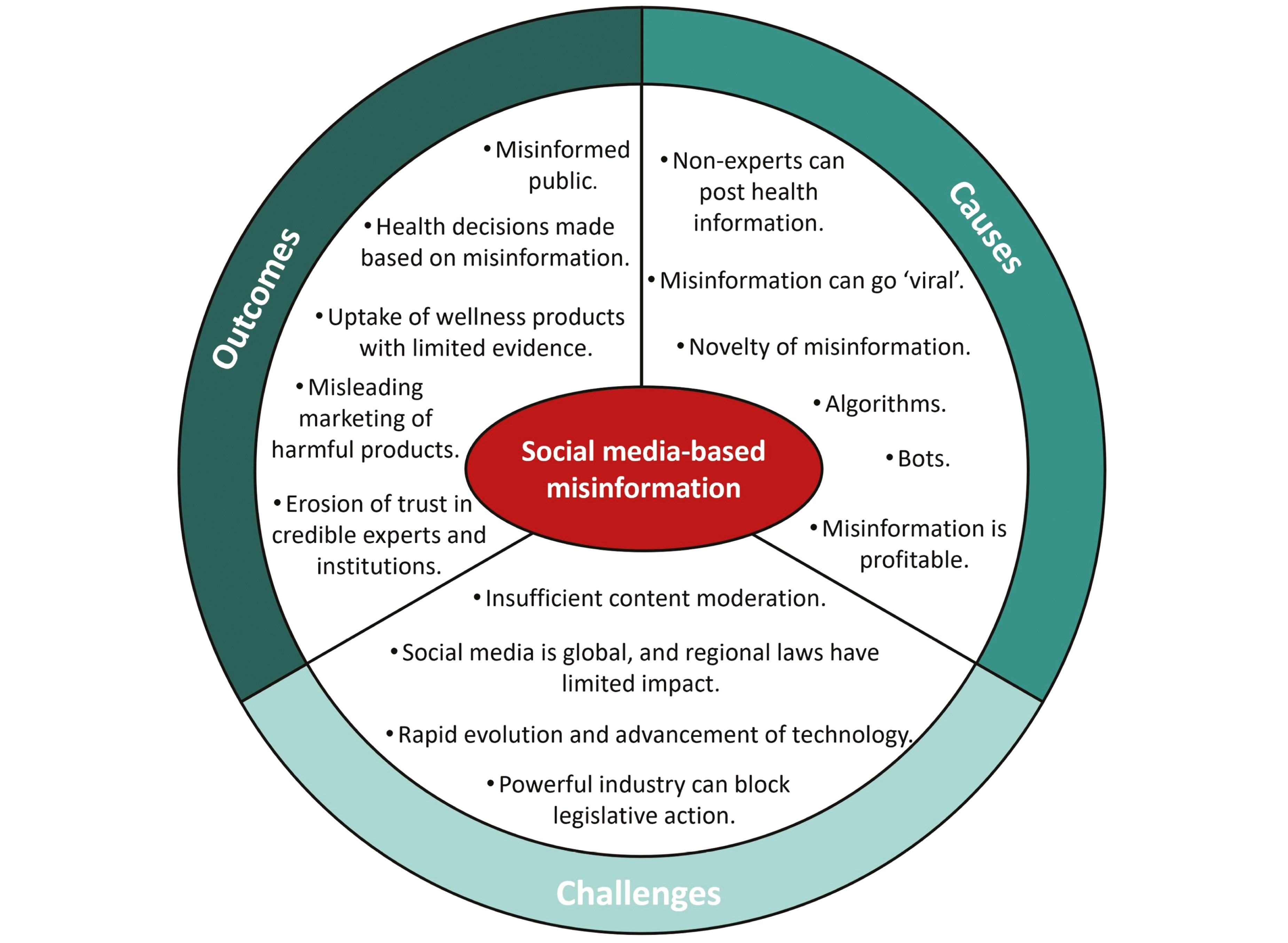
Health misinformation on social media is a major public health threat, driven by rapid sharing, algorithms, and limited oversight—and requires action from users, platforms, and governments (Health Promotion International, April 2025)
HOT TIP
While social media algorithms shape much of what we see, their influence can be reduced by being intentional about your information sources. Following trusted outlets (see below) and subscribing to their newsletters ensures reliable news reaches you beyond algorithm-curated feeds. Meta has also recently introduced a feature that allows users to reset their algorithm—here’s how.
Spotting red flags: how to tell if a scientific claim is trustworthy
It’s easier than ever to come across bold health or science claims on social media — but not all of them are trustworthy. Before you believe, share or act on something, ask yourself these questions to spot red flags and stay science-savvy.
1. Does it sound too good to be true?
If a headline promises a “cure” or “world-first breakthrough”, that’s your first warning sign. Words like these are often used to grab attention, even when research is still in early stages.
Example:
❌ “This new treatment cures cancer!”
✅ “Researchers discover a new way to treat cancer that could improve survival.”
Similarly, be cautious when a post makes sweeping claims from a single study — like “People who sleep less than five hours train their brains to be more productive”. In science, one study is usually just one piece of a much bigger puzzle. Look for more credible evidence before changing your habits.
2. Who's behind the claim?
- Personal experience: Hearing other people’s stories can feel relatable and helpful — but personal experience isn’t the same as scientific evidence. What works for one person might not work for others because everyone’s biology is different.
- Bias and motivation: Ask yourself if the person or platform benefits from your trust. Are they selling something or earning clicks? Bias doesn’t always mean bad intent, but it can influence how information is presented and whether it is scientific and neutral.
3. Where is the information coming from?
Does the post or article link to credible sources like medical or scientific, peer-reviewed journals or university research pages? Reliable findings are usually supported by several studies that reach similar conclusions, not just one.
In addition to the OCRF, here are a few trusted sources of information:
- Australian Institute of Health and Welfare
- Cancer Australia
- Cancer Council
- Ovarian Cancer Australia
- The World Ovarian Cancer Coalition
- The Australian and New Zealand Gynaecological Oncology Group
- Trusted journals including: The Lancet, Nature, Science, New England Journal of Medicine, British Medicine Journal
4. Do other scientific experts also agree?
For research to get published in an academic science journal it needs to have been ‘peer-reviewed’, meaning other experts in the field check the research before it’s published, making it generally more reputable. It’s also good to check if the research is endorsed by peak bodies or reputable organisations that are experts in the field. Does the piece of news you’re reading link to a scientific journal or peak organisation?
5. What stage is the research at?
Is it still early-stage research in the lab, or is it being tested in people? Does it mention how many samples were studied or how diverse they were? This could mean different cancer cell types, or the diversity of people in clinical trials. Is it just starting clinical trials, or have they been completed? Have the results of the clinical trials been published? A high percentage of drugs and tests that enter clinical trials don’t make it through all the stages and into clinical use for patients. The more complete this picture is, the better you can judge how close the research is to real-world use.
Learn more about the phases or the research timeline here.
6. Does the article mention next steps?
Good researchers are proud of their progress — but they’re also open about what still needs to be tested or confirmed to ensure accuracy and safety. Look for transparency about what comes next, such as “further studies”, “validation”, or “trials underway”.
7. When was this information published, and is this evidence still up to date?
Medical knowledge moves quickly. What was accurate five years ago might now be outdated or disproven. Always check the date before sharing or relying on any health claim.
Why is misinformation complicated in science?
According to the National Academies of Sciences, Engineering, and Medicine, the very nature of science means that what we understand today may change in the future as new discoveries build on existing knowledge. That’s why misinformation is defined as information that’s “inconsistent with the weight of accepted scientific evidence at the time”. New findings need to be rigorously tested before we rely on them for decisions.
Increasingly, inaccurate or misleading content can also be generated by AI tools. These systems may sound persuasive and confident even when they’re wrong, making it even more important to check health information with trusted institutions and organisations.
Misinformation can also spread more easily in communities with limited access to trustworthy health sources — especially when accurate material isn’t available in a person’s preferred language. Ensuring reliable, inclusive communication is key to keeping everyone health-informed.
How we evaluate and consider research at the OCRF:
To decide which research projects to fund, the OCRF’s National Research Grants Program works with a committee of international scientific experts and a panel of people with lived experience of ovarian cancer, ensuring each project is considered and assessed from a variety of viewpoints and criteria.
We report on the progress of the research that we fund in consultation with the researchers involved, and through the lens of our own scientific expertise, to ensure we understand and communicate the research accurately.
Good science requires time, expertise, checks and balances, accountability and, of course, money. We take our commitment to the ovarian cancer community very seriously, ensuring the projects we back, and the stories and information we share, are founded in evidence, truth and a deep sense of responsibility for their psychological and physical well-being and safety.
- National Academies of Sciences, Engineering, and Medicine. 2025. Understanding and Addressing Misinformation About Science. Washington, DC: The National Academies Press. https://doi.org/10.17226/27894. Accessed 12 November 2025.
- Adams Z, Osman M, Bechlivanidis C, Meder B. (Why) Is Misinformation a Problem? Perspect Psychol Sci. 2023 Nov;18(6):1436-1463. doi: 10.1177/17456916221141344. Epub 2023 Feb 16. PMID: 36795592; PMCID: PMC10623619.
- Emily Denniss, Rebecca Lindberg, Social media and the spread of misinformation: infectious and a threat to public health, Health Promotion International, Volume 40, Issue 2, April 2025, daaf023, https://doi.org/10.1093/heapro/daaf023
- The Lancet Editorial: Health in the age of disinformation, The Lancet, The Lancet, Volume 405, Issue 10474, 173
LEARN MORE ABOUT HOW MEDICAL RESEARCH REALLY WORKS
Explore our All Over It articles to cut through the noise and learn how real medical research works — from early discovery to clinical trials. Understand what’s proven, what’s not, and why evidence matters.
Sign up to our newsletter to learn more about OCRF-funded research, and other opportunities to learn in 2026 including webinars.
Donations to support ovarian cancer research are always needed and welcome – find out how you can support the OCRF.

Get the latest news, stories & updates.
