OCRF-funded early detection research showcased on the world stage demonstrates ability to detect earliest stage ovarian cancers
There’s currently no reliable, non-invasive early detection test for ovarian cancer — yet, and as a result most cases are diagnosed in the advanced stages of disease. Last month, leading global ovarian cancer experts heard about the exciting strides being made by Australian researchers to change this.
Reading time: 2 mins
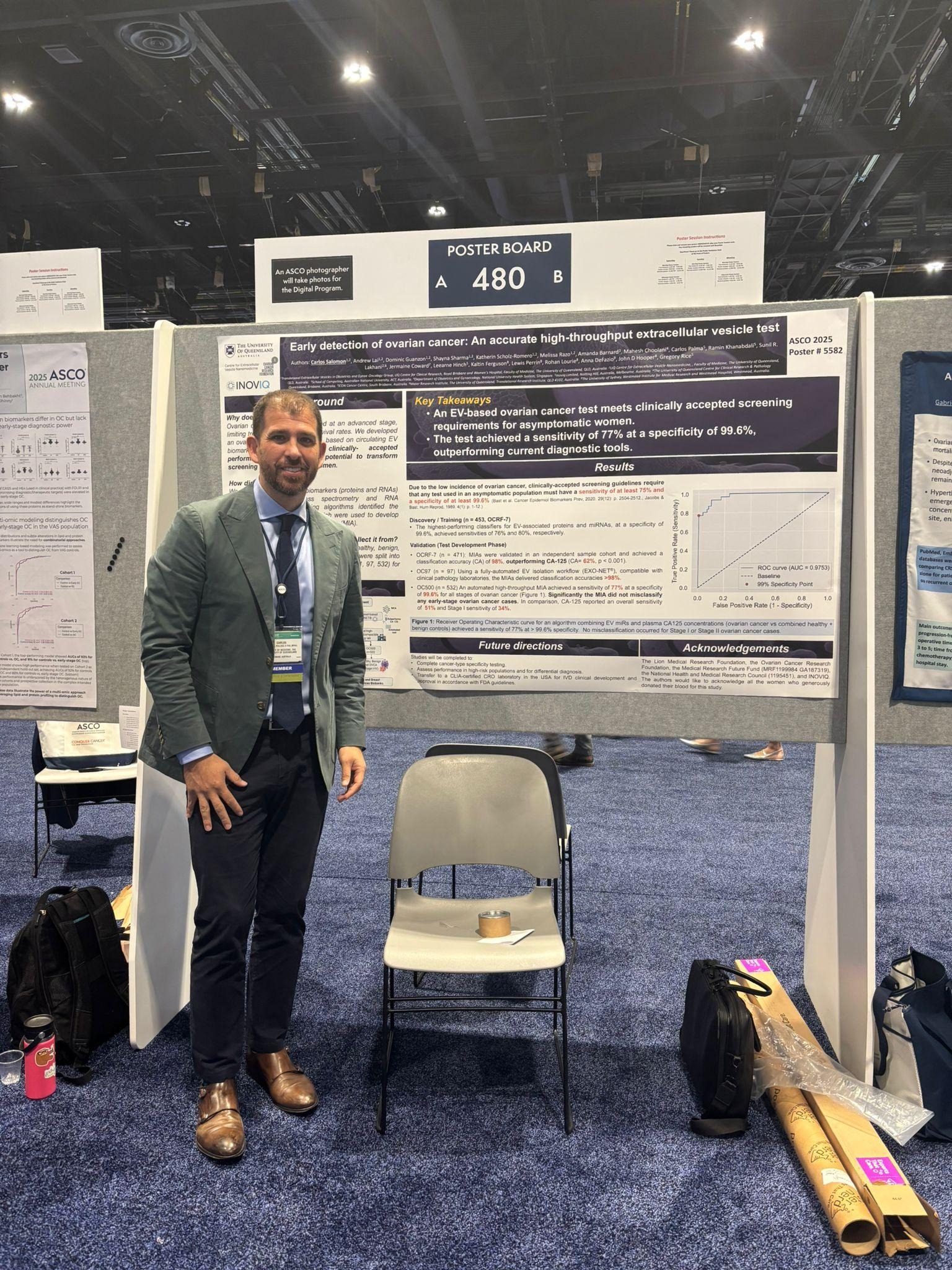
Professor Carlos Salomon Gallo, from The University of Queensland, presented his OCRF-funded early detection research at the American Society of Clinical Oncology (ASCO) Annual Meeting in Chicago. The conference abstract details the research presented at ASCO, and the work was recently published in the Journal of Clinical Oncology.
Image: Prof. Carlos Salomon Gallo at the ASCO Annual Meeting in Chicago.
This provided an ideal opportunity for Professor Salomon Gallo to share his team’s early detection and diagnostic approach results with some of the world’s leading cancer researchers and seek the feedback to ensure they continue to make headway.
Prof Salomon Gallo highlighted some of the most exciting results of the longstanding OCRF-supported program:
“This program began nine years ago, with initial funding from the OCRF to explore whether circulating extracellular vesicles (EVs) could be used to detect ovarian cancer. Since then, the program has grown significantly and is now considered a leading initiative in EV-based biomarker research for ovarian cancer. The OCRF has continued to support the program over the years, providing substantial funding to help us move closer to developing a reliable test for early detection.
"In our most recent study, we achieved the performance required for a screening test for ovarian cancer, meeting the high standard of at least 99.6% specificity and 75% sensitivity. What’s even more encouraging is that we were able to correctly identify all women with early-stage ovarian cancer. These are truly remarkable results and a significant step toward earlier and more accurate diagnosis.”
The team’s most recent version of the test, evaluated in over 500 samples, achieved a sensitivity rating (how well the test can detect ovarian cancer, including at an early stage) of 77% and a specificity rating of 99.6%, meaning it accurately distinguished between ovarian cancer and other cancers or non-cancerous conditions in nearly all cases.
“Because ovarian cancer is relatively rare, with an incidence of about 1 in 3000 in the general population, a screening test must be extremely specific to avoid false alarms. At 77% sensitivity and 99.6% specificity, the positive predictive value (PPV) of the test is at least 10%. This means that 1 in 10 women who test positive are truly likely to have ovarian cancer, a strong benchmark for a screening tool. Without such high specificity, many healthy women could face unnecessary anxiety and invasive follow-up procedures,” Professor Salomon Gallo says.
The results that Professor Salomon Gallo presented in Chicago are a really promising step forward for early detection research. There’s a long way to go, but the OCRF is proud to have supported this work right from its initial stages, and excited about where it could lead."
David Hunt OCRF Research Director – Policy and Programs.
To detect ovarian cancer, blood test uses an AI-algorithm with selected biomarkers within extracellular vesicles (EVs) that are shed from ovarian cancer cells, like little envelopes carrying messages around the body.
The early detection program has grown from an initial $180,000 OCRF grant to a multi-million-dollar program. Last year, the University of Queensland team was awarded $1.46 million by the Australian Government, successfully leveraging their most recent OCRF National Research Grants Program grant of $940,000.
Feedback received from leading experts in the field during the conference speaks to the test’s promise explained Professor Salomon Gallo, "The test generated strong interest and praise from leading experts at the conference, highlighting its potential impact. The study attracted significant attention, with around 100 attendees stopping by the presentation. Feedback from experts was overwhelmingly positive, emphasising that a reliable and accurate test for ovarian cancer is a critical first step toward establishing an effective screening program. Many noted that the data look very promising, with the potential to shift the current paradigm in ovarian cancer screening, particularly because of the test’s ability to identify early-stage disease with high specificity.”
With most individuals diagnosed with ovarian cancer in advanced stages, leading to lower survival outcomes, sharing progress with the world’s leading cancer researchers demonstrates the collaborative spirit required bring rapid progress to the community. The team hope that following a further validation study they will proceed to a clinical trial.
Read more about Professor Salomon Gallo’s research.

Get the latest news, stories & updates.
