The Ovarian Cancer Research Foundation commits $2.4M in new funding to innovative ovarian cancer research projects
Approx. reading time: 5 minutes
Examining ovarian cancer from all angles to overcome its complexities
Key funding announcement points:
- The Ovarian Cancer Research Foundation has awarded three significant medical research grants totalling nearly $2.1 million to Australian researchers tackling three distinct areas of ovarian cancer.
- Researchers are investigating an early detection approach, a vaccine treatment solution, and a drug combination treatment to target a rare subtype of the disease.
- An additional $300k will be distributed through co-funding of collaborative research projects and tissue bank support for a combined commitment of $2.4 million.
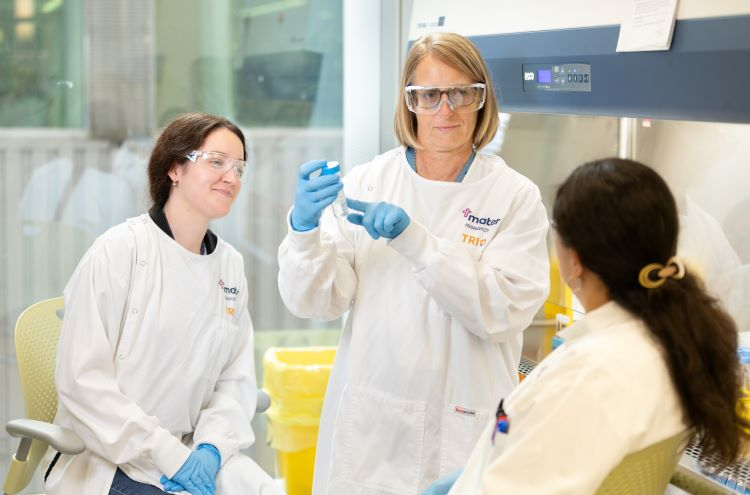
Pictured: Professor Kristen Radford and research team
Ovarian cancer is not one disease. It has multiple subtypes, each posing their own unique challenges. It remains the most lethal gynaecological cancer: of the four people diagnosed in Australia every day, less than half survive beyond five years. Today’s patients urgently need targeted treatments while early detection solutions could save thousands of lives in the future.
A ‘divide and conquer’ approach is critical, and today, the OCRF is announcing that is has awarded three significant grants totalling over $2 million to Australian researchers tackling three distinct areas of this complex disease, with an additional $300k committed to co-funding collaborative research projects and supporting vital tissue banks, for a combined commitment of $2.4 million.
From laboratories at The University of Queensland and Mater Research, researchers will probe promising leads on an early detection approach and a vaccine treatment, respectively. In Victoria, a team from the Peter MacCallum Cancer Centre, University of Melbourne, will investigate a combination drug treatment targeting a rare subtype of the disease.
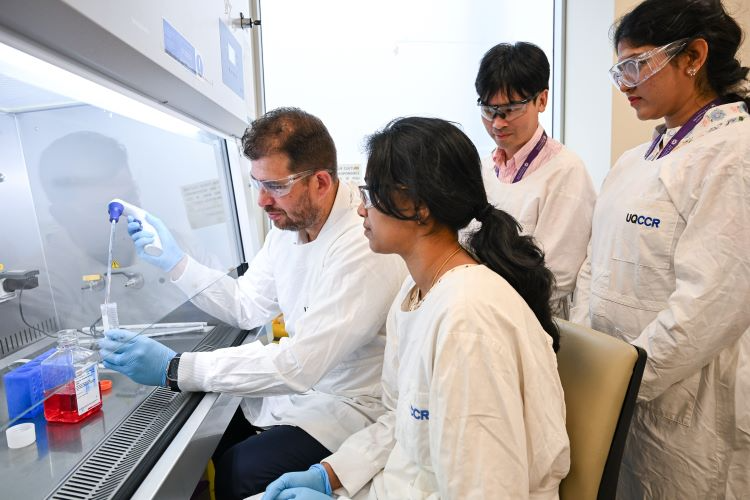

Professor Carlos Salomon Gallo
“We know early detection could raise the survival rate above 90%, there’s an urgent need and everyone, this huge group of people internationally and across Australia, agreed to help on this project very quickly.”
Picture on left: Professor Salomon Gallo with his team.
Using the ‘fingerprints’ left behind by ovarian cancer cells to detect it earlier and more accurately.
The University of Queensland team are taking their promising diagnostic test a crucial step forward by determining whether it can accurately distinguish ovarian cancer from other cancers and benign conditions in the body, such as endometriosis.
Lead researcher Professor Carlos Salomon Gallo explained, “We’ve tested the OCRF-7 test on 1500 ovarian cancer samples with the aim of completing the test in over 3000 patient samples by the end of 2025 and have promising results so far. Because the body is complex with many things going on at once, we’ll use this funding to see whether the test returns false positives when faced with other cancers and conditions. This will help us determine if it is specific enough to progress to trials.”
Named “OCRF-7” in recognition of the OCRF’s seed funding, the test combines multiple biomarkers to identify the most common type of ovarian cancer — high-grade serous.
The OCRF-7 test is trained to read extracellular vesicles: tiny bubble-like secretions released from cells into the blood stream. Professor Salomon Gallo believes that if you know what to look for, these tiny bubbles can act as accessible ‘fingerprints’ of ovarian cancer cells, indicating disease presence.
The grant of $940,000 will enable Professor Salomon Gallo to lead a large-scale collaboration between nine hospitals and four research institutions across Australia and the United Kingdom.
“As a researcher you want to focus on a project that can make a real impact on the community. You can make a strong case for ovarian cancer where the survival rate hasn’t improved in decades because we aren’t able to identify it early enough,” considers Professor Salomon Gallo, cognisant of the fact that 70% of cases are still diagnosed in advanced stages when the disease is least treatable.
“We know early detection could raise the survival rate above 90%, there’s an urgent need and everyone, this huge group of people internationally and across Australia, agreed to help on this project very quickly,” he says.
Professor Kristen Radford
Investigating a novel dendritic cell-based vaccine treatment for ovarian cancer with OCRF funding.
Training the immune system to recognise and eliminate ovarian cancer.
Answering the call for effective new treatments, Professor Kristen Radford’s team at Mater Research are devising a solution that could help the body help itself.
Vaccines are often considered as prevention tools against viruses. However, because cancer grows inside the body, the immune system doesn’t easily recognise it. Although vaccines that train the immune system to recognise and target certain cancer types are promising, ovarian cancer has proved to be more challenging. Why? Professor Radford has pinpointed a certain subtype of immune cells called ‘dendritic cells’ as the probable answer. Her research has demonstrated the effectiveness of a dendritic cell-based vaccine for treating prostate cancer. Now she’s using her innovative system for ovarian cancer.
“In ovarian cancer patients, we know dendritic cells are probably a bit dysfunctional. And we think that's the reason why ovarian cancer doesn't respond to immunotherapy as well as other cancers. Dendritic cells are the primary cells that kick off the immune response,” she explains.
The $670,000 grant enables Professor Radford’s team to investigate which molecules on dendritic cells could be targeted to train the immune system to more effectively fight ovarian cancer. With this information they will create a vaccine and test it on patient samples. Professor Radford’s vaccine design could also deter ovarian cancer from coming back by training the immune system to recognise and target a patient’s specific cancer type.
In today’s climate, where there’s a sea of need and funding can be scarce Professor Radford said, “without the OCRF and Mater Foundation we wouldn’t be here today. Working closely with Mater’s network of hospitals and healthcare services we see ovarian cancer — we know there’s a huge clinical need for treatments”.
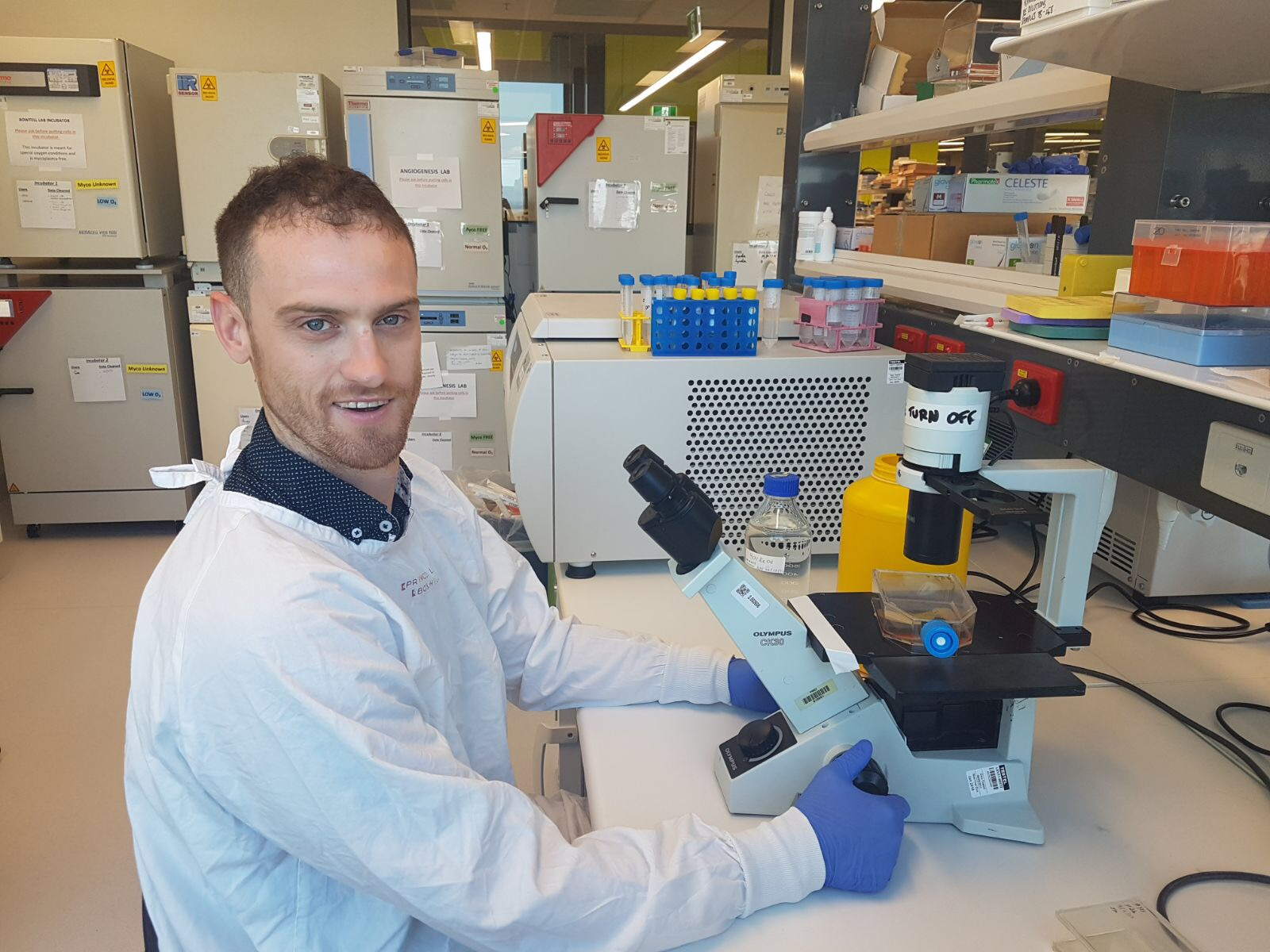
Dr Dane Cheasley
“I’m excited about the prospect of our team taking what’s happening in the lab and making a huge difference to patients, for whom a rare disease has meant to date there’s been very few options.”
Picture on right: Dr Dane Cheasley
Ensuring patients with rare ovarian cancer subtypes are not left behind.
Awarded $480,000, the team at the Peter MacCallum Cancer Centre, University of Melbourne, led by Dr Dane Cheasley, seek to determine an effective treatment for one of the rarer types of ovarian cancer — low-grade serous. It is frequently diagnosed in younger people and is generally unresponsive to treatments including chemotherapy. Heartbreakingly, when it recurs in 70% of patients, available treatments only give 5% of patients more time[1].
Using powerful high throughput technology to scan thousands of drugs, Dr Cheasley has identified twenty of them that are likely to be able to target the unique characteristics of low-grade serous ovarian cancer.
The team aim to determine which drug combination is most effective and has the least toxic side effects for patients. Better yet, all the drugs being tested are already approved by the Therapeutic Goods Administration for use in other cancers, and they are off patent. This means that, following successful rigorous clinical trials, Dr Cheasley’s most promising drug combination is highly likely to be able to be fast-tracked to the clinic and be more affordable.
Reflecting on his commitment to finding a solution to one of the rarer forms of ovarian cancer, Dr Cheasley says, “I’m excited about the prospect of our team taking what’s happening in the lab and making a huge difference to patients, for whom a rare disease has meant to date there’s been very few options.”
Collectively these three innovative projects, proudly funded by the Ovarian Cancer Research Foundation, are poised to make potentially life-saving leaps for ovarian cancer patients in the short term and for generations to come.
Together with $300k in co-funding for collaborative research projects and tissue bank support, the OCRF will distribute $2.4 million in new funding to ovarian cancer research.
The OCRF looks forward to bringing you project updates as this research progresses.
Learn more about the ovarian cancer research currently underway here.
Read the full 2024 Grants Announcement press release, here.
References
[1] Journal Gynaecologic Oncology https://pubmed.ncbi.nlm.nih.gov/31969252/

Get the latest news, stories & updates.
