An innovative ovarian cancer cell targeting system that could enhance the effectiveness of current treatments
June 30, 2024
OCRF-funded researchers from The University of Queensland have recently published the results of a new treatment system that can specifically target ovarian cancer cells and could provide the key to enhancing the effectiveness of ovarian cancer treatments that are already approved for clinical use.
- OCRF grant recipient Professor Carlos Salomon Gallo and his team have developed a new targeted treatment delivery system for ovarian cancer.
- The system uses engineered extracellular vesicles, released from cells and altered in the lab, to precisely targeted ovarian cancer cells.
- The system’s precision targeting suggests that engineered EVs could provide the ideal treatment delivery vehicles, with potential to significantly boost the effectiveness of currently available ovarian cancer treatments and minimise side effects.
Professor Carlos Salomon Gallo and his team from The University of Queensland have recently published exciting progress for ovarian cancer treatment in the International Journal of Cancer. The study demonstrates a new approach that delivers treatment in a way that specifically targets ovarian cancer cells.
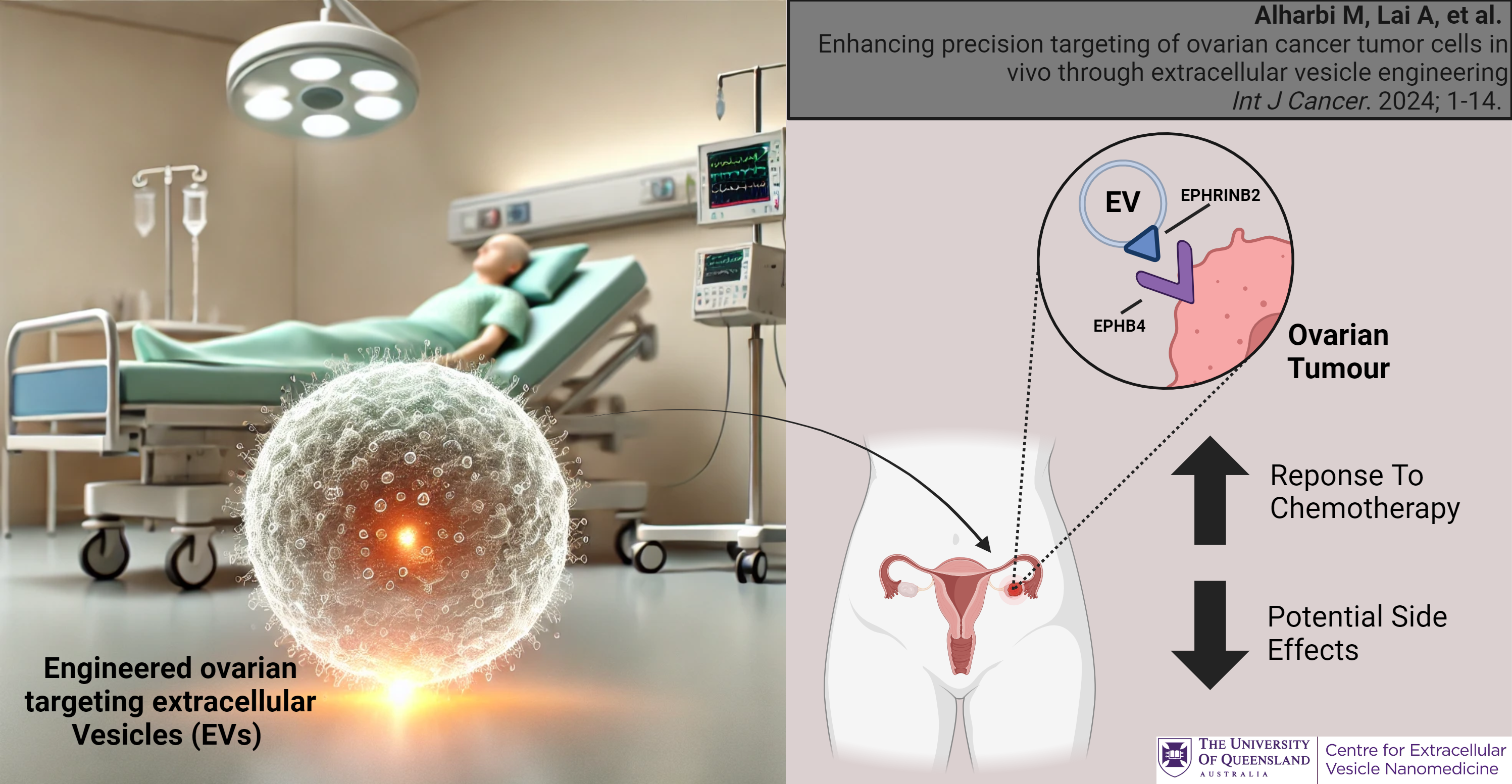
This delivery system harnesses the behaviour of extracellular vesicles (EVs), which are released by cells and can travel to local or distant sites providing cell-to-cell communication.
“EV research has emerged and grown exponentially over the last twenty years. We know EVs have an important role in cell biology. They have a role in how normal and cancer cells can communicate with other cells,” explained Professor Salomon Gallo who is a leading global expert in EV cell research.
How can EVs be engineered so that they only seek out and attach to ovarian cancer cells?
With their understanding that these tiny EVs are excellent communicators that already carry information between cells, the team considered that EVs could also be used to carry therapies to ovarian cancer cells as a treatment strategy.
Prof. Salomon Gallo and his team wanted to alter these tiny EVs to only target ovarian cancer cells and not healthy cells. Additionally, the team needed to determine whether EVs could target more ovarian cancer cells than the currently used treatment delivery systems. To test whether EVs could provide more effective and more selective delivery, the team physically altered the EVs, engineering them on a nanoscale to change their make-up by attaching an ovarian cancer cell-targeting mechanism.
On the outside of the EVs (the membrane), the team attached a protein called LAMP2b. This protein allowed the team to ‘anchor’ or attach another protein called ephrin-B2 ligand. Ephrin-B2 allows the EVs to target and attach to the tiny ephrin-B4 receptors that naturally sit on the surface of most ovarian cancer cells. This is the first time that this targeting mechanism has been used in ovarian cancer research.
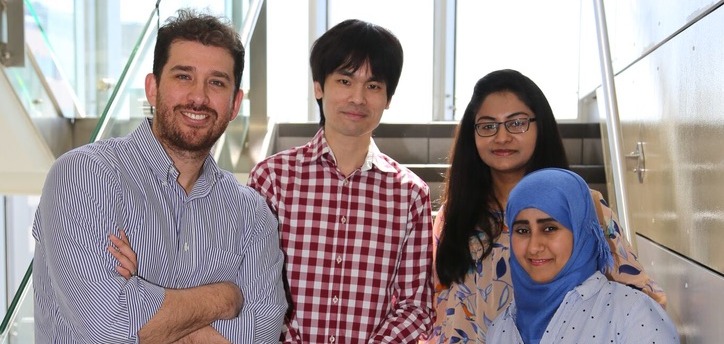
The team (pictured above) took the engineered EVs, fitted out with ephrin-B2 ‘connectors’, and tested them on pre-clinical ovarian cancer models. To observe how well the EVs were targeting ovarian cancer cells, the team used state-of-the-art imaging techniques to detect the Green Florescent Proteins which were added to the EVs. Using fluorescent imaging, the team could track their fluorescent green engineered EVs and see them targeting and binding to almost all the ovarian cancer cells — far more than control EVs that were not engineered. They also observed that when the engineered EVs connected to the ovarian cancer cells, the cells ‘internalise’ the EV: this process of absorbing the EV into the cell is essential for drug targeting.
These results have laid the foundation for the next level of ovarian cancer drug targeting: imagine if these EVs also contained an anti-cancer drug, like chemotherapy, and could cause cancer cell death with this level of precision?
Benefits of an ovarian cancer treatment delivery system that could enhance current treatments and minimise side effects
This study opens significant opportunities for enhanced targeting of ovarian cancer treatments that are already used in the clinic. It demonstrates that EVs, engineered with Professor Salomon Gallo’s ‘targeting unit’, can effectively and selectively target ovarian cancer cells. This indicates that they could be ideal vehicles to deliver ovarian cancer treatment drugs directly to ovarian cancer cells, and have two major benefits for ovarian cancer patients.
- More effective treatment: Ovarian cancer patients are often treated with a combination of surgery and chemotherapy as first line treatment. A persistent problem is that this course of treatment does not always destroy all the cancer cells, and in 70% of cases, ovarian cancer patients experience recurrence. The EV system can attach to more ovarian cancer cells, due to the targeting unit, than would otherwise be possible through current treatment delivery systems. This means less cells escape and have the chance to multiply, and therefore the chance of recurrence is reduced.
- More selective treatment: Chemotherapy can have significant side effects because it cannot distinguish between cancerous and healthy cells. Additionally, there is a limit to the dosage of chemotherapy that a patient can safely receive before it is too toxic. However, Professor Salomon Gallo explained how his EV delivery system could provide the guide chemotherapy needs to ensure the limited dosage is used most effectively.
We observed that it is possible to change the distribution of treatment drugs because you can use extracellular vesicles to target only ovarian cancer cells. This means a higher proportion of the drugs will then interact with cancer cells, decreasing the portion of the drugs harming healthy cells, therefore decreasing side effects. An added benefit is that your immune system doesn’t recognise EVs as something bad for you. This means that if treatment drugs were added inside the EVs, you could avoid prompting an immune response that can cause side effects.
A significant piece of new knowledge for treatment ovarian cancer researchers
In the lab, Professor Salomon Gallo’s team are now trialling chemotherapy drugs inside the engineered EVs to test how they release the chemotherapy into the ovarian cancer cells and cause cancer cell death. If this approach proves effective in pre-clinical models, they hope to progress to a Phase one clinical trial of 10-20 patients during the next twelve months.
The team believe that this targeted delivery system could be used to enhance the effectiveness of many treatments, providing a powerful tool for researchers and clinicians to improve patient outcomes.
The Ovarian Cancer Research Foundation (OCRF) is dedicated to supporting the research sector by funding promising research in Australia and New Zealand. Without funding, innovative ideas never get the chance to become medical breakthroughs. The OCRF initially funded Professor Salomon Gallo’s early-stage EV research across treatment and early detection. This assisted him in securing the $1M grant from the government’s Medical Research Future Fund which, in addition to continued OCRF co-funding, has enabled him to harness the significant potential of EVs.
The 2025 OCRF’s National Grant Scheme is currently open for research applications and closes 17 July 2024.

Get the latest news, stories & updates.
