A recent study demonstrates that an innovative procedure could reduce the risk of some ovarian cancers by nearly 80%
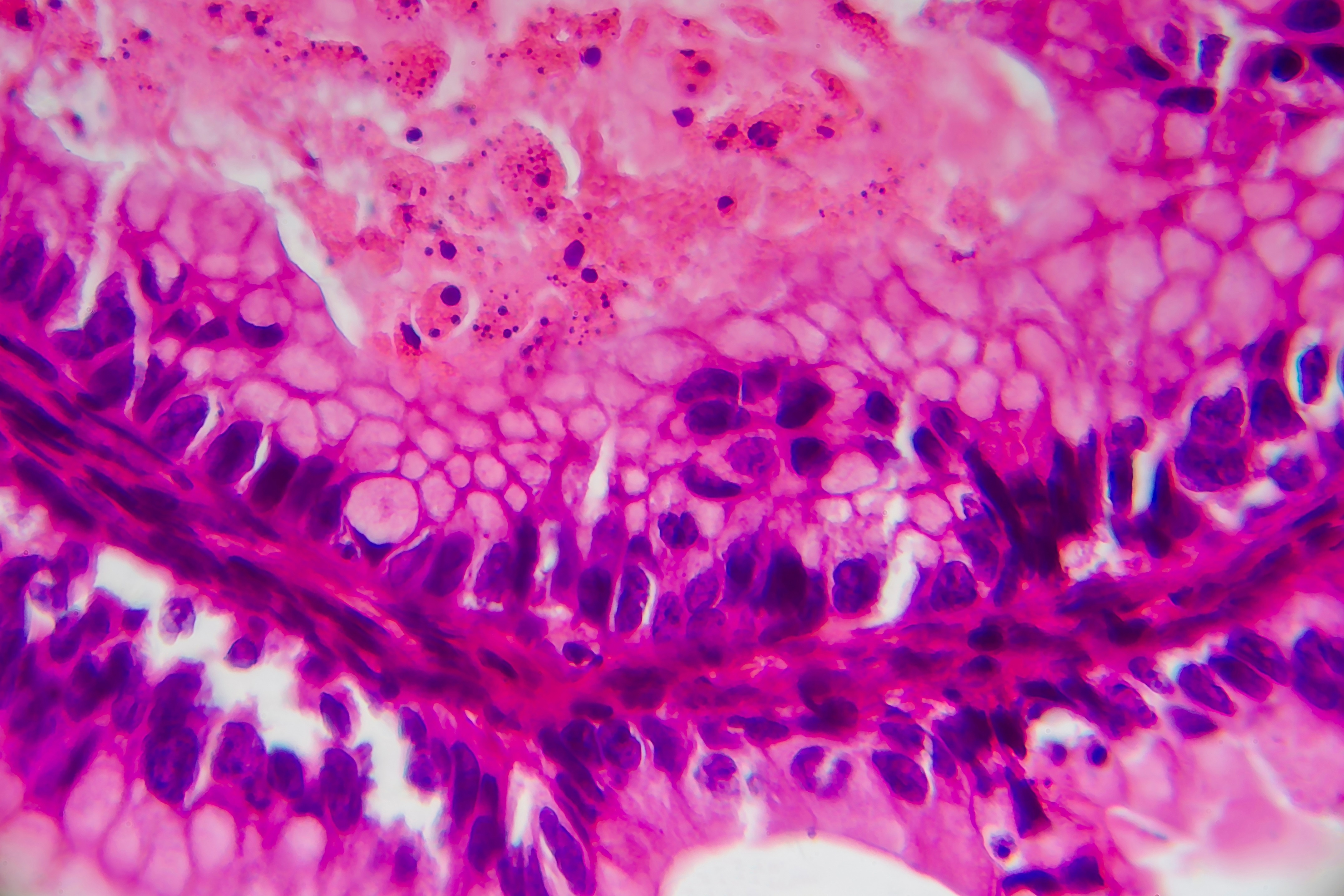
A large Canadian study led by researchers from the University of British Columbia, BC Cancer and Vancouver Coastal Health has found that removing the fallopian tubes during another pelvic surgery, a procedure known as opportunistic salpingectomy, reduced the risk of developing serous ovarian cancers by nearly 80%.
Reading time: 2.5 minutes
Image: High-grade serous ovarian cancer.
Understanding the shift in ovarian cancer prevention
Over the past decade, research has reshaped our understanding of where many ovarian cancers begin. After it was discovered that most serous ovarian cancer originate in the fallopian tubes rather than the ovaries, a group of researchers in British Columbia, Canada from the University of British Columbia, BC Cancer and Vancouver Coastal Health pioneered a life-changing surgery called opportunistic salpingectomy (OS).
What is opportunistic salpingectomy?
Opportunistic salpingectomy involves removing the fallopian tubes (where the majority of serous ovarian cancers develop) during another pelvic surgery such as hysterectomy or tubal permanent contraception (having one’s ‘tubes tied’), and before the cancer can establish itself. A recent study published in JAMA Network suggests that OS could reduce the risk of developing serous ovarian cancer (a type of epithelial ovarian cancer) by nearly 80%.
Serous ovarian cancer, which makes up approximately 60-70% of ovarian cancers, is an aggressive form of ovarian cancer with a five-year survival rate below 50%, and prevention of this type of is now possible using OS. Opportunistic salpingectomy has been shown to be as safe as similar pelvic procedures, does not impact the onset of menopause, and is cost-effective. Since its introduction in 2010, OS is now globally recognised and recommended by medical organisations in 24 countries.
Lead researcher and co-author of the study Dr David Huntsman described opportunistic salpingectomy as ‘the culmination of more than a decade of work that started here in British Columbia.’
What did the study find?
The study analysed data from more than 85,000 people who underwent gynaecological surgeries. This included all people who underwent a hysterectomy or tubal permanent contraception in British Columbia between 2008 and 2020. The researchers compared rates of ovarian cancer for those who had OS and those who had similar surgeries but did not undergo the procedure.
They also asked international pathologists to enter anonymized data involving any patient who developed ovarian cancer without fallopian tubes into a database.
Overall, people who had OS were 78 per cent less likely to develop serous ovarian cancer, and in the rare cases where ovarian cancer occurred after OS, those cancers were found to be less aggressive.

What does this mean for patients?
The researchers involved believe that OS could eventually prevent thousands of ovarian cancer cases worldwide, and represents one of the most effective known strategies to reduce the risk of developing serous ovarian cancer in those already undergoing pelvic surgery.
While this approach does not eliminate all ovarian cancer risk and is not a substitute for other risk-reducing strategies in high-risk individuals, it reflects how advances in understanding cancer origins can translate into practical prevention options.
These are very exciting findings and we hope that further adoption of this approach could offer genuine protection for many women across the globe. For more information, the original study can be found here on JAMA Network.
- BC Cancer Research, ‘Canadian surgical innovation cuts ovarian cancer risk by nearly 80 per cent’, https://bccrc.ca/dept/qrt/dept/ora/dept/ccr/articles/canadian-surgical-innovation-cuts-ovarian-cancer-risk-nearly-80-cent, accessed 23 February 2026.
- Labidi-Galy SI, Papp E, Hallberg D, Niknafs N, Adleff V, Noe M, Bhattacharya R, Novak M, Jones S, Phallen J, Hruban CA, Hirsch MS, Lin DI, Schwartz L, Maire CL, Tille JC, Bowden M, Ayhan A, Wood LD, Scharpf RB, Kurman R, Wang TL, Shih IM, Karchin R, Drapkin R, Velculescu VE. High grade serous ovarian carcinomas originate in the fallopian tube. Nat Commun. 2017 Oct 23;8(1):1093. doi: 10.1038/s41467-017-00962-1.
- Sowamber R, Mei AJ, Kaur P, McLeod J, McKay E, Lukey A, Bakkum-Gamez J, Buza N, Cohen PA, Devins K, Farrell R, Garcia C, Gilks B, Goode E, Hodgson A, Howitt B, Hui P, Huvila J, Karnezis A, Keyhanian K, Kinloch M, Köbel M, Kommoss FKF, Kushi L, Kwon JS, Long-Roche K, Malpica A, McAlpine JN, Miller D, Oliva E, Palicelli A, Paliga A, Parra-Herran C, Pearce CL, Perera S, Piek JM, Qiu H, Rabban J, Rome R, Steenbeek M, Stone R, Talhouk A, Tischer KM, Trabert B, Webb PM, Zalcberg JR, Huntsman DG, Hanley GE. Serous Ovarian Cancer Following Opportunistic Bilateral Salpingectomy. JAMA Netw Open. 2026 Feb 2;9(2):e2557267. doi: 10.1001/jamanetworkopen.2025.57267.
Related OCRF articles

Get the latest news, stories & updates.
