Discovery of new blood protein biomarkers for ovarian cancer early detection
Overview
Associate Professor Michelle Hill’s team are investigating glycoproteins in blood, to see which of the set they’ve identified are most accurately able to detect early-stage high-grade serous ovarian cancer.
Lead researcher: Associate Professor Michelle Hill
Grant received: $236,172 for 2 years
OCRF research pillar: Early Detection
Primary institution: Proseek Bio and previously at QIMR Berghofer Medical Research Institute

Latest update
Without the OCRF funding we wouldn’t have completed this discovery work for the biomarkers, and without these there would be no potential new detection method. OCRF funding allowed us to see if there was potential to push this approach that had worked in other cancers, and the results look really promising and we hope to complete a larger study as our next step.”
A/Prof Michelle Hill, November 2025
Project details
Associate Professor Michelle Hill’s team have identified a series of biomarkers or potential indicators of cancer, that could help them develop a way to improve ovarian cancer early detection, particularly in high-grade serous cases—the most common subtype.
Associate Professor Hill’s previous research developed a platform technology to identify changes of the sugar modifications on proteins in the blood, or “glycoproteins." They developed a blood test approach that uses these proteins to detect oesophageal cancer.
With OCRF funding, the team now hope to see whether a similar method with a similar type of biomarker could provide a promising approach to ovarian cancer early detection.
The team’s previous studies have indicated that the changes occurring in these sugars may be in response to the body developing a tumour. With this in mind, the team aren’t just searching for the protein most indicative of ovarian cancer, but a way to measure this change or the ‘glycosylation’ these proteins go through.
“If there was no OCRF grant providing this opportunity, we wouldn’t be working on ovarian cancer.”
Aims:
Through their OCRF grant the team aim to:
- Discover blood glycoprotein candidates that differentiate between ovarian cancer and non-cancer.
- Verify the most promising of the biomarkers in new samples.
- Investigate whether the most promising biomarkers can detect ovarian cancer early enough to contribute to a future screening test, or whether they are most suitable for diagnostics.
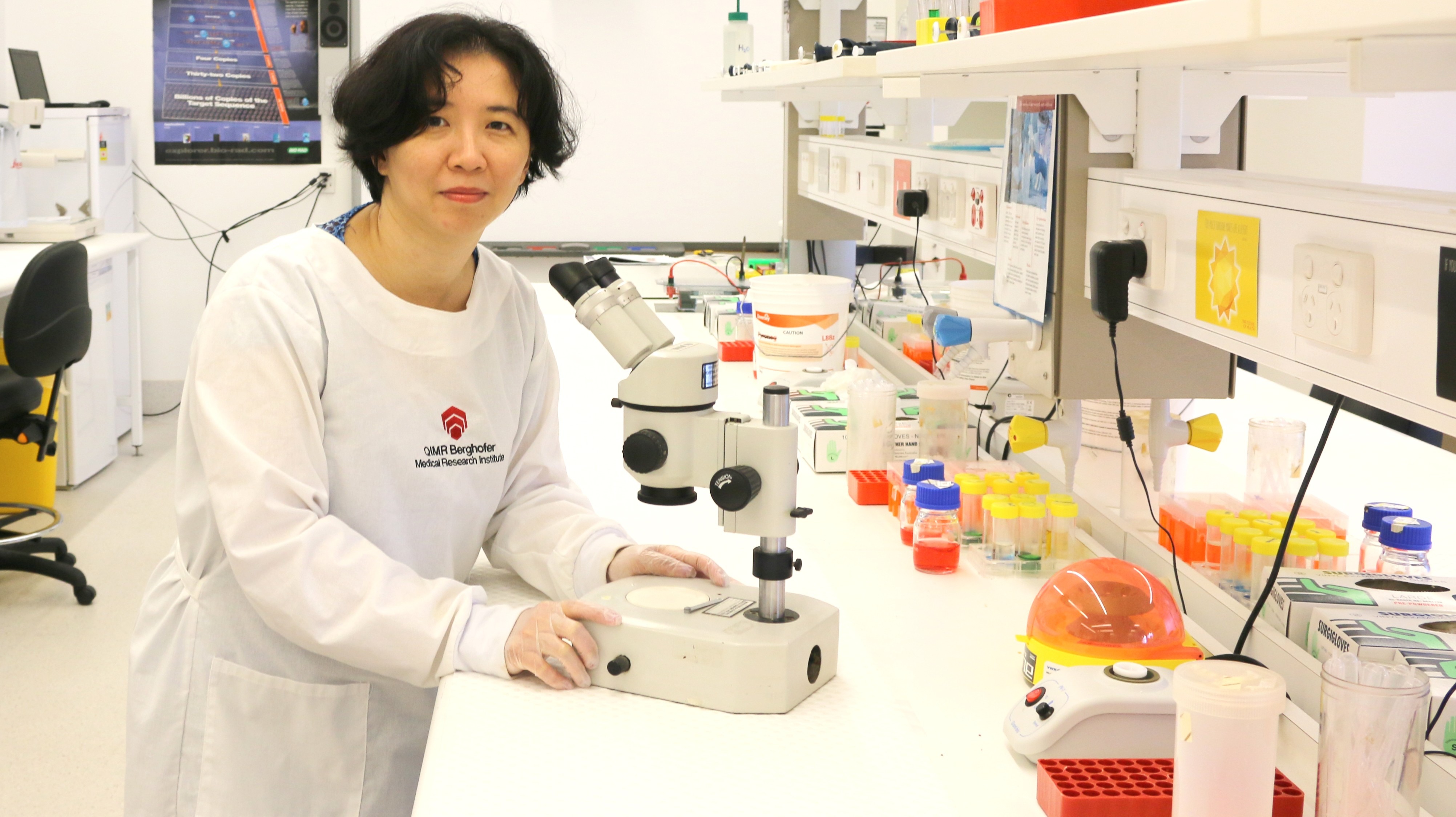
(Pictured above: Associate Professor Michelle Hill in the lab)
Approach:
The team will use a previously established glycoprotein biomarker platform for a two-phase project. Firstly, they will test the most promising of over 200 glycoproteins to shortlist the best candidates.
In the second step, the team will test the most promising biomarkers in a second set of samples to ensure they are consistent across datasets.
Ambition and outcomes:
During the project the team compared UKCTOCS samples that were collected at different time periods, including at the point of diagnosis and others collected between 4-18 months prior to diagnosis.
This allowed the team to shortlist approximately 60 glycoproteins that indicate ovarian cancer across the tested sample types.
This project resulted in useful findings for both ovarian cancer detection (determining if a disease is present) and ovarian cancer early detection (detecting it prior to symptoms).
Key findings included:
- Diagnostics: a 7-biomarker panel distinguished between ovarian cancer and non-cancerous samples with 87.6% accuracy (AUC).
- Early detection: Three of the biomarkers were shown to change, on average, almost a year prior to the period that currently available diagnostic techniques would detect them, in women without symptoms. (Note this is only a pilot set).
Following this project Associate Professor Hill established her own biotechnology company called Proseek Bio to progress the manufacturing and further verification of a test using these biomarkers.
The team are now seeking funding to develop a prototype test and hope to conduct a larger study with approximately 1000 samples to validate the biomarker approach.
They also hope to test this approach on subtypes of ovarian cancer beyond high-grade serous in the future.
Current status:
This ovarian cancer research project is at the preclinical stage where researchers are conducting extensive studies in the lab with samples and models to verify the effectiveness of their approach as well as evaluating how safe it is likely to be for humans *
*Want to learn more about the medical research pipeline? Read more here.

For every project like this, many more can’t get underway due to a lack of funding. Support research like this to help them move forward.
Share page

Get the latest news, stories & updates.
