A new therapy to overcome ovarian cancer recurrence and chemoresistance
Overview
Dr Alexander Cole’s team are hoping to develop a nanobody that can treat ovarian cancer by targeting a protein called follistatin.
Lead researcher: Dr Alexander Cole
Grant received: $200,000 for 2 years with $100,000 from the OCRF and $100,000 from Cancer Australia through the Priority-driven Collaborative Cancer Research Scheme
OCRF research pillar: Treatment
Primary institution: The Centenary Institute of Cancer Medicine and Cell Biology

Latest update
We’ve been building the synthetic circuit to train the nanobodies to target follistatin. This includes making sure the specific nanobodies are expressed under the correct conditions to be able to bind and neutralise secreted follistatin.”
Dr Alexander Cole, February 2026
Project details
High-grade serous ovarian cancer, the most common and deadly subtype of ovarian cancer, often develops resistance to chemotherapy where the treatment stops working, contributing to low survival rates.
For this reason, Dr Alexander Cole and his team are investigating an innovative new treatment approach that uses nanobodies, tiny antibodies that can bind to cancer cells or cancer proteins, to target a protein called follistatin that the team discovered is produced by ovarian cancer cells. Follistatin is a key driver of drug resistance, causing ovarian cancer cells to outsmart treatments over time.
This research started when Dr Cole was completing postdoctoral studies at the University of Pittsburgh, USA. The team were focusing on a protein called NFATc4 which they found was able to reversibly decrease cell growth (quiescence) in ovarian cancer. This protein functioned in a similar manner to the other NFAT protein family member (NFATc1) which regulated growth of hair follicle stem cells.
When NFATc4 was at high levels in ovarian tumours, ovarian cancer cells stopped growing and became resistant to chemotherapy, but when NFATc4 was reduced, cancer cells grew again and became sensitive to chemotherapy. But what exactly was it about NFATc4 that was controlling ovarian cancer cell growth?
The team completed RNA sequencing, to analyse all the molecules in ovarian cancer cells and found a protein called ‘follistatin’ was responsible for the decreased growth and subsequent chemoresistance, and could potentially be used as a target for a new treatment approach.
In a study published in Clinical Cancer Research, the team compared ascites fluid, which is fluid that collects in the abdomen, of ovarian cancer. They found that chemotherapy was prompting high spikes in follistatin, and that follistatin was contributing to chemotherapy resistance. When they inhibited this mechanism in ovarian cancer preclinical models, they were able increase the survival rate. This suggests that stopping the effects of follistatin would allow chemotherapy treatments to work again.
Aims:
With OCRF and Cancer Australia funding the team are now, aiming to:
- Develop nanobodies to target follistatin and disrupt its functions in high-grade ovarian cancer. The idea is that, like a sponge, the nanobodies will soak up all the follistatin that the ovarian cancer cells are producing, making them more sensitive to chemotherapy.
- Test how well the nanobody can improve response to chemotherapy in ovarian cancer lab models.
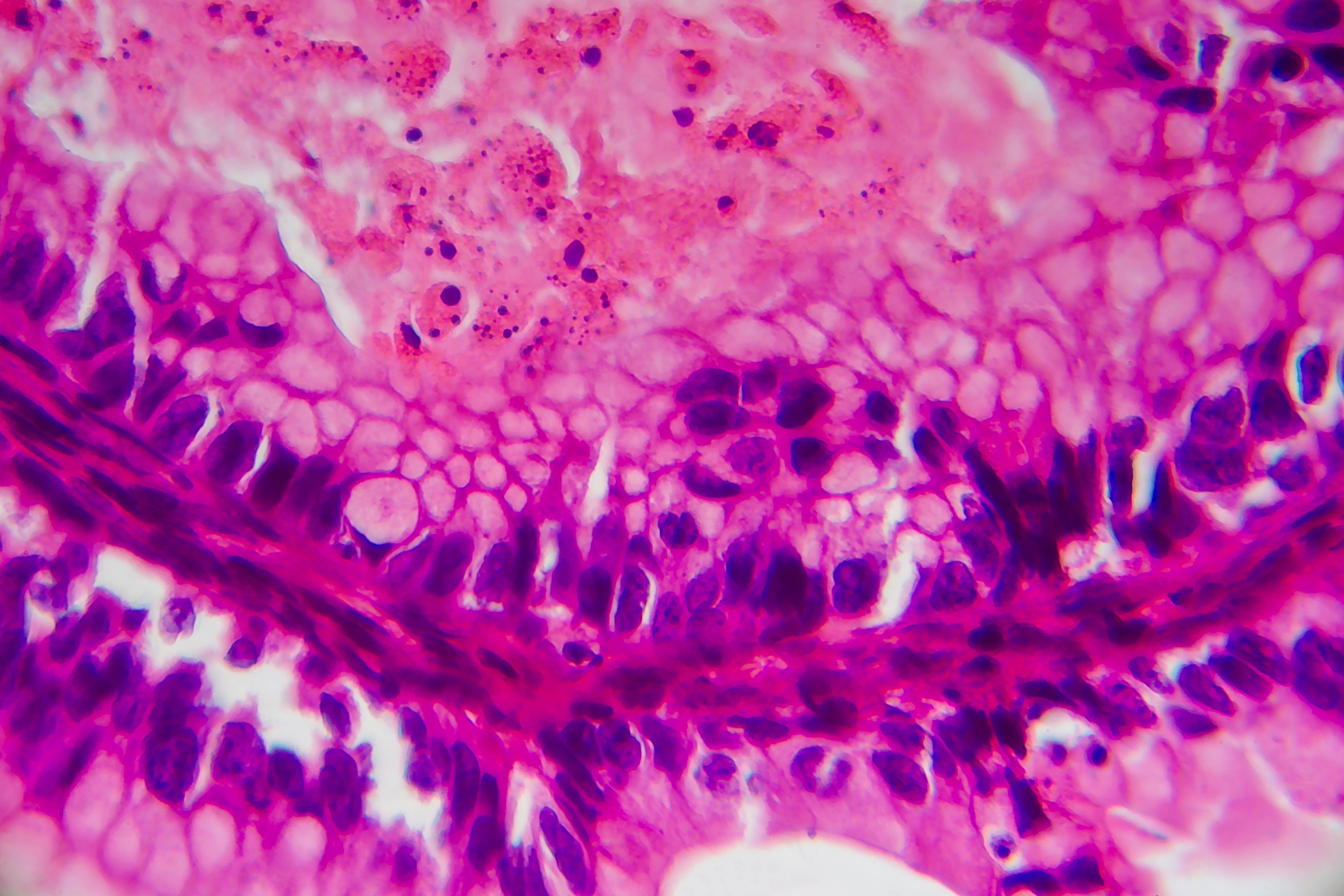
(Pictured above: High-grade serous ovarian cancer under a microscope)
Approach:
Using an innovative system to train nanobodies and improve their function against ovarian cancer
Dr Cole is using an approach called ‘directed evolution’ to improve the nanobodies by letting them advance through evolution, training them repeatedly through subsequent rounds to increase their ‘fitness’ and ability to bind to the protein they’re targeting, enhancing their function against diseases like cancer. This helps them identify unexpected ways for certain proteins to evolve and target the effects of cancer cells. Dr Cole has previously shown they could use this method to improve a nanobody which targets P53, an essential tumour suppressor, which is mutated in ovarian cancer. The team’s platform called PROTEUS, is one of the only of its kind in the world.
They will now use this platform to train nanobodies to target follistatin.
Ambition and outcomes:
If the team successfully produce a nanobody-based treatment that works against ovarian cancer they hope to also combine it with chemotherapy. In theory, the nanobody should neutralise the follistatin, allowing chemotherapy to work more effectively, while providing a barrier to the cancer becoming resistant to chemotherapy. Therefore, if successful, this project could significantly improve a patient’s response to chemotherapy and help prevent the disease coming back or recurring, helping to raise survival rates.
While the team’s current project is focused on high-grade serous ovarian cancer, they hope to expand this in the future to include additional subtypes.
Current status:
This ovarian cancer research project is at the preclinical stage where researchers are conducting extensive studies in the lab with samples and models to verify the effectiveness of their approach as well as evaluating how safe it is likely to be for humans *
*Want to learn more about the medical research pipeline? Read more here.

For every project like this, many more can’t get underway due to a lack of funding. Support research like this to help them move forward.
Share page

Get the latest news, stories & updates.
