OCRF-funded researchers launch ovarian cancer study — an exciting step toward early detection and screening
- Enabled by OCRF funding, researchers at The University of Queensland (UQ) have commenced a new study to test whether their blood-based biomarker panel to detect ovarian cancer is practical and reliable for real-world use.
- The EARLY Study (Evaluating the Specificity and Feasibility of the EARLY Test for Ovarian Cancer Detection) will assess how recruitment, sample collection, transport, and storage affect the test’s accuracy and stability.
- Led by Professor Carlos Salomon Gallo, with Professor Andreas Obermair and clinicians from the Queensland Centre for Gynaecological Cancer Research and Mater Research, the team plans to collect samples from 1,500 participants over three years.
- If successful, this study could pave the way for a larger clinical trial and, ultimately, an early detection or screening program for ovarian cancer.
- This milestone has been made possible through more than $1.7 million in OCRF community-funded research grants.
Reading time: 3 minutes
Image: Lead OCRF-funded researcher, Professor Carlos Salomon Gallo, The University of Queensland

Why this matters
There is currently no reliable early detection or screening test for ovarian cancer. As a result, most people are diagnosed once the disease has advanced and spread. Nearly 2,000 Australians are diagnosed each year, and the five-year survival rate remains around 49%. Detecting the disease earlier could dramatically improve these outcomes.
Testing the test
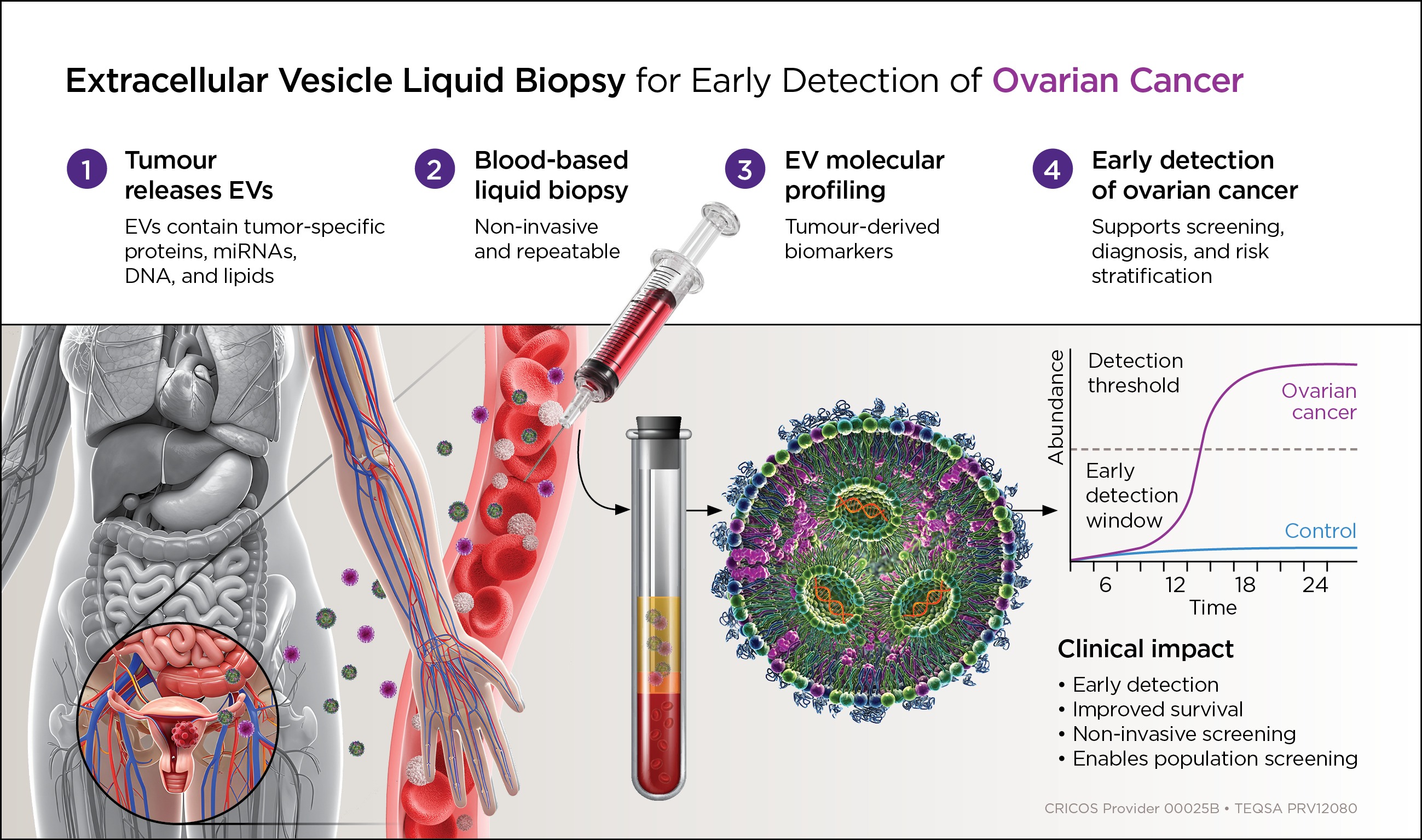
The biomarker panel, named OCRF‑7 in recognition of the Foundation’s support, focuses on extracellular vesicles — tiny particles released by cells into the bloodstream that carry molecular “signals” of disease. Cancer cells release these vesicles early in development, making them a promising avenue for early detection.
Developed at UQ and licensed to the biotech company INOVIQ Ltd (ASX: IIQ), the test has already detected all early-stage (I and II) ovarian cancers in more than 500 samples, with a false‑positive rate of just 0.4%.
The new trial will test how well the biomarkers perform under everyday laboratory conditions — for example, how temperature or transport affect results and whether standard pathology labs can handle and analyse samples effectively.
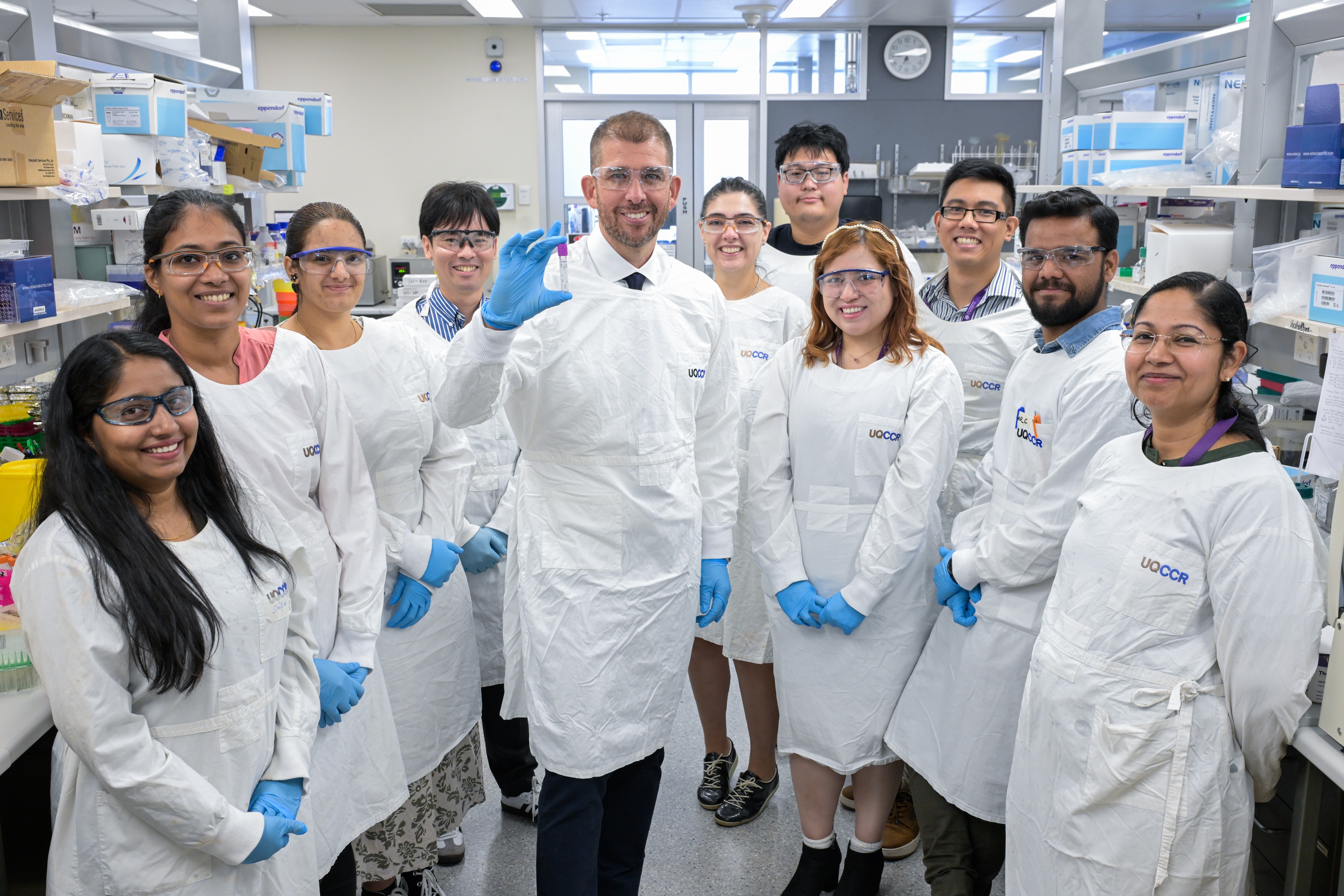
Image: Professor Carlos Salomon Gallo and his research team, The University of Queensland
Building on strong foundations
The OCRF has supported Professor Salomon Gallo’s research with grants exceeding $1.7 million since 2017. The first grant was $180,000 to explore whether exosomes (tiny fluid-filled particles shed by cells) could be used for early ovarian cancer detection. Additional grants from the OCRF, helped the team attract a further $1.4 million in additional Government support through the National Health and Medical Research Council to build a multidisciplinary research team of more than 10 scientists.
“This trial is a critical step in finding out whether our approach works in real-world settings,”
said Professor Salomon Gallo.
“We hope it brings us closer to detecting ovarian cancer before symptoms appear, so fewer women and families face this disease at advanced stages.”
About the trial
The study is funded through an NHMRC Partnership Grant, with the OCRF as an industry partner alongside the Lions Medical Research Foundation. Blood samples will be collected from eligible postmenopausal participants aged 50–74 years, at trial sites in Queensland.
Individual results will not be provided, as the test is still in development and not yet approved by the FDA or TGA. However, each participant contributes critical data with the potential to help validate an effective screening test.
A step closer to early detection
Developing an ovarian cancer screening test is complex — the disease has more than 30 subtypes, and the science is intricate. “Getting a screening test into the world is like running a marathon,” said Professor Salomon Gallo. “This trial is that vital first 5 km.”
The OCRF’s Research Impact Strategy 2025–30, informed by consultations with more than 300 people with lived experience, identified early detection as a top community priority. Every step forward is therefore a shared achievement and a reason to celebrate.
Learn more about this study via the trial webpage or explore related OCRF‑funded projects like Professor Salomon-Gallo’s Sierra Study and the government-funded research announcement.
Read the media release from The University of Queensland.
- Cancer data in Australia, Australian Institute of Health and Welfare, Australian Government, last updated 08 Oct 2025. https://www.aihw.gov.au/reports/cancer/cancer-data-in-australia/contents/overview
- Croft PK, Sharma S, Godbole N, Rice GE, Salomon C. Ovarian-Cancer-Associated Extracellular Vesicles: Microenvironmental Regulation and Potential Clinical Applications. Cells. 2021 Sep 1;10(9):2272. doi: 10.3390/cells10092272.
- EARLY Study, Queensland Centre for Gynaecological Cancer Research, The University of Queensland, last accessed 2 March 2026. https://gyncan.org/our-research/current-trials/early-study
- Salomon C, Lai A, Guanzon D, Sharma S, Scholz-Romero K, Razon M, Barnard A, Choolani M, Palma C, Khanabdali R, Lakhani S, Coward J, Hinch K, Ferguson K, Perrin L, Lourie R, DeFazio A, Hooper J, Rice G. Abstract 5582: Early detection of ovarian cancer: An accurate high-throughput extracellular vesicle test. 2025 ASCO Annual Meeting.
INOVIQ Ltd (ASX: IIQ), an ASX-listed biotechnology company, holds an exclusive worldwide licence to novel exosomal biomarker intellectual property from UniQuest, the commercialisation arm of The University of Queensland.
Related OCRF articles

Get the latest news, stories & updates.
